The top 10 best games of all time is an impossible list to settle permanently. Gaming spans arcade machines, home consoles, PCs, handhelds, mobile devices, and now multiple generations of hardware. A game that feels revolutionary in one era can look dated in another, while a modern title may still need decades before its full influence becomes clear.
So rather than treating this as an objective scoreboard, this list looks at games through several lenses: gameplay design, innovation, influence, longevity, cultural impact, and how well the experience still holds up.
That approach also reflects how institutions such as The Strong’s World Video Game Hall of Fame evaluate historically important games. Its criteria include icon status, longevity, international reach, and influence on games and popular culture.
The result is a cross-generational selection covering platformers, action-adventure, sandbox games, puzzle games, shooters, narrative adventures, and open-world experiences.
How We Chose the Best Games of All Time
There is no universal formula for determining the greatest game ever made.
Sales alone cannot answer the question. A hugely successful game may have enormous commercial reach without introducing mechanics that influence generations of developers. Critical reception is useful, but reviews represent opinions from a particular time. Technical achievement matters, but graphics eventually age.
For this list, the most useful criteria are:
- Gameplay: Does the core experience remain enjoyable?
- Innovation: Did the game introduce or popularize important ideas?
- Influence: Did other developers build on its design?
- Longevity: Does it remain relevant years after release?
- Cultural impact: Did it reach beyond its immediate audience?
- Replayability: Does it continue to offer reasons to return?
- Historical importance: Did it help shape its genre or the medium?
That explains why the list includes older games alongside much newer releases.
The Strong’s Hall of Fame provides a useful historical reference because it recognizes games across arcade, console, computer, handheld, and mobile platforms rather than restricting the concept of influential gaming to one generation.
Top 10 Best Games of All Time
The Legend of Zelda: Ocarina of Time
Developer: Nintendo EAD
Original platform: Nintendo 64
Genre: Action-adventure
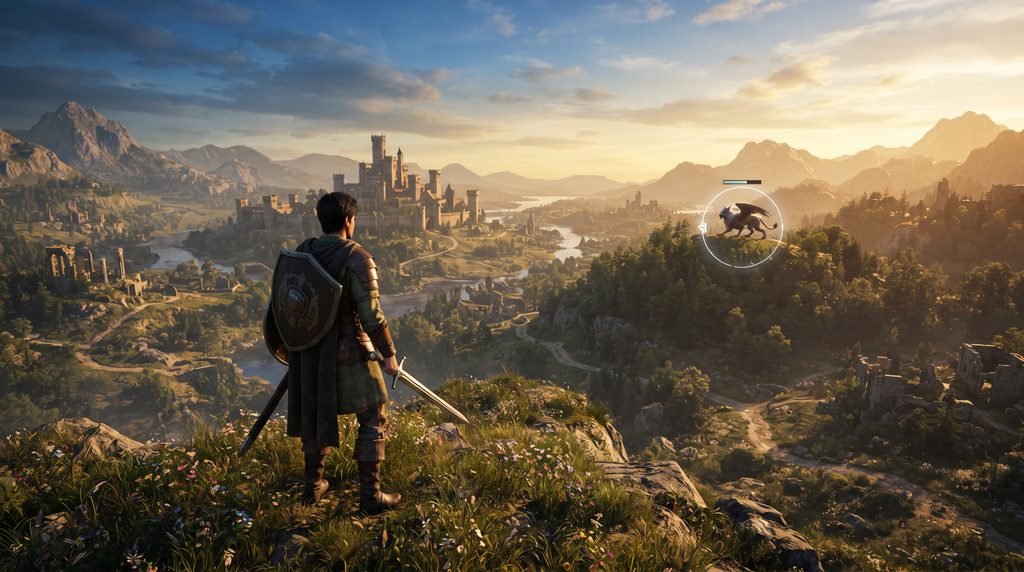
The Legend of Zelda: Ocarina of Time remains one of the clearest examples of how a major franchise successfully transitioned into three-dimensional gaming.
Its importance is not simply that it was a popular Nintendo 64 game. It helped establish conventions for 3D action-adventure design, including contextual interaction, lock-on targeting, environmental puzzles, exploration, and a carefully structured progression system.
The lock-on system in particular helped solve a fundamental problem: how do you make melee combat and camera control manageable in a three-dimensional environment?
Instead of expecting players to manually control every aspect of targeting, the game gave them a practical system for focusing on enemies and objects.
Its world design also combines exploration with progression. New equipment opens previously inaccessible areas, while dungeons introduce mechanics that gradually teach players how to use their new tools.
The game was inducted into The Strong’s World Video Game Hall of Fame in 2022, reinforcing its long-term historical significance.
Its age is visible today, especially in camera behavior and presentation, but the underlying design remains remarkably influential.
Minecraft
Developer: Mojang Studios
Original release: 2011
Genre: Sandbox / survival / building
Few games demonstrate the power of player-driven design like Minecraft.
There is no single path through the game. Players can construct elaborate structures, explore dangerous environments, gather resources, experiment with crafting systems, create automated mechanisms, or simply build a small home and explore.
That flexibility is the game’s defining strength.
The progression system is also unusually open-ended. Gathering resources leads to crafting, crafting enables stronger equipment, and stronger equipment opens additional possibilities. Yet players are not forced to follow a tightly scripted campaign.
That makes Minecraft accessible to very different audiences.
A child might treat it as a digital construction set. A survival player may focus on resource management. A technical player can build complicated redstone machines. A multiplayer group can turn the game into a social sandbox.
Its influence extends far beyond one genre. Minecraft helped establish the modern expectation that a game could function as a persistent creative platform rather than simply a sequence of designed levels.
The Strong recognizes Minecraft among its inducted games, reflecting its sustained popularity and broader influence.
Super Mario Bros.
Developer: Nintendo
Original platform: Nintendo Entertainment System
Genre: Platformer
Super Mario Bros. demonstrated how much design depth could be built around a deceptively simple control scheme.
Move, jump, avoid hazards, collect items, defeat enemies, and reach the end of the stage.
The controls are straightforward, but the level design gradually introduces new concepts and then combines them.
That teaching method is one of the game’s most important achievements.
Players learn through interaction rather than long explanations. A particular enemy teaches spacing. A platform teaches timing. A pipe suggests exploration. A power-up changes the player’s options.
The result is a game that can be understood quickly but offers room for mastery.
Its historical importance is also difficult to overstate. Super Mario Bros. was among the inaugural class of The Strong’s World Video Game Hall of Fame in 2015, alongside games including Pong, Pac-Man, Tetris, DOOM, and World of Warcraft.
Even modern platformers continue to build on ideas established by Nintendo’s classic.
The Legend of Zelda: Breath of the Wild
Developer: Nintendo
Original platforms: Nintendo Switch, Wii U
Genre: Open-world action-adventure
Breath of the Wild changed how many players thought about open-world game design.
Rather than constantly directing the player toward a rigid sequence of objectives, the game encourages experimentation.
A cliff does not necessarily mean you cannot go there. It becomes a question of stamina, equipment, environmental conditions, and available routes.
The physics system creates additional possibilities. Objects can interact with fire, electricity, wind, water, and other environmental elements, allowing players to solve problems in different ways.
This design philosophy makes exploration part of the gameplay rather than merely transportation between missions.
Another important decision is how the game handles progression. Instead of giving the player an enormous list of increasingly powerful weapons that permanently remove most challenge, weapon durability encourages experimentation and adaptation.
That system is controversial, but it supports the broader philosophy of making players work with what they find.
The game was also inducted into the International Video Game Hall of Fame as a modern-era title, demonstrating its broader recognition in gaming history.
Tetris
Creator: Alexey Pajitnov
Original release: 1984
Genre: Puzzle
Tetris may have the simplest gameplay concept on this list.
Blocks fall.
The player rotates and positions them.
Completed lines disappear.
Yet the simplicity is exactly why it remains so powerful.
There is almost no barrier to understanding the objective. A new player can learn the basic rules in seconds, while experienced players can spend years improving their efficiency and decision-making.
The game also demonstrates one of the most important principles in game design: a small number of rules can produce enormous strategic depth when they interact properly.
Every piece creates a decision.
Do you clear lines immediately or prepare for a larger combination? Do you protect a particular column? Do you accept a bad placement to avoid a worse one?
The rules remain stable while player skill creates the complexity.
Tetris was part of The Strong’s inaugural World Video Game Hall of Fame class in 2015.
It remains one of gaming’s strongest examples of elegant design.
Half-Life 2
Developer: Valve
Original platform: PC
Genre: First-person shooter
Half-Life 2 showed how a first-person shooter could use its environment and physics system to make the player feel like they were moving through a connected world rather than simply completing isolated combat arenas.
The Source engine’s physics were central to the experience.
The gravity gun, environmental objects, vehicles, and physics-based puzzles created gameplay situations that differed from the standard run-and-gun formula.
But the game’s importance goes beyond technology.
Valve carefully controlled pacing by moving between combat, exploration, environmental puzzles, scripted sequences, and narrative scenes.
The result was a campaign that rarely felt like a simple sequence of shooting galleries.
Its influence can be seen in later first-person games that placed greater emphasis on environmental interaction and cinematic storytelling.
Half-Life 2 was also recognized by The Strong’s World Video Game Hall of Fame as part of the museum’s historical collection.
For players interested in how first-person games evolved beyond basic shooting mechanics, it remains an important game to experience.
Super Mario 64
Developer: Nintendo EAD
Original platform: Nintendo 64
Genre: 3D platformer
Before Super Mario 64, developers had to solve a fundamental problem: how do you translate precise 2D platforming into a three-dimensional space?
Nintendo’s answer involved analog movement, a controllable camera, open-ended stages, and a movement system built around Mario’s physical abilities.
Running, jumping, long-jumping, wall-jumping, swimming, climbing, and other movements gave players a broad vocabulary for navigating environments.
The game’s worlds were also designed around discovery.
Instead of simply reaching the end of a stage, players could search for stars through different objectives within the same environment.
That structure became influential for 3D platformers and action-adventure games.
The game is also part of the broader historical record recognized by gaming halls of fame; Super Mario 64 has been included among influential games in the International Video Game Hall of Fame.
Its camera can feel awkward by modern standards, but the underlying movement design remains highly influential.
Red Dead Redemption 2
Developer: Rockstar Games
Original release: 2018
Genre: Open-world action-adventure
Red Dead Redemption 2 represents a different kind of achievement.
Its greatest strength is the density of its world.
Instead of treating the open world as a large map filled primarily with icons, Rockstar built numerous environmental systems and character interactions around Arthur Morgan’s journey.
The game pays unusual attention to animation, environmental detail, NPC routines, wildlife, weather, travel, and character interactions.
That detail serves a narrative purpose.
Arthur’s story unfolds within a group of characters whose relationships change as circumstances deteriorate. The slow pace of travel and the long stretches between major events give the story room to develop.
The game is not designed for players who want constant action.
Its deliberate pacing can actually be a strength for players willing to spend time with the world, but it can also frustrate anyone expecting a fast-moving action game.
That balance is important when evaluating it among the best games ever made: its achievement is not simply graphical detail, but the integration of environment, character, narrative, and gameplay.
The Last of Us
Developer: Naughty Dog
Original platform: PlayStation 3
Genre: Action-adventure
The Last of Us demonstrated how cinematic storytelling and conventional game mechanics could work together without one completely overwhelming the other.
Its central relationship between Joel and Ellie gives the campaign a strong narrative structure, but the game still depends on exploration, stealth, combat, resource management, and environmental navigation.
Limited ammunition and crafting materials create meaningful decisions during encounters.
Players can approach certain situations aggressively, but stealth and resource conservation often become important because resources are not unlimited.
That design supports the game’s broader themes of survival.
The emotional impact of a game is subjective, but the title’s influence on narrative-focused action games is much easier to discuss objectively. It helped reinforce the commercial and critical viability of games that placed character relationships and dramatic storytelling near the center of the experience.
The Strong inducted The Last of Us into its World Video Game Hall of Fame in 2023.
Its position in gaming history therefore extends beyond its original release.
DOOM
Developer: id Software
Original release: 1993
Genre: First-person shooter
Modern first-person shooters owe an enormous debt to DOOM.
The game helped popularize fast-paced first-person combat, maze-like environments, weapon switching, enemy encounters, secret areas, and a distinctive approach to multiplayer and PC distribution.
The important point is that DOOM did not simply make a successful shooter.
It helped demonstrate that the first-person perspective could become one of gaming’s defining formats.
Its speed also distinguishes it from many modern shooters.
Movement is aggressive. Enemy positioning matters. Weapon selection matters. The player is constantly encouraged to move, react, and manage threats.
The game was included in The Strong’s inaugural Hall of Fame class in 2015.
Its influence can still be felt in modern shooters and in the resurgence of fast, movement-focused first-person games.
What Makes These Games Stand Out
Looking at the ten games together reveals something interesting: they are successful for very different reasons.
Tetris succeeds through simplicity.
Minecraft succeeds through freedom.
Super Mario Bros. succeeds through level design and accessibility.
DOOM succeeds through speed and combat.
Half-Life 2 combines physics, storytelling, and pacing.
Ocarina of Time established influential conventions for 3D action-adventure games.
Breath of the Wild emphasizes experimentation and open-ended exploration.
Super Mario 64 transformed 3D platforming.
The Last of Us pushed cinematic character-driven storytelling.
Red Dead Redemption 2 demonstrates how detailed world-building can support an open-world narrative.
This is why there is no single formula for a great game.
A title does not need the most advanced graphics, the largest map, or the longest campaign.
The strongest games usually understand what their core mechanic is supposed to accomplish and build the rest of the experience around it.
Classic Games vs. Modern Masterpieces
Comparing games from completely different eras can be difficult.
A modern player may find Super Mario Bros. mechanically simple compared with a contemporary open-world game.
That does not mean the older game has less historical importance.
Technology changes what developers can build.
The difference between Super Mario Bros. and Super Mario 64, for example, is not merely graphical. The move from two dimensions to three dimensions required entirely new approaches to movement, cameras, level structure, and spatial navigation.
Likewise, Minecraft demonstrates how modern computing allows a game to provide enormous player-created environments and persistent worlds.
The best way to judge older games is therefore to consider both their original achievements and how well their core design survives today.
Some age better than others.
A dated interface can be frustrating, but a strong control system or compelling gameplay loop can remain effective for decades.
Which Game Should You Play First?
The best starting point depends on what type of experience you want.
For classic platforming:
Start with Super Mario Bros.
For 3D adventure:
Try The Legend of Zelda: Ocarina of Time.
For open-ended exploration:
Breath of the Wild is an obvious choice.
For creativity and sandbox gameplay:
Choose Minecraft.
For puzzle gaming:
Tetris is the easiest recommendation.
For classic FPS action:
Try DOOM.
For physics-driven first-person storytelling:
Play Half-Life 2.
For modern open-world storytelling:
Red Dead Redemption 2 offers a very different pace.
For cinematic character-driven gameplay:
The Last of Us is a strong starting point.
For 3D platforming history:
Super Mario 64 remains essential.
The important point is not to treat this list as a mandatory order. Gaming history is much too broad for one ranking to settle every debate.
Internal Linking Opportunities
Anchor Text: Best Gaming Stores
Suggested Topic: Guide to major gaming retailers and online stores.
Reason: Readers discovering classic games may want to know where they can purchase physical or digital titles.
Anchor Text: Best Gaming PC and Monitor Setup
Suggested Topic: Gaming PC and monitor buying/setup guide.
Reason: Connects game discovery with the hardware needed to play PC classics and modern titles.
Anchor Text: Fun Games to Play
Suggested Topic: Gaming recommendations for casual and social play.
Reason: Provides a natural follow-up for readers looking for more accessible game recommendations.
Anchor Text: Best Free Time Games
Suggested Topic: Games suitable for shorter gaming sessions.
Reason: Expands the recommendation cluster beyond historically significant games.
Anchor Text: Top Switch Games for Kids
Suggested Topic: Family-friendly Nintendo Switch recommendations.
Reason: Creates a useful pathway for readers searching for age-appropriate games.
Conclusion
The top 10 best games of all time cannot be reduced to a universal objective ranking.
The games on this list earned their place because each represents an important achievement in game design, whether through innovation, influence, accessibility, storytelling, technical ambition, or long-term replayability.
Tetris proves that extraordinarily deep gameplay can emerge from simple rules. Super Mario Bros. demonstrates the power of precise level design. DOOM helped establish the modern first-person shooter. Minecraft turned player creativity into the central mechanic. Ocarina of Time and Super Mario 64 helped define 3D game design, while Breath of the Wild pushed open-world experimentation further.
Modern titles such as The Last of Us and Red Dead Redemption 2 show how far games can go with character development, world-building, and cinematic presentation.
The Strong’s continuing Hall of Fame selections also demonstrate that the definition of an important game keeps expanding. In 2026, its inductees included Angry Birds, Dragon Quest, EA Sports FIFA International Soccer, and Silent Hill, showing that influential gaming history reaches across mobile games, RPGs, sports titles, and horror.
Ultimately, the most interesting part of a list like this is not deciding which game sits at number one. It is understanding why certain games remain worth playing long after their original hardware has disappeared from store shelves.
LEAVE A PIXEL ZINE COMMENT