A great family board game gives everyone a meaningful way to participate. It does not necessarily need simple rules, bright artwork, or a children’s theme. Instead, it should offer a balance between accessibility and interesting decisions.
The most useful starting point is the youngest player’s ability to understand the rules. If a child struggles to read the cards, calculate scores, or remember several conditions at once, the experience can become frustrating. On the other hand, a game with almost no meaningful choices may quickly bore older players.
The best games find a middle ground.
Accessibility without sacrificing strategy
A well-designed family game can be easy to learn while still offering room for improvement. Players might begin by making obvious decisions, then gradually discover better ways to manage resources, plan routes, recognize patterns, or anticipate opponents.
This is why games with a small number of core actions can work particularly well. Players spend less time checking rules and more time making decisions.
Replayability and session length
Replayability matters because families often want to return to a favorite game over many evenings. Different board layouts, changing objectives, player interaction, and alternative strategies can keep repeated sessions interesting.
Session length is equally important. A quick game is useful on busy weekdays, while a longer strategy game may suit weekends and holidays.
Age recommendations, player counts, and playing times vary by edition. Treat the publisher’s specifications as a starting point, then consider the experience and attention span of the people who will actually play.
Best Family Board Games Reviewed
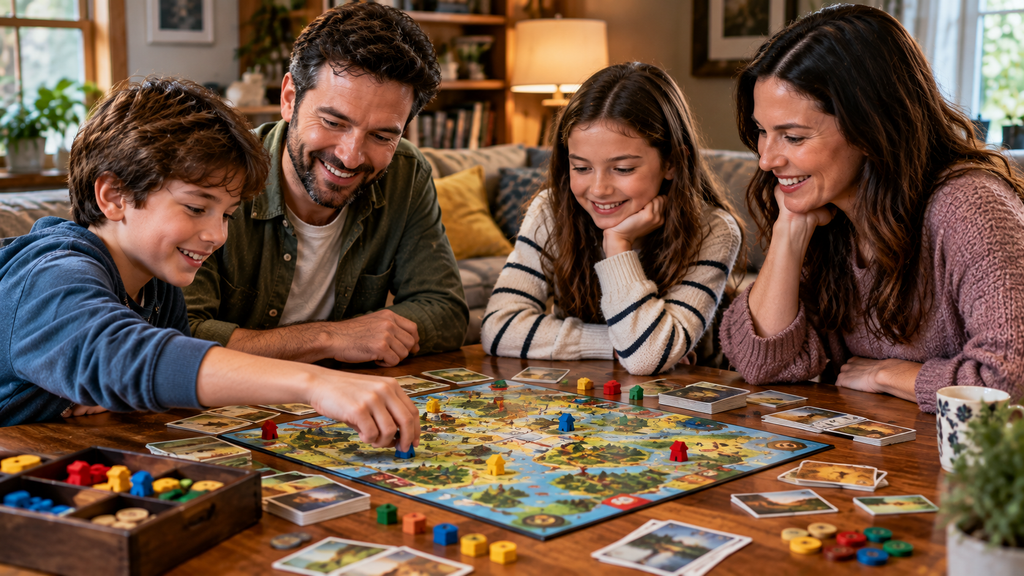
The following selections cover different types of tabletop entertainment. Some emphasize competitive strategy, others focus on cooperation, and several are particularly suitable for families learning modern board games.
Ticket to Ride — Best Overall Starting Point
Best for: Families looking for accessible strategy and satisfying long-term planning.
Typical player count: 2–5 in the original game.
Published age recommendation: 8+ for the original edition.
Typical playing time: Approximately 30–60 minutes, depending on the edition and group.
Ticket to Ride is an excellent place to start when comparing family board games because its central objective is easy to understand. Players collect colored train cards and use them to claim railway routes across a map.
Destination tickets provide longer-term goals. Completing the routes on these tickets earns points, but pursuing them requires players to plan around the routes available on the board.
That creates the game’s main tension. A short connection may be easy to claim, while a longer route might require several turns of collecting cards. Waiting too long can allow another player to occupy an important connection.
The best part is that players can understand these decisions without learning an elaborate rules system.
Younger participants can concentrate on completing visible routes, while experienced players can think several turns ahead and watch opponents’ movements. This difference in experience does not prevent everyone from participating.
Strengths
- Straightforward core rules.
- Meaningful route-planning decisions.
- Strong replay value.
- A useful introduction to modern board games.
Weaknesses
- Competition for important routes can frustrate some players.
- Destination tickets may become difficult to complete if a route is blocked.
- Longer editions or variants may not suit every family.
Verdict: Ticket to Ride is a strong first purchase for families who want a game that combines approachable rules with strategic decisions. Choose the edition according to your preferred map, player count, and available playing time.
Carcassonne — Best for Creative Tile Placement
Best for: Families who enjoy building a shared landscape and planning around changing opportunities.
Typical player count: 2–5.
Published age recommendation: 7+ for the standard edition.
Typical playing time: Approximately 30–45 minutes.
Carcassonne turns landscape construction into a competitive strategy game. Players draw and place tiles depicting features such as roads, cities, fields, and monasteries.
Each tile must connect appropriately with the existing landscape. Players can then deploy their limited followers to claim features and earn points as those features develop or are completed.
The simple act of placing a tile creates several decisions. Should you expand your own city? Help complete a road? Connect two sections of the landscape? Or place a tile that makes an opponent’s plans more difficult?
These decisions give Carcassonne considerable depth without requiring players to manage large collections of cards or resources.
Its changing landscape also provides replay value. Even though the basic rules remain consistent, the arrangement of tiles creates different opportunities in every session.
One consideration is that player interaction can be more direct than newcomers expect. Joining a feature or competing for valuable territory requires players to think about what others are building.
Strengths
- A constantly changing board.
- Simple tile-placement rules.
- Strategic choices that develop with experience.
- A strong balance between planning and adaptability.
Weaknesses
- Scoring can take time to understand.
- Competitive territory decisions may frustrate younger players.
- The base game may feel abstract to families who prefer a strong narrative.
Verdict: Carcassonne is ideal for households that enjoy building something together while competing for points. It is particularly appealing to families who want a game that rewards repeated play.
Azul — Best Abstract Strategy Game
Best for: Families who enjoy patterns, spatial reasoning, and tactical decisions.
Typical player count: 2–4.
Published age recommendation: 8+ for the original game.
Typical playing time: Approximately 30–45 minutes.
Azul challenges players to build a patterned wall using colorful tiles. On each turn, players select tiles from a shared supply and place them into designated pattern lines before transferring completed rows to their personal boards.
The rules are relatively compact, but the decisions are more subtle than they first appear.
Selecting a particular group of tiles may help complete your own pattern while leaving unwanted pieces for opponents. Taking too many tiles of one color can also create a problem if there is not enough room to place them safely.
This is what makes Azul engaging. Players must balance their immediate scoring opportunities against the consequences of their choices.
The physical tiles and clear visual layout make the game attractive on the table. However, its abstract nature means that families looking for a story-driven adventure may prefer another recommendation.
Strengths
- Attractive, tactile components.
- A compact rules system.
- Meaningful decisions without an elaborate theme.
- Good opportunities to improve strategic play.
Weaknesses
- Some scoring details require explanation.
- Taking unwanted tiles can be frustrating.
- Direct competition may not suit every mixed-age group.
Verdict: Azul is a strong choice for families who enjoy puzzles and careful decisions. It is especially suitable for players who prefer thoughtful competition over storytelling.
Catan — Best for Trading and Resource Management
Best for: Families who enjoy negotiation, economic decisions, and long-term planning.
Typical player count: 3–4 for the standard base game; expansions can change the supported player count.
Published age recommendation: Check the edition, commonly 10+ for the standard game.
Typical playing time: Around 60–90 minutes, depending on the edition and group.
Catan asks players to develop settlements and cities on an island by collecting resources and expanding their networks.
Resource production depends partly on dice rolls and the numbers associated with the hexagonal terrain tiles. Players use the resources they receive to build roads, settlements, cities, and development cards.
The trading system is central to the experience. A player who lacks a necessary resource may negotiate with others, exchange cards, or wait for a more favorable roll.
This creates an interesting mixture of planning and uncertainty. Players need a long-term development strategy, but they must adapt when resources are scarce or opponents control valuable locations.
Catan can also generate lively table conversation. Negotiation creates interaction that is more direct than the relatively quiet competition of Azul or Carcassonne.
However, it requires more time and patience than a short card game. Families should be comfortable with trading, resource management, and the possibility that luck influences the outcome.
Strengths
- Resource management with meaningful decisions.
- Trading and negotiation between players.
- Multiple paths toward development.
- Strong potential for replayability.
Weaknesses
- Longer sessions.
- Dice results introduce uncertainty.
- The standard base game has a limited player count.
- Negotiation may be challenging for younger children.
Verdict: Catan is a good option for families ready to move beyond introductory games. It works best when everyone enjoys planning, trading, and adapting to changing circumstances.
Pandemic — Best Cooperative Family Game
Best for: Families who prefer teamwork over direct competition.
Typical player count: 2–4 for the standard base game.
Published age recommendation: Check the current edition; the standard game is commonly listed for ages 8 and up.
Typical playing time: Approximately 45 minutes.
Pandemic takes a different approach to family gaming. Rather than trying to defeat one another, players work together to contain disease outbreaks and discover cures before the game reaches a losing condition.
Each participant has a role with particular abilities. Players travel between cities, share information, manage outbreaks, and coordinate their actions.
The challenge comes from limited resources and competing priorities. A city may need immediate attention, but spending too many actions there could leave another region vulnerable.
Communication is essential. Families must discuss which problems deserve attention, when to collect cards, and how to use each player’s abilities effectively.
The cooperative structure can be helpful for households where direct competition creates tension. Everyone shares the same objective, so winning or losing becomes a collective experience.
However, cooperation does not automatically make a game easy. Pandemic can be demanding, and an experienced player may be tempted to make every decision for the group.
Encourage everyone to suggest plans and make meaningful choices. The experience is more enjoyable when each person contributes rather than simply following instructions from the strongest player.
Strengths
- A shared objective.
- Strategic teamwork.
- Decisions that encourage discussion.
- High replay value through changing situations.
Weaknesses
- The difficulty can be demanding for beginners.
- A dominant player may reduce others’ involvement.
- The theme may not appeal to every family.
Verdict: Pandemic is one of the strongest options for families that enjoy solving problems together. Choose it when collaboration matters more than direct competition.
Codenames — Best for Wordplay and Group Interaction
Best for: Families who enjoy word associations, clues, and team-based communication.
Typical player count: The standard team format is best suited to groups, with four or more players recommended for a conventional match.
Published age recommendation: Check the edition; the standard game is commonly listed for ages 10 and up.
Typical playing time: Approximately 15 minutes.
Codenames divides players into two teams. One player on each team gives clues intended to help teammates identify specific words from a shared grid.
The challenge is to connect several words through a single clue without accidentally directing teammates toward an opposing word or a dangerous selection.
For example, a clue might connect two or three words through a shared concept. The clue giver must be precise enough to communicate the intended relationship without making the clue so narrow that teammates miss the connection.
The result is a game built around interpretation. Teammates must think about how the clue giver sees the words, while clue givers must anticipate how their team will interpret the hint.
This makes Codenames particularly suitable for families with older children and teenagers who enjoy language and lateral thinking.
It is less suitable for very young players who may struggle with abstract word associations or unfamiliar vocabulary.
Strengths
- Short rounds.
- Strong group interaction.
- Creativity and communication are central.
- Easy to introduce to people who rarely play board games.
Weaknesses
- Vocabulary differences can create an uneven experience.
- It requires enough players for the preferred team format.
- Some clues may be confusing for younger participants.
Verdict: Choose Codenames for a larger family gathering where conversation and creative thinking are the main attractions.
Sushi Go! — Best Quick Card Game
Best for: Families who want short rounds and straightforward decisions.
Typical player count: 2–5 for the original game.
Published age recommendation: 8+ for the original edition.
Typical playing time: Approximately 15 minutes.
Sushi Go! is a card-drafting game in which players select a card from their hand and pass the remaining cards to another player.
Each card represents a type of sushi or another food item, and different sets score in different ways. Some reward collecting matching cards, while others reward combinations or particular quantities.
The central decision is what to take now and what to leave for someone else.
A card that is useful to you may also be valuable to the next player. Passing the remaining hand creates a small amount of prediction and competition without requiring a large rules explanation.
The short playtime makes Sushi Go! useful for weeknight sessions, travel, or a quick game before moving on to something longer.
Its scoring combinations can take a little explaining, but most families can begin making meaningful decisions after a round or two.
Strengths
- Fast sessions.
- Compact components.
- Simple card-drafting mechanics.
- Suitable for repeated rounds.
Weaknesses
- Limited player count in the original version.
- Scoring combinations need explanation.
- Families seeking a large board and elaborate story may prefer another game.
Verdict: Sushi Go! is a practical choice for families who want a quick game with more decision-making than a simple matching activity.
Kingdomino — Best for Short Strategy Sessions
Best for: Families who enjoy tile placement and spatial planning.
Typical player count: 2–4 for the standard game.
Published age recommendation: 8+ for the standard edition.
Typical playing time: Approximately 15–20 minutes.
Kingdomino asks players to build a kingdom by selecting and connecting domino-shaped tiles.
Each tile contains two terrain sections. Players must fit their selections into a limited grid, connecting matching terrain types while planning the shape of their growing kingdom.
The objective is to create valuable connected areas rather than simply collect as many tiles as possible.
This creates a satisfying spatial puzzle. A tile may be attractive because it extends a large forest or field, but its shape may not fit the space you have available.
The selection system also introduces a timing decision: taking a desirable tile can affect which tile becomes available to you on a later turn.
Kingdomino’s relatively short duration makes it especially useful for families who want meaningful decisions without committing to a full hour.
Strengths
- Short playing time.
- Easy-to-understand tile placement.
- Spatial reasoning and planning.
- Useful for families building confidence with strategy games.
Weaknesses
- The grid limits how much a kingdom can expand.
- The experience may feel too brief for players who prefer longer games.
- Its abstract structure may not appeal to everyone.
Verdict: Kingdomino is a strong choice for a quick family strategy session. It offers a compact puzzle with enough decisions to make repeated plays worthwhile.
Forbidden Island — Best Cooperative Adventure for Beginners
Best for: Families who want teamwork and a clear shared objective.
Typical player count: 2–4.
Published age recommendation: Commonly listed for ages 10 and up; check the edition.
Typical playing time: Approximately 30 minutes.
Forbidden Island places players on a sinking island where they must recover treasures and escape before important locations disappear beneath the water.
Players have different roles and abilities, and each turn involves deciding how to move, collect resources, recover treasure, or protect vulnerable parts of the island.
The island changes as the game progresses. Flooded locations may become unusable or sink entirely, reducing the group’s options.
This creates pressure without requiring direct competition between players. The group must coordinate its movement, decide which locations to protect, and determine when it is time to leave.
Compared with a more involved cooperative game, Forbidden Island offers a focused adventure with a relatively short playing time.
Its shared objective can be particularly useful for families introducing children to cooperative board games.
Strengths
- A clear shared objective.
- Teamwork and communication.
- Changing conditions that demand adaptation.
- A shorter session than many complex cooperative games.
Weaknesses
- The group must coordinate its actions.
- Some players may find the rising difficulty stressful.
- The island’s changing layout can limit available options.
Verdict: Forbidden Island is a worthwhile option for families who want a cooperative adventure without the longer session and broader systems of more demanding games.
Cascadia — Best for Relaxed Nature-Themed Strategy
Best for: Families who enjoy calm, thoughtful decisions and spatial puzzles.
Typical player count: 1–4.
Published age recommendation: Commonly listed for ages 10 and up.
Typical playing time: Approximately 30–45 minutes.
Cascadia challenges players to create habitats and arrange wildlife within a developing landscape.
On each turn, players choose a combination of terrain and wildlife tokens, then add them to their personal ecosystem. Different animals score according to specific placement patterns, while terrain benefits from connected areas.
The challenge is balancing these objectives. A tile that improves a habitat may not provide the animal token you need, and a desirable animal may be difficult to place without disrupting your landscape.
This creates a puzzle that rewards planning without requiring constant direct attacks against opponents.
Cascadia is especially appealing to families who prefer a calmer atmosphere. Players can concentrate on their own landscapes while still making tactical choices based on the shared selection of available pieces.
The scoring rules may require a little more explanation than a simple card game, particularly for younger players.
Strengths
- A nature-inspired theme.
- Spatial planning and pattern recognition.
- Limited direct conflict.
- A personal puzzle that develops throughout the game.
Weaknesses
- Scoring patterns require explanation.
- Less direct player interaction than some competitive games.
- The theme may not appeal to families who prefer negotiation or storytelling.
Verdict: Cascadia is a strong candidate for families who enjoy thoughtful games with a relaxed atmosphere. It provides strategic depth without relying on aggressive competition.
Comparing the Best Family Board Games
Use this table to narrow your choices before buying. Player counts and playtimes refer to commonly published specifications for the named editions; check the current box for confirmation.
| Game | Best For | Typical Players | Approximate Time |
|---|---|---|---|
| Ticket to Ride | Accessible route-building strategy | 2–5 | 30–60 minutes |
| Carcassonne | Tile placement and territory planning | 2–5 | 30–45 minutes |
| Azul | Abstract strategy and patterns | 2–4 | 30–45 minutes |
| Catan | Trading and resource management | 3–4 | 60–90 minutes |
| Pandemic | Cooperative problem-solving | 2–4 | Around 45 minutes |
| Codenames | Wordplay and team communication | Group play | Around 15 minutes |
| Sushi Go! | Quick card drafting | 2–5 | Around 15 minutes |
| Kingdomino | Short strategy sessions | 2–4 | 15–20 minutes |
| Forbidden Island | Cooperative adventure | 2–4 | Around 30 minutes |
| Cascadia | Nature-themed spatial puzzles | 1–4 | 30–45 minutes |
The right choice depends on the type of interaction your family enjoys.
If you want a versatile introduction to modern board games, start by comparing Ticket to Ride and Carcassonne. For short sessions, Sushi Go! and Kingdomino are useful options. If your family prefers shared objectives, consider Pandemic or Forbidden Island.
For larger gatherings, Codenames may be a better fit than games with a strict four-player limit. Families that enjoy quiet planning can also compare Azul and Cascadia.
How to Choose the Right Family Board Game
Before purchasing, consider these practical factors.
Start with the youngest player’s needs. A game’s published age recommendation is useful, but reading ability, patience, and previous gaming experience also matter. Choose something that allows the youngest participant to make meaningful decisions.
Match the session to your schedule. A 15-minute card game is often easier to fit into a busy evening than a strategy game that can last an hour or longer.
Decide whether you want competition or cooperation. Competitive games can be exciting, but they may frustrate players who dislike being blocked or losing points. Cooperative games replace direct rivalry with shared planning, although they can still be challenging.
Consider the number of players. A game designed for four people may not work as well with a larger gathering. Check the player count for the specific edition, particularly if you regularly play with extended family.
Think about replay value. Some games generate variety through different layouts and player decisions. Others offer shorter, repeatable rounds. Consider whether your household prefers mastering one game or rotating through several experiences.
Check the rules before buying. Many publishers provide rulebooks or introductory explanations online. Reading the rules can help you determine whether the game is suitable for your family.
Tips for a Better Family Game Night
A successful game night depends as much on the group as on the game.
Start by choosing a game that fits the time available. Trying to teach a complex strategy game when everyone is tired can make even an excellent title feel difficult.
Explain the objective first, then introduce the most important rules. Demonstrate a sample turn if necessary. Players generally understand a game more easily when they can connect the rules to an actual decision.
Keep the first session friendly. Avoid overwhelming new players with advanced tactics before they understand the basic mechanics.
It also helps to rotate who chooses the next game. Children may prefer a quick card game one evening, while adults may want a longer strategic challenge another time.
Finally, allow players to learn through mistakes. Correcting every minor error can make the session feel like a lesson rather than entertainment. If everyone is enjoying the experience, a relaxed atmosphere is often more valuable than perfect play.
Are Family Board Games Worth Buying?
Family board games can be worthwhile purchases because a single box may provide many sessions of entertainment without requiring an ongoing subscription or an internet connection.
The strongest long-term choices offer meaningful decisions, variety between plays, and rules that remain manageable as players gain experience.
However, a game does not need to be complicated to provide good value. A short card game may see more use than a large strategy game simply because it is easier to set up and finish.
Consider how often your family is likely to play, how many people usually participate, and whether the game suits their interests.
If you are building a collection, begin with one versatile strategy game, one quick game, and one cooperative option. That combination provides variety without requiring a large initial investment.
Conclusion
The best family board games offer more than a way to pass the time. They give players opportunities to plan, communicate, solve problems, and enjoy friendly competition across different ages.
Ticket to Ride is a strong starting point for accessible strategy, while Carcassonne and Azul reward careful decisions. Catan adds negotiation and resource management, whereas Pandemic and Forbidden Island focus on teamwork. Sushi Go! and Kingdomino suit shorter sessions, Codenames brings wordplay to larger gatherings, and Cascadia offers a calmer spatial challenge.
No single game will suit every family. Consider your group’s age range, preferred playtime, appetite for competition, and interest in strategy before making a purchase.
Choose a game that fits the people around your table, and you will have a much better chance of finding a family favorite that earns a regular place in game night
FAQ
What is the best family board game overall?
Ticket to Ride is a strong all-around recommendation for families who want accessible rules and satisfying route-planning decisions. The best choice still depends on the ages and interests of your players.
What are the best family board games for younger children?
Choose games according to the youngest player’s reading ability, patience, and understanding of rules. Carcassonne is commonly recommended from age seven, while the original Ticket to Ride and Azul editions are generally listed for ages eight and up. For younger children, consider games specifically designed for their age group.
What are the best cooperative board games for families?
Pandemic and Forbidden Island are two strong options. Both ask players to work toward a shared objective rather than compete directly against one another.
Which family board games are best for a short game night?
Sushi Go! and Kingdomino are useful choices because their typical sessions are relatively short. Codenames is another option for groups that enjoy wordplay.
Are family board games suitable for adults?
Yes. Games such as Azul, Catan, Carcassonne, and Cascadia offer decisions that can remain interesting for experienced adult players while being approachable to newcomers.
What is the difference between competitive and cooperative family board games?
In competitive games, players pursue individual goals and usually compete for points or resources. In cooperative games, everyone works toward a shared objective and wins or loses together.
How many family board games should I own?
There is no required number. A small collection with a short game, a strategy game, and a cooperative game can provide plenty of variety. Add more titles as your family’s interests develop.
How can I choose a board game that everyone will enjoy?
Consider the youngest player’s abilities, the usual group size, available playing time, and whether your family prefers competition or teamwork. These factors are often more useful than popularity alone
LEAVE A PIXEL ZINE COMMENT