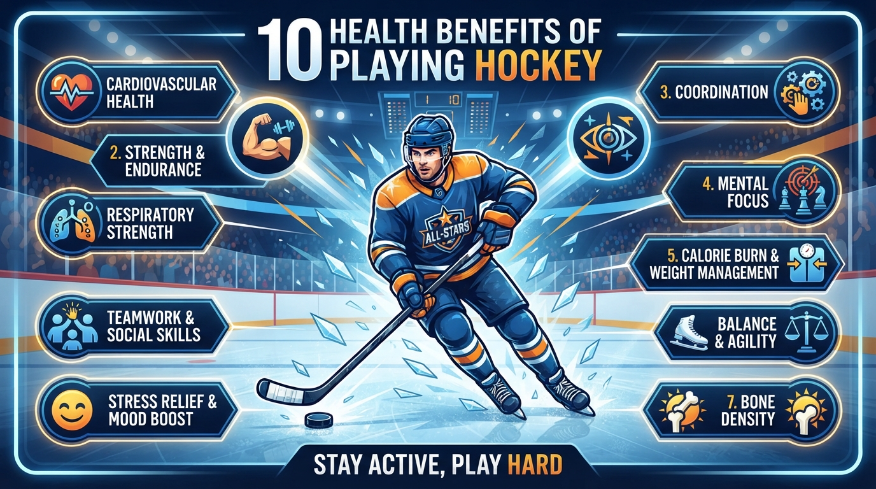
What are the health benefits of playing hockey? The short answer is that hockey can provide a demanding combination of aerobic exercise, muscular work, balance training, coordination practice, and repeated bursts of high intensity movement. Those demands make it a useful form of physical activity for people who enjoy competitive or recreational sport.
The exact benefits depend on factors such as playing frequency, intensity, age, fitness level, and the type of hockey being played. A competitive game places very different demands on the body than an occasional recreational skate.
Still, the basic movement patterns of hockey make it an unusually varied workout. Players repeatedly accelerate, decelerate, change direction, maintain balance on skates, handle a stick, react to opponents and teammates, and recover between intense efforts.
Regular physical activity is associated with important long term health benefits, including lower risks of cardiovascular disease, stroke and type 2 diabetes, as well as improvements in bone health, balance and healthy weight management.
Here is how those general benefits connect to hockey.
Hockey Provides a Strong Cardiovascular Workout
One of the biggest health benefits of playing hockey is the cardiovascular demand created by skating.
A hockey shift can involve rapid acceleration, hard skating, stopping, turning, battling for position and recovering before the next play. This creates repeated periods of elevated effort rather than one continuous, steady movement pattern.
That makes hockey particularly useful for developing cardiovascular fitness when played regularly at an appropriate intensity.
The U.S. Department of Health and Human Services recommends that adults accumulate at least 150 minutes of moderate intensity aerobic activity each week, or 75 minutes of vigorous intensity activity, along with muscle strengthening activity on at least two days.
A hockey session does not automatically mean someone has met those weekly recommendations. The amount of exercise varies considerably according to game length, ice time, intensity and the player’s role.
However, regular hockey can contribute meaningfully to a physically active lifestyle.
Hockey trains the body to handle repeated effort
Hockey is not simply about maintaining one pace.
A player might skate hard for a short period, slow down while reading the play, accelerate again, then return to the bench and recover. Repeated cycles like these challenge the cardiovascular system in a different way from leisurely movement.
Over time, consistent training can help players become better conditioned for these repeated efforts.
That conditioning can also make everyday physical activities feel easier because the player has developed a greater capacity for demanding movement.
Playing Hockey Builds Muscular Strength and Endurance
Hockey requires considerably more than cardiovascular fitness.
Skating places substantial demands on the legs and hips. Players repeatedly bend their knees, push against the ice, stabilize their bodies and generate force during acceleration and changes of direction.
The core also plays an important role.
A stable trunk helps players maintain posture while skating, shooting, passing and competing for the puck. The upper body contributes during stick handling, shooting and physical battles where those forms of contact are permitted.
This combination gives hockey a broad muscular component rather than focusing on one isolated muscle group.
Hockey Canadas player development resources specifically include strength and power, core conditioning, agility, balance and coordination as important areas of office training for hockey players.
Why skating demands so much from the lower body
Skating is different from ordinary walking or jogging because the player pushes laterally against the ice.
Every stride requires controlled force production followed by recovery and stabilization. Acceleration requires more force, while tight turns require the player to control body position and edge use.
Repeated skating therefore challenges the:
- Quadriceps
- Hamstrings
- Glutes
- Calves
- Hip muscles
- Core
The result is a sport that can contribute to lower body muscular endurance while also requiring bursts of power.
Players who want to maximize strength gains should not rely exclusively on hockey. Resistance training can complement skating by allowing specific muscle groups and movement patterns to be trained progressively.
Hockey Improves Balance, Coordination and Agility
Balance is one of the defining physical skills in hockey because players perform almost every movement while standing on narrow skate blades.
Maintaining stability becomes even more difficult when a player is accelerating, turning, stopping or handling the puck.
The sport therefore combines balance with dynamic movement.
A player has to control their body while simultaneously paying attention to the puck, teammates, opponents and available space. That creates a strong coordination component.
Physical activity in general is associated with improved balance and coordination, and the CDC lists better balance and reduced fall risk among the health benefits of regular physical activity.
Hockey adds a particularly demanding environment because balance is constantly challenged by movement.
Hand eye coordination is part of the workout
Stickhandling and shooting require players to coordinate their hands with visual information.
The puck may change direction unexpectedly, an opponent may close down space or a teammate may move into position. Players must process that information while controlling the stick and maintaining skating mechanics.
These skills do not replace dedicated neurological or coordination training, but regular hockey naturally gives players repeated opportunities to practice them.
Hockey Can Support Healthy Weight Management
Playing hockey can contribute to energy expenditure because skating involves the entire body and can become highly demanding.
The effect on body weight, however, should not be exaggerated.
There is no single amount of hockey that guarantees weight loss. Body weight is influenced by overall physical activity, nutrition, sleep, genetics and other factors.
The U.S. Physical Activity Guidelines explain that physical activity can help prevent weight gain, support weight loss and help people maintain weight, while also providing health benefits independent of changes in body weight.
For someone who enjoys hockey, that matters because an enjoyable sport can make regular activity easier to maintain.
A recreational player who consistently attends practices, skates with friends or joins games may accumulate meaningful physical activity without treating every session like a traditional gym workout.
That consistency can be more useful than an exercise routine someone dislikes and eventually abandons.
Playing Hockey Can Benefit Bone and Musculoskeletal Health
Weight bearing physical activity can support bone health, while resistance and impact related movement can place useful mechanical demands on the musculoskeletal system.
The CDC identifies improved bone health as one of the long term benefits associated with regular physical activity.
Hockey combines skating, body control, muscular loading and, depending on the level and rules, varying degrees of physical contact.
That does not mean hockey should be treated as a medical treatment for bone conditions. People with known musculoskeletal problems should discuss appropriate activity with a qualified healthcare professional.
The broader point is that regular physical activity is an important part of maintaining musculoskeletal health, and hockey can be one enjoyable way to obtain that activity.
Hockey Develops Speed, Reaction Time and Body Control
Hockey is played at a pace that forces players to make decisions quickly.
A player may have only a short window to control the puck, pass, shoot or change direction. That means physical movement and decision making happen simultaneously.
Over time, practice can improve sport specific reactions and movement efficiency.
This is particularly noticeable when an experienced player appears to move smoothly while a beginner struggles to maintain balance or react to changing play.
The difference is not simply raw speed. Experienced players generally combine:
- Better skating technique
- Better balance
- Faster visual processing
- More efficient movement
- Greater awareness of surrounding players
- Better anticipation
Hockey therefore provides a physical and cognitive challenge at the same time.
It should not be presented as a guaranteed way to improve general reaction time in every aspect of life, but the sport clearly requires rapid perception, decision making and motor responses.
Team Hockey Can Support Mental and Social Well Being
The health benefits of playing hockey are not limited to muscles and cardiovascular fitness.
Team sports provide regular opportunities for social interaction, cooperation and shared goals. Hockey requires players to communicate, coordinate positioning and work toward a common objective.
Those experiences can make physical activity more enjoyable and easier to sustain.
The CDC reports that physical activity can provide immediate benefits including improved sleep quality and reduced feelings of anxiety, while regular activity is associated with lower risk of depression and other long term health benefits.
The social side of hockey can add another reason for players to remain active.
For some people, the motivation is not simply exercise. It is meeting teammates, attending practice, competing, improving skills or being part of a local hockey community.
That social connection can make regular participation feel less like a chore.
Competition can also teach useful habits
Sport introduces situations where players have to respond to mistakes, adapt to changing circumstances and continue performing under pressure.
A missed shot or poor pass does not necessarily end the game. Players have to reset and focus on the next play.
That experience can contribute to psychological skills such as persistence and emotional regulation, although individual outcomes vary and competitive environments can also create stress if poorly managed.
A healthy hockey environment should prioritize development, respect and safety rather than constant performance pressure.
Hockey Can Build Fitness Beyond the Ice
Players do not have to rely exclusively on games to improve their hockey related fitness.
Hockey Canada recommends office training that can include warm ups, stretching, plyometrics, balance and coordination exercises, core conditioning, agility work, stickhandling and nutrition.
This approach is useful because hockey itself does not train every physical quality equally.
For example, a player might use strength training to develop force production, mobility work to address movement limitations and aerobic conditioning to improve general endurance.
A well rounded program can also reduce the temptation to increase skating volume endlessly.
The U.S. Physical Activity Guidelines recommend variety because doing too much of one type of activity can contribute to overuse injuries.
For recreational players, that could mean combining hockey with activities such as walking, cycling, swimming, resistance training or other sports.
The Health Risks of Hockey Should Not Be Ignored
A responsible discussion of hockey health benefits also has to acknowledge injury risk.
Hockey is a fast sport performed on a hard playing surface with sticks, skates and other players nearby. Falls, collisions and other impacts can cause injuries.
Concussions are a particular concern.
Hockey Canada notes that concussion can occur from direct head contact, impacts to the body that cause the head to move suddenly, falls and other indirect forces.
There is also no helmet that can make a player completely concussion proof. Hockey Canada emphasizes that helmets are important for protecting against certain head injuries but cannot eliminate concussion risk.
That distinction is important.
Protective equipment reduces certain risks, but it does not make a high speed sport risk free.
Equipment and concussion awareness
Players should use properly fitted and approved protective equipment and follow the rules of their league or governing organization.
Hockey Canada’s rules require players on the ice to wear a CSA certified hockey helmet with a properly attached certified facial protector, with specific requirements varying by participant category and jurisdiction.
Players, parents and coaches should also understand concussion symptoms and follow appropriate medical and return to play procedures when an injury is suspected.
Hockey Canada maintains dedicated concussion resources covering prevention, recognition, management and return to sport procedures.
If someone experiences a suspected concussion or significant injury, medical evaluation should take priority over returning to play.
How to Get More Health Benefits From Hockey Safely
The best approach is not simply to play more hockey. It is to make participation consistent, appropriately challenging and safe.
Start with a proper warm up before skating or practice. Gradually increase intensity rather than immediately performing maximal sprints.
Office conditioning can also help develop qualities that support skating and movement. Hockey Canada’s training resources specifically include warm ups, plyometrics, balance, coordination, core conditioning and agility work.
Recovery matters too.
Players who train frequently should pay attention to sleep, nutrition, hydration and rest days. Persistent pain or unusual fatigue should not be dismissed simply as part of playing hockey.
Another useful principle is progression.
Someone returning to hockey after a long break should not automatically try to match the workload of a highly conditioned player. Gradually increasing duration and intensity gives the body more time to adapt.
This is consistent with broader physical activity guidance encouraging people to build activity progressively, particularly when they are starting from a lower level of fitness.
Who Can Benefit From Playing Hockey?
Hockey can be useful for a wide range of people, provided the form of participation is appropriate for their age, fitness, experience and health status.
A beginner might benefit from recreational skating and skills sessions before joining competitive games.
An experienced player may use hockey as one part of a broader training program.
Older adults who are interested in hockey may choose lower impact or recreational formats based on their abilities, while young players should participate in age appropriate programs with proper coaching and safety practices.
The key is matching the activity to the person.
Someone with a medical condition, significant injury history or concerns about starting vigorous exercise should speak with a healthcare professional about what level of activity is appropriate.
The general health message remains strong: regular physical activity offers substantial benefits, and adults should aim for a combination of aerobic activity and muscle strengthening work.
Hockey can be one enjoyable way to achieve part of that goal.
Final Takeaway
So, what are the health benefits of playing hockey?
Hockey can support cardiovascular fitness, muscular endurance, balance, coordination, agility, bone health, healthy weight management and overall physical activity. Its team environment can also provide social interaction and a reason to stay active consistently.
The sport’s biggest advantage is variety. A single session can involve skating, acceleration, deceleration, balance, strength, coordination, decision making and repeated high effort movements.
At the same time, hockey should not be presented as risk free exercise. Proper equipment, rule compliance, appropriate conditioning and responsible concussion management are essential parts of participation. Hockey Canada specifically emphasizes safety, concussion awareness and skill development as important elements of the sport.
For people who enjoy hockey, that combination of exercise and competition can make staying active considerably more engaging than a repetitive workout routine.
FAQ
Is hockey a good workout?
Yes. Hockey combines aerobic activity with repeated bursts of high intensity skating, muscular work, balance and coordination. The amount of exercise depends on playing time, intensity and fitness level.
Does playing hockey improve cardiovascular fitness?
Regular hockey can contribute to cardiovascular fitness because skating requires sustained and repeated physical effort. The effect depends on how often and how intensely someone plays.
Does hockey build muscle?
Hockey can develop muscular endurance and contribute to strength, particularly in the legs, hips and core. Dedicated resistance training is generally more effective for maximizing strength and muscle development.
Can hockey help with weight management?
Yes. Hockey can increase physical activity and energy expenditure, which can support healthy weight management when combined with appropriate nutrition and other healthy habits.
Does hockey improve balance and coordination?
Hockey requires players to maintain balance while skating, turning, stopping and handling a puck. Regular practice can develop sport specific balance, coordination and body control.
Is hockey safe for children?
Children can participate in hockey safely when they use appropriate equipment, receive proper coaching and follow age appropriate rules. Hockey still carries injury risks, including concussion, so parents and coaches should understand injury prevention and concussion protocols.
Can playing hockey help mental health?
Regular physical activity is associated with benefits such as improved sleep and reduced anxiety, while long term activity is associated with a lower risk of depression. Hockey can also provide social interaction and teamwork.
How often should I play hockey?
There is no single ideal frequency for everyone. Hockey can be combined with other aerobic and strength activities to build a balanced weekly exercise routine. Adults should generally aim for at least 150 minutes of moderate aerobic activity or 75 minutes of vigorous activity per week, plus muscle strengthening activity on at least two days.
LEAVE A PIXEL ZINE COMMENT