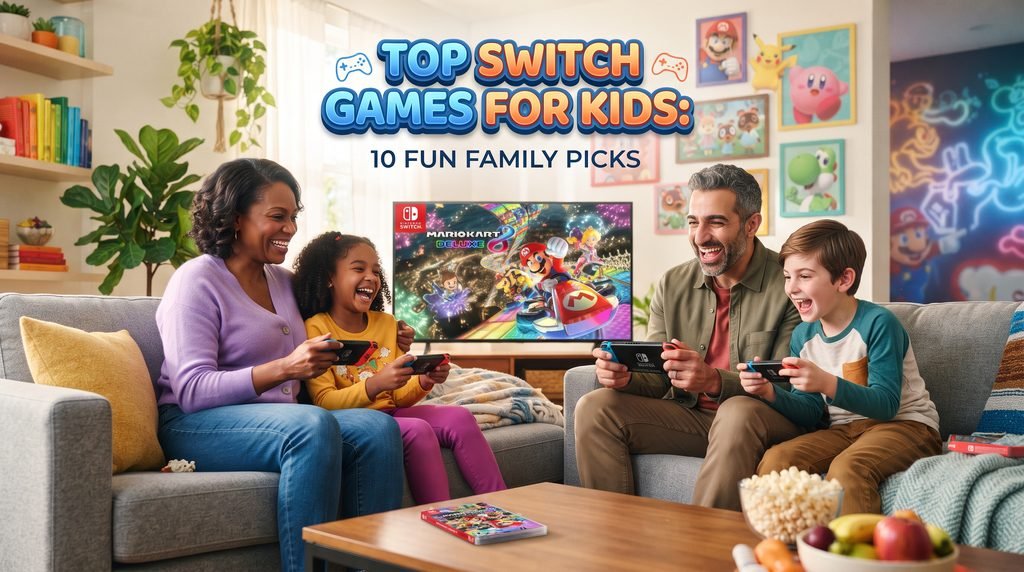
inding the top Switch games for kids is less about choosing the most famous Nintendo titles and more about matching a game’s mechanics to the child who will actually play it. A five year old who is still learning basic controller movement needs a very different experience from a ten year old who enjoys competition, exploration, or solving puzzles.
Nintendo’s library is particularly useful for families because it includes simple platformers, racing games, creative simulations, motion controlled sports, cooperative adventures, and puzzle focused experiences. Several titles also provide difficulty options or local multiplayer, giving parents ways to make the first few hours less frustrating.
The games below focus on accessible controls, family friendly content, replay value, and different types of play. Age ratings should still be checked for your particular child and region; Nintendo notes that ratings such as ESRB and PEGI are intended to help families judge age appropriateness.
What Makes a Nintendo Switch Game Good for Kids?
A good children’s game does not necessarily have to be extremely easy. In fact, a little challenge can be useful if the game teaches its mechanics clearly and allows the player to improve without excessive punishment.
For younger players, several characteristics matter.
Simple controls: A child should be able to understand the basic controls without constantly asking an adult what every button does.
Readable objectives: Games are easier to enjoy when players understand what they are supposed to accomplish.
Manageable difficulty: A game can be challenging, but repeated failure should feel like part of learning rather than an obstacle that stops progress.
Flexible multiplayer: Local multiplayer can turn a difficult game into a shared family activity.
Age appropriate content: Parents should look beyond the overall rating and check content descriptors and interactive features.
Room to grow: The best family games can remain interesting after the child understands the basics.
Nintendo also provides parental control tools that can restrict games based on ratings, limit communication features, control certain social features, and set play time limits through the Nintendo Switch Parental Controls app.
Top Switch Games For Kids
Rather than presenting these as one universal ranking, think of them as different options for different kinds of young players.
1. Mario Kart 8 Deluxe
Mario Kart 8 Deluxe is an excellent starting point for children who enjoy racing and short competitive matches.
The basic concept is immediately understandable: choose a character, pick a kart, drive around a course, and try to finish ahead of the other racers. The item system adds another layer because players can collect objects that change the race rather than relying entirely on driving skill.
That combination makes Mario Kart useful for family play. A child who is still learning how to steer can participate while more experienced players deal with the game’s more technical racing elements.
Nintendo supports up to four player local multiplayer on one Switch in TV mode, making it particularly practical for siblings or family game nights.
Best for: Racing fans, siblings, and families that want competitive multiplayer.
Why kids may like it: Short races, recognizable characters, colorful tracks, and immediate feedback.
Potential drawback: Competition can become surprisingly serious in a family with multiple players.
Tip: Let younger players experiment with different characters and kart combinations rather than focusing immediately on winning.
2. Super Mario Bros. Wonder
Super Mario Bros. Wonder is a strong choice for children who like traditional platforming but may not be ready for extremely demanding precision gameplay.
Its defining mechanic is the Wonder Flower. Activating one can dramatically change the behavior of a level, creating unexpected situations and giving otherwise familiar platforming a fresh rhythm. Nintendo also designed the game around cooperative play, with up to four players able to play together locally.
That cooperative structure is important for younger players. An older sibling or parent can participate instead of simply watching from the sidelines.
The game also provides different character choices, and the multiplayer system allows players to help one another through courses.
Best for: Kids who enjoy jumping, collecting items, exploration, and cooperative play.
Tip: For a younger child, play together initially. Co-op can make learning movement much less frustrating.
Why kids may like it: Levels constantly introduce new ideas instead of relying on one mechanic for an entire game.
Potential drawback: Some later platforming challenges can require more precise timing.
3. Kirby and the Forgotten Land
Kirby and the Forgotten Land takes Kirby into a 3D environment and is particularly useful for children who are just beginning to explore adventure games.
One of its biggest advantages for younger players is the choice between two difficulty settings. Spring Breeze Mode gives players more health and easier enemies, while Wild Mode provides a tougher challenge and greater rewards.
That flexibility means a family does not necessarily need to move to a different game when a child’s ability changes.
Kirby can also evolve Copy Abilities, giving the game a simple introduction to experimenting with different attacks. Local two player co-op is available, with a second player controlling Bandana Waddle Dee.
Best for: First time adventure and action players.
Why kids may like it: Bright environments, forgiving difficulty, simple objectives, and familiar character design.
Potential drawback: Older children who want deep combat systems may eventually find it less demanding.
Tip: Start with the easier mode and increase the challenge if the child begins completing stages comfortably.
4. Yoshi’s Crafted World
Yoshi’s Crafted World is particularly well suited to children who enjoy exploration and collecting rather than constant competition.
The game’s world is presented as a handmade craft environment filled with objects such as boxes and paper cups. Players can search for collectibles, explore levels from different perspectives, and even replay stages from the opposite direction.
Yoshi’s Crafted World also offers Mellow mode, which gives Yoshi wings and makes certain sections easier. Two players can cooperate on the same system.
This makes it a useful choice when a child likes platformers but struggles with demanding jumps.
Best for: Younger platforming fans and children who enjoy collecting.
Why kids may like it: Gentle presentation, exploration, collectibles, and cooperative play.
Potential drawback: Completion focused players may discover that collecting everything becomes much more challenging than simply finishing a level.
Tip: Treat collectibles as optional goals rather than requirements during a first playthrough.
5. Animal Crossing: New Horizons
Animal Crossing: New Horizons is very different from Mario or Kirby.
Instead of rushing through levels, players develop an island, decorate spaces, interact with characters, collect resources, and decide how they want to spend their time. Nintendo describes it as a game where players can live at their own pace and create their own island environment.
That makes it an interesting option for children who prefer creativity over reflexes.
It can also become a family activity. The game supports multiple players on one system, as well as local wireless and online play, although online and user interaction features are areas where parents should pay particular attention to their family’s rules.
Best for: Creative children, collectors, decorators, and players who dislike time pressure.
Why kids may like it: Customization and freedom to decide what to do.
Potential drawback: Its slower progression may not appeal to children who want constant action.
Tip: Use the game as a creative project rather than expecting the child to “finish” it like a conventional adventure.
6. Nintendo Switch Sports
Nintendo Switch Sports is one of the more accessible options for families that want to play together in the same room.
The collection includes sports such as soccer, volleyball, bowling, tennis, badminton, basketball, golf, and Chambara. Motion controls translate physical movements into in game actions, so children can often understand the connection between what they do with the controller and what happens on screen.
That makes the game different from traditional controller based experiences.
However, parents should pay attention to the physical environment. Nintendo specifically advises players to use wrist straps and leave adequate space around them while playing.
Best for: Family gatherings, active play, sports fans, and children who enjoy motion controls.
Why kids may like it: The controls feel physical and the rules of sports are already familiar.
Potential drawback: Motion controlled play requires enough room to move safely.
Tip: Bowling and tennis can be good starting points because their basic actions are easy to understand.
7. Princess Peach: Showtime!
Princess Peach: Showtime! offers a more straightforward single player adventure centered on Princess Peach.
Peach explores the Sparkle Theater and gains different transformations with their own abilities. Nintendo’s official page lists the game as a single system, single player title, so this is more appropriate for children who enjoy playing independently than those specifically looking for couch co-op.
The transformation structure also gives the game variety. Instead of Peach using exactly the same approach throughout, different stages introduce different abilities and objectives.
Nintendo also provides a free demo, which can be useful when a parent wants to see whether the child connects with the game’s controls and style before buying.
Best for: Peach fans and children who prefer solo adventures.
Why kids may like it: Different transformations keep the basic gameplay from becoming too repetitive.
Potential drawback: It does not offer the same local multiplayer appeal as Mario Kart or Super Mario Bros. Wonder.
8. Pikmin 4
Pikmin 4 is a good option for children who are ready for more strategic thinking.
Instead of focusing purely on jumping or racing, Pikmin 4 asks players to manage small groups of Pikmin while exploring environments and solving problems. Different Pikmin types provide different abilities, so success often comes from deciding which creatures to use for a particular situation.
The game also supports two players on one system, according to Nintendo’s product information.
This makes Pikmin 4 a useful step for children moving from straightforward action games toward strategy and resource management.
Best for: Older children who enjoy planning, exploration, puzzles, and problem solving.
Why kids may like it: It rewards thinking ahead rather than relying solely on fast reflexes.
Potential drawback: Its systems require more attention than a simple platformer.
Tip: Encourage children to experiment rather than trying to solve every encounter perfectly on the first attempt.
9. Big Brain Academy: Brain vs. Brain
Big Brain Academy: Brain vs. Brain is built around short mental challenges rather than traditional adventure gameplay.
Activities include memory tests, visual recognition, and tasks involving timing and problem solving. Nintendo supports four player matches on one system, and the game allows players of different skill levels to participate together.
That last point is especially useful for families. A parent does not necessarily need to play at the same difficulty as a child.
The short activities also make it easy to play for a limited amount of time without committing to a long story session.
Best for: Puzzle fans, family competitions, and children who enjoy quick challenges.
Why kids may like it: Sessions can be short and varied.
Potential drawback: Children who primarily want exploration or action may not stay interested as long.
Tip: Use multiplayer sessions as friendly challenges rather than treating every score as a competition.
How to Choose the Right Switch Game for Your Child
The best choice depends heavily on the child’s personality.
A child who likes competition may gravitate toward Mario Kart 8 Deluxe or Nintendo Switch Sports.
A child who likes platforming has several options, but Super Mario Bros. Wonder and Yoshi’s Crafted World approach the genre differently. Mario offers more multiplayer flexibility, while Yoshi emphasizes a gentler exploration and collection structure.
A child who prefers creative play may get considerably more mileage from Animal Crossing: New Horizons than from a traditional linear adventure.
For strategy minded children, Pikmin 4 provides a more complex experience.
For quick family sessions, Big Brain Academy can work better than a large adventure because its activities are designed around short challenges.
Difficulty should also influence the decision. A game with a beginner friendly mode can be more useful than one that simply carries an “E for Everyone” rating. Ratings communicate age suitability and content, but they do not tell you whether a particular child will find the controls easy. Nintendo recommends using the relevant rating system for your region when deciding what software is appropriate.
Best Switch Games for Different Types of Kids
| Type of player | Good starting point | Why |
|---|---|---|
| New to gaming | Kirby and the Forgotten Land | Beginner friendly difficulty option |
| Loves racing | Mario Kart 8 Deluxe | Simple racing basics with room to improve |
| Loves platformers | Super Mario Bros. Wonder | Accessible movement and local co-op |
| Enjoys collecting | Yoshi’s Crafted World | Collectibles and exploration |
| Creative player | Animal Crossing: New Horizons | Open ended island customization |
| Sports fan | Nintendo Switch Sports | Motion based sports |
| Likes solo adventures | Princess Peach: Showtime! | Straightforward single player structure |
| Enjoys strategy | Pikmin 4 | Planning and resource management |
| Loves puzzles | Big Brain Academy: Brain vs. Brain | Short mental challenges |
This table is not a ranking. The right choice depends on the child’s age, gaming experience, preferred play style, and whether the family wants solo or multiplayer gaming.
Multiplayer and Parental Control Considerations
Multiplayer can change the experience dramatically.
Local multiplayer is often the easiest option for younger children because a parent or sibling can sit beside them and provide help. Mario Kart 8 Deluxe, Super Mario Bros. Wonder, Yoshi’s Crafted World, Kirby and the Forgotten Land, Nintendo Switch Sports, and Big Brain Academy all provide different forms of shared play.
Online multiplayer requires more consideration.
Nintendo’s parental control system can restrict communication with other players, restrict software by age rating, manage social media related features, and set play time limits. Some controls can be managed through the console, while the smart device app provides additional options such as gameplay time limits and gameplay history.
For younger children, parents should also explain basic online safety. Nintendo specifically advises families to discuss information children should not share online, including their name, address, email address, and phone number.
The goal is not simply to restrict everything. It is to make the console’s settings match the child’s age, maturity, and the family’s rules.
Conclusion
The top Switch games for kids are not necessarily the games with the simplest mechanics. The strongest choices are the ones that match a child’s interests while leaving room to learn.
Mario Kart 8 Deluxe works particularly well for racing and family competition. Super Mario Bros. Wonder and Yoshi’s Crafted World provide accessible platforming with different approaches to difficulty and exploration. Kirby and the Forgotten Land offers useful beginner friendly options, while Animal Crossing: New Horizons gives creative children an entirely different kind of experience.
Nintendo Switch Sports is a natural choice for families that want motion controlled activities, while Pikmin 4 introduces more strategic thinking. Princess Peach: Showtime! suits solo players, and Big Brain Academy offers short puzzle based challenges.
Parents should combine those gameplay differences with the official age rating information and Nintendo’s parental control tools. That approach makes it easier to find a game that is not just appropriate for a child’s age, but genuinely suited to how that child likes to play.
FAQ
What are the best Switch games for younger kids?
Kirby and the Forgotten Land, Yoshi’s Crafted World, and Super Mario Bros. Wonder are useful starting points because they offer accessible platforming and, in some cases, cooperative or easier gameplay options.
Is Mario Kart 8 Deluxe good for kids?
Yes, it can work particularly well for children who enjoy racing. Its basic objective is easy to understand, while its item and track systems provide additional depth as players improve. Local multiplayer supports up to four players.
Which Switch games can parents play with their kids?
Mario Kart 8 Deluxe, Super Mario Bros. Wonder, Kirby and the Forgotten Land, Yoshi’s Crafted World, Nintendo Switch Sports, Pikmin 4, and Big Brain Academy all provide forms of multiplayer or shared play.
What Switch game is good for a child who dislikes difficult games?
Kirby and the Forgotten Land is worth considering because its Spring Breeze Mode provides more health and easier enemies. Yoshi’s Crafted World also includes Mellow mode, which gives Yoshi additional assistance.
Are Nintendo Switch games safe for kids?
Many Switch games are designed for younger audiences, but parents should check the game’s rating and content descriptors rather than assuming every Nintendo title is suitable for every child. Nintendo also provides parental controls for software, communication, social features, and play time.
What is a good Switch game for creative kids?
Animal Crossing: New Horizons is a strong option for children who enjoy customization, collecting, decorating, and deciding how to develop their own island.
Are there educational Switch games for kids?
Big Brain Academy: Brain vs. Brain is a notable option because it uses short activities involving memory, recognition, timing, and problem solving. It also supports multiplayer challenges for up to four people on one system.
Should parents allow online multiplayer for children?
That depends on the child’s age and the family’s rules. Nintendo provides settings that can restrict communication and other online related features, and parents can configure controls according to their needs
LEAVE A PIXEL ZINE COMMENT