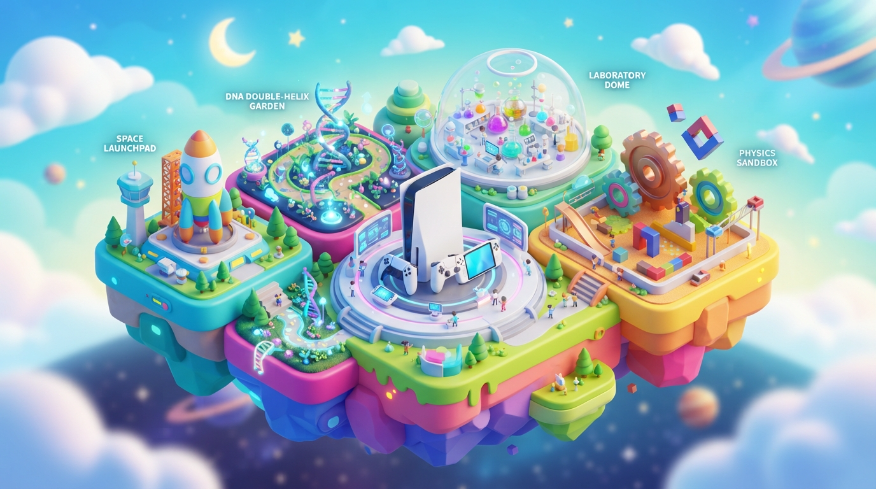
The top science games are not necessarily the ones with the most educational labels attached to them. The better examples are games that make scientific ideas part of the actual play. Gravity determines whether your spacecraft reaches orbit. Chemical reactions become puzzle solutions. Ecosystems respond to player decisions. Computer architecture becomes something you construct rather than simply read about.
That makes science games particularly interesting for gamers who enjoy experimentation and problem solving. Instead of memorizing a formula or reading a definition, you can manipulate a system, see what happens, change your approach, and try again.
This list covers ten games that approach science from very different directions. Some are close to simulations, while others use scientific concepts as the foundation for puzzles, strategy, survival, or experimentation. They should not all be treated as scientifically accurate simulations, but each offers something valuable for players who want their games to make them think.
What Makes a Science Game Worth Playing?
A good science game needs more than scientific terminology in its menus or a futuristic laboratory in the background.
The strongest examples make scientific principles affect the player’s decisions. If you are designing a rocket, for example, understanding mass, thrust, staging, and orbital movement should produce better results. If you are rebuilding an ecosystem, your decisions should change how that environment develops.
There are several different ways games can accomplish this.
Simulation is the most obvious approach. Games such as Universe Sandbox allow players to manipulate physical systems and observe the consequences.
Problem solving works differently. SpaceChem turns chemistry inspired processes into engineering puzzles where the player must design a working system.
Systems management can also teach scientific thinking. Oxygen Not Included requires players to understand relationships between gases, heat, resources, machines, and living organisms.
Then there are games such as Foldit, where gameplay has a direct connection to real scientific research.
The key difference is that these games encourage players to experiment. You are not simply being told how something works. You are interacting with a system.
Top Science Games for Curious Gamers
Universe Sandbox
If astronomy and physics are your interests, Universe Sandbox is one of the clearest examples of a game built around scientific experimentation.
It is a physics based space simulator that combines gravity, climate, collisions, and material interactions. Players can create planetary systems, manipulate celestial bodies, observe collisions, and experiment with changes to planetary conditions. Its simulation uses N body physics and Newtonian mechanics, although the developers also explain that some aspects are simplified so the game can operate in real time.
That distinction matters. Universe Sandbox should not be treated as a perfect replacement for professional astrophysics software. Its strength is accessibility.
You can change a planet’s orbit and immediately observe the consequences. You can alter mass, experiment with systems, or watch how climate changes under different conditions.
The educational version of the game is also explicitly designed for classroom use, with material covering gravity, orbital mechanics, climate, planetary composition, and astronomical objects.
Best for: Astronomy, gravity, planetary science, experimentation.
Why play it: It turns abstract concepts such as orbital mechanics into something you can visually manipulate.
Kerbal Space Program
Kerbal Space Program takes a more engineering focused approach to science.
The basic challenge sounds simple: build a spacecraft and get it into space. The reality is considerably more complicated. Players have to think about propulsion, vehicle construction, staging, trajectory, orbital movement, fuel, and the consequences of poorly planned designs.
That trial and error is what makes the game valuable. A rocket that looks impressive can still fail spectacularly if its design does not produce enough thrust or if the player’s trajectory is wrong.
The game has long been recognized for its connection to real physics and spaceflight concepts. Science Mode also provides a progression built around collecting scientific information and unlocking technology, while Career Mode adds financial and management considerations.
The important thing is that Kerbal Space Program does not make learning feel like a conventional lesson. Failure becomes part of the process. A failed launch can reveal exactly which assumption in your design was wrong.
Best for: Physics, aerospace engineering, orbital mechanics.
Why play it: It teaches through experimentation, failure, redesign, and increasingly ambitious missions.
Foldit
Foldit is one of the most unusual entries among the top science games because the connection to scientific research is unusually direct.
Developed by university scientists, Foldit turns protein folding into a puzzle game. Players manipulate protein structures and attempt to find effective configurations. The project uses player solutions as part of research into protein structure, protein design, and related biological problems.
The game also has different puzzle categories. Campaign puzzles introduce basic concepts, education puzzles explain protein folding, and science puzzles are based on problems connected to current research.
You do not need to arrive with an advanced biology degree. The interesting part is learning how molecular structures can be manipulated and why their shapes matter.
For players who want a science game with a genuine research connection rather than a fictional laboratory setting, Foldit stands out.
Best for: Biology, biochemistry, protein structure.
Why play it: Your puzzle solving is connected to real scientific research rather than existing purely inside a fictional game world.
SpaceChem
SpaceChem is aimed at players who enjoy logic puzzles more than conventional simulations.
You take the role of a reactor engineer and design systems that transform raw materials into chemical products. The game gives you components and processes, then challenges you to construct an efficient solution. Steam describes it as a design based puzzle game centered around chemical synthesis.
The interesting part is that you are not simply answering chemistry questions.
You are designing a machine.
That changes how the subject feels. Instead of being asked to remember a chemical fact, you have to think about sequences, inputs, outputs, timing, automation, and efficiency.
It also rewards optimization. Once you have a working solution, you can often find ways to make it smaller, faster, or more efficient.
Best for: Chemistry, logic, automation, systems thinking.
Why play it: It combines chemistry inspired mechanics with demanding engineering puzzles.
Plague Inc: Evolved
Plague Inc: Evolved approaches science through disease modeling and strategy.
The premise is intentionally fictional and dramatic, but the game asks players to think about transmission, mutation, population behavior, government responses, and competing priorities.
The developer describes the game as a strategy and simulation experience centered on evolving a pathogen and adapting to humanity’s response.
The game’s Cure mode provides an especially interesting alternative perspective. Instead of spreading a disease, players work to control a global pandemic by investigating outbreaks, improving testing, implementing interventions, managing public support, and developing a vaccine. The developer also makes an important distinction: Cure was developed with input from public health experts, but it is still a game and does not represent a completely accurate model of pandemic response.
That disclaimer is worth remembering.
Plague Inc is useful for thinking about systems and disease spread, but it should not be treated as a medical training simulator.
Best for: Epidemiology concepts, strategy, disease modeling.
Why play it: It shows how biological and social variables can interact inside a large strategic system.
Oxygen Not Included
Oxygen Not Included is a colony simulation where scientific thinking becomes necessary for survival.
Your colony exists inside an asteroid, and the environment is governed by interconnected systems involving oxygen, temperature, resources, machines, research, and living organisms. The game’s official Steam description specifically emphasizes mastering science and technology as part of surviving and developing the colony.
What makes it particularly useful for science minded players is the way problems interact.
A room is not simply hot because the game says it is hot. Heat can become a problem because of machines, environmental conditions, or poorly designed infrastructure. Oxygen is not an unlimited background resource. Your colony needs systems capable of producing and distributing what its inhabitants require.
This creates a constant cycle of observation and adjustment.
You identify a problem, form a solution, build it, watch the system react, and then modify the design when another problem appears.
Best for: Thermodynamics concepts, resource systems, environmental management, engineering.
Why play it: It rewards understanding interconnected systems rather than memorizing isolated facts.
Cell to Singularity
For players more interested in biology and evolution, Cell to Singularity provides a much more accessible entry point.
The game presents the development of life from a single cell through increasingly complex organisms and eventually human civilization. Its progression includes evolutionary discoveries, technological development, and scientific information.
The gameplay is built around incremental progression, so it is considerably less demanding than something like SpaceChem or Kerbal Space Program.
That is part of its appeal.
It can work well for someone who wants science themed gameplay without learning a complicated control system first. You gradually unlock biological and technological developments and encounter information about evolution and natural history along the way.
It is worth keeping expectations realistic, though. Evolution is vastly more complicated than a game’s progression tree. Cell to Singularity is better viewed as an accessible interactive introduction than a comprehensive biology course.
Best for: Evolution, biology, natural history.
Why play it: It presents complex biological history in an approachable progression system.
The Powder Toy
The Powder Toy is almost pure experimentation.
It is a free particle physics sandbox where players can work with numerous substances and observe interactions involving heat, gravity, air pressure, velocity, electronics, and other systems. Steam describes it as a physics sandbox capable of simulating many interactions between substances.
This is the kind of game where curiosity can drive the entire experience.
You can construct a system simply to see what happens. You can build machines, experiment with materials, create complicated reactions, or investigate how one change affects another.
It also supports custom elements and community creations, which gives the sandbox considerable room for experimentation.
The visual presentation is deliberately simple compared with major commercial games, but that can actually make the underlying interactions easier to observe.
Best for: Physics, materials, experimentation, electronics.
Why play it: There is very little separating the player from the experiment.
The Planet Crafter
The Planet Crafter takes scientific concepts and combines them with survival and base building.
You begin on an inhospitable planet and work toward transforming its environment. The game’s progression involves generating oxygen, warmth, and atmospheric pressure, with the ultimate goal of developing a habitable biosphere.
The game also connects environmental changes to visible results. As terraforming progresses, players can see new forms of life appear, including vegetation and animals.
That makes the game particularly approachable for players who enjoy exploration and construction but want scientific ideas underneath those systems.
It is not a rigorous planetary science simulator. Its systems are designed around gameplay and progression. Still, the central idea of gradually changing an environment gives players an intuitive way to think about atmospheric conditions and habitability.
Best for: Terraforming concepts, environmental science, survival systems.
Why play it: It turns planetary engineering into a progression system that you can see developing around you.
Turing Complete
Not every science game has to involve planets, biology, or chemistry.
Turing Complete focuses on computer science and digital hardware.
The game teaches concepts by taking players from basic logic gates toward arithmetic, memory, and CPU architecture. Its Steam description specifically presents the game as a way to understand how components such as NAND gates connect to larger computing systems.
This is one of the strongest choices on the list for players interested in how computers actually work underneath the software.
The important distinction is that it does not merely ask you to solve programming exercises. You build systems from low level components and gradually understand how those components contribute to a functioning computer.
The learning curve can be substantial, especially if logic circuits are unfamiliar, but that challenge is also the reason it can be rewarding.
Best for: Computer science, logic, digital circuits, CPU architecture.
Why play it: It turns computer architecture into something you construct instead of simply studying.
Which Science Game Is Right for You?
The best choice depends heavily on the scientific subject you want to explore.
| If you like… | Start with… |
|---|---|
| Astronomy and planets | Universe Sandbox |
| Rockets and spaceflight | Kerbal Space Program |
| Biology and proteins | Foldit |
| Chemistry and automation | SpaceChem |
| Disease and strategy | Plague Inc: Evolved |
| Environmental systems | Oxygen Not Included |
| Evolution | Cell to Singularity |
| Physics experiments | The Powder Toy |
| Terraforming and survival | The Planet Crafter |
| Computer architecture | Turing Complete |
There is also a useful difficulty distinction.
If you want something immediately accessible, The Powder Toy, Cell to Singularity, and The Planet Crafter are relatively easy places to start.
If you want deeper problem solving, SpaceChem, Turing Complete, and Foldit are stronger choices.
For players who want systems that can become extremely involved, Kerbal Space Program, Universe Sandbox, and Oxygen Not Included offer considerably more room for experimentation.
How Accurate Are Science Games?
This is where players need to separate scientific inspiration from scientific simulation.
A game can teach useful ideas without being scientifically perfect.
Universe Sandbox explicitly acknowledges that some of its simulations are simplified so they can run in real time. Plague Inc’s developers similarly warn that Cure mode is not a completely accurate representation of how a real pandemic is controlled.
The same principle applies to almost every title on this list.
Games need understandable rules, readable feedback, progression, and enjoyable challenges. Real scientific systems can be enormously complicated, and reproducing every variable would often make a game unusable.
The better question is therefore not, Is this game perfectly realistic?
Ask instead:
Does the game make scientific concepts meaningful to the decisions I am making?
That is a much more useful standard.
Kerbal Space Program can teach players to think about orbital mechanics without replacing aerospace engineering coursework. SpaceChem can encourage chemical and systems thinking without becoming a university chemistry lab. Foldit can expose players to protein folding while still operating as a puzzle game.
Science Games Versus Traditional Educational Software
Traditional educational software often starts with the lesson and adds interaction around it.
Science games can work in the opposite direction.
The player starts with a problem.
You need to launch the rocket. You need to keep the colony alive. You need to design the machine. You need to fold the protein. You need to make the environment habitable.
The scientific concept becomes useful because you need it to solve something.
That structure is particularly effective for gamers who learn through experimentation. Failure provides information, and successful solutions demonstrate why a particular approach works.
It does not mean games should replace textbooks, teachers, laboratories, or formal education. They are better understood as interactive supplements that can make abstract concepts easier to visualize and remember.
For younger players, educators should also consider whether a game’s difficulty, subject matter, and level of scientific accuracy match the learner’s needs.
How to Get More Educational Value From Science Games
The easiest way to get more from these games is to treat them like experiments rather than simply trying to win.
In Universe Sandbox, change one variable at a time and observe what happens. In Kerbal Space Program, try to understand why a launch failed instead of immediately copying another player’s design.
With Oxygen Not Included, look at the relationship between systems instead of fixing problems individually. With SpaceChem, compare two working solutions and ask why one is more efficient.
You can also keep a simple experiment log.
Write down what you changed, what you expected to happen, what actually happened, and what you would change next time.
That turns normal gameplay into a basic experimental process.
For games with weaker scientific accuracy, compare the game’s rules with reliable scientific sources after playing. That is particularly useful for subjects such as disease modeling, evolution, climate, and planetary science where game systems necessarily simplify reality.
Final Verdict
The top science games are valuable because they make players interact with ideas rather than simply read about them.
Universe Sandbox is the standout for astronomy and physics experimentation. Kerbal Space Program is excellent for players fascinated by rockets and engineering. Foldit is the unusual choice for anyone interested in genuine scientific research. SpaceChem turns chemistry into demanding engineering puzzles, while Plague Inc: Evolved uses disease modeling as the foundation for strategy.
For systems thinkers, Oxygen Not Included is particularly strong. Cell to Singularity offers a gentler route into evolution, while The Powder Toy provides an open experimentation playground. The Planet Crafter makes terraforming approachable through survival mechanics, and Turing Complete brings computer architecture into puzzle form.
None should replace formal scientific study, and not all of them are equally realistic. Their real strength is giving players a reason to ask questions, test ideas, notice relationships, and learn from failure.
For gamers who enjoy asking what happens if I change this?, that can be far more engaging than a traditional lesson.
FAQ
What are the best science games for learning?
Universe Sandbox, Kerbal Space Program, Foldit, SpaceChem, and Turing Complete are among the strongest choices because scientific concepts directly influence gameplay rather than simply appearing in the story.
Which science game is best for physics?
Universe Sandbox is an excellent choice for physics experimentation, while Kerbal Space Program is better suited to players who want physics combined with spacecraft engineering and practical problem solving. Universe Sandbox specifically simulates gravity and other physical interactions in real time.
Is Kerbal Space Program educational?
Yes, it can be educational because its spacecraft design and flight systems encourage players to understand concepts related to physics and spaceflight. It should still be treated as a game rather than a replacement for formal aerospace education.
Is Foldit a real science game?
Yes. Foldit was developed by university scientists, and its puzzles can contribute to research involving protein folding and protein design.
What science game is good for chemistry?
SpaceChem is one of the strongest choices because its gameplay revolves around designing systems that transform raw materials into chemical products.
Are science games scientifically accurate?
Accuracy varies considerably. Some games aim for relatively realistic simulations, while others simplify science to make gameplay understandable. Developers themselves sometimes acknowledge these limitations, so players should distinguish scientific inspiration from professional simulation.
What is a good science game for computer science?
Turing Complete is particularly suitable for players interested in computer architecture, logic gates, memory, arithmetic, and CPU design.
Are science games useful for students?
They can be useful as interactive learning supplements. Games can help students visualize systems and experiment with concepts, but they work best alongside reliable educational material and instruction.
LEAVE A PIXEL ZINE COMMENT