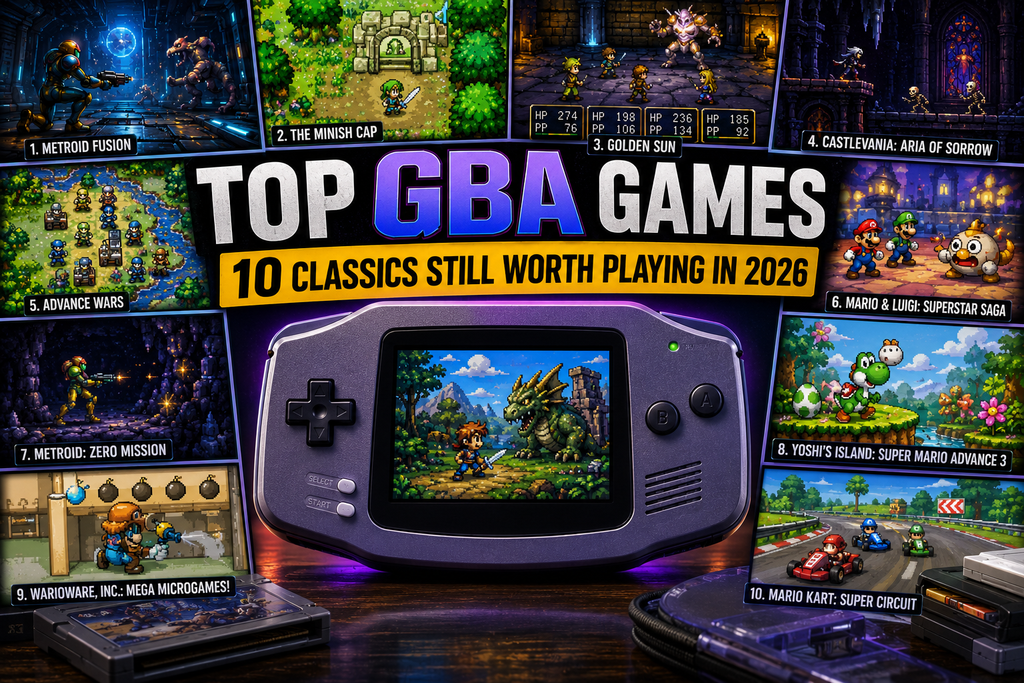
he top GBA games remain impressive because many of them were designed around strong fundamentals rather than hardware power. The Game Boy Advance could not compete with home consoles in graphical horsepower, but its library delivered compact adventures, clever level design, deep RPG systems, strategy games, racing, platforming, and experimentation that still work remarkably well today.
That makes choosing the best games harder than simply picking the most famous Nintendo releases. A good GBA game needs to feel enjoyable on its original hardware while also offering enough mechanical depth or personality to justify another playthrough decades later.
This selection focuses on games that continue to stand out for gameplay quality, design, replay value, genre variety, and overall historical importance. It includes major Nintendo releases alongside third party games that demonstrated just how much the handheld could accomplish.
Several of these titles remain highly regarded by critics. For example, Metroid Fusion holds a 92 Metascore based on 44 critic reviews, while Castlevania: Aria of Sorrow sits at 91. Golden Sun also earned a 91 Metascore.
Why These GBA Games Still Matter
The Game Boy Advance occupies an interesting position in handheld gaming history. Its games had to communicate mechanics through a relatively small screen, limited buttons, and short play sessions. That restriction often encouraged developers to make levels readable, controls responsive, and progression easy to understand.
The best releases also avoided feeling like scaled down console games.
Instead, developers created experiences specifically suited to portable play. A strategy game could be played in short turns. An action game could deliver a satisfying section without requiring hours of uninterrupted play. An RPG could provide a substantial adventure while still working naturally on a handheld.
That design philosophy explains why many of the top GBA games continue to attract players who did not grow up with the system.
MobyGames’ current GBA catalog, for example, continues to list games such as Castlevania: Aria of Sorrow, Mario & Luigi: Superstar Saga, Advance Wars, The Minish Cap, Metroid: Zero Mission, and Metroid Fusion among the platform’s notable releases.
The Top GBA Games Worth Playing Today
Metroid Fusion
Best for: Action, exploration, atmospheric scifi
Metroid Fusion is one of the strongest demonstrations of how to build tension around a compact handheld adventure.
The game follows Samus through a damaged research station where the X parasite creates a dangerous new threat. Its structure is more directed than Super Metroid, with mission objectives providing a clearer route through the adventure.
That difference is significant. Players looking for completely open ended exploration may prefer another entry, but Fusion benefits from its focused pacing.
The atmosphere is also surprisingly strong for GBA hardware. Environments have enough visual distinction to make the station feel like a collection of interconnected spaces rather than a collection of identical rooms.
Combat is responsive, power ups meaningfully change movement and combat possibilities, and the SA X creates an additional layer of tension.
Critics were particularly positive about the game. Metroid Fusion received a 92 Metascore, with 43 of 44 listed critic reviews classified as positive.
Why it still holds up: Excellent controls, strong pacing, atmospheric presentation, and satisfying progression.
Potential drawback: Players wanting the freedom of a more exploration heavy Metroid experience may find its structure restrictive.
The Legend of Zelda: The Minish Cap
Best for: Action adventure and puzzle solving
The Minish Cap is an excellent choice for players who want a traditional top down Zelda adventure without committing to a massive game.
Its defining mechanic allows Link to shrink and explore environments from a miniature perspective. This isn’t simply a visual gimmick. Size changes affect exploration, puzzles, combat situations, and how familiar locations are understood.
The game’s compact structure works particularly well on GBA. Dungeons offer recognizable Zelda style puzzle design, while the overworld provides enough optional activity to make exploration worthwhile.
The art direction has also aged well because it emphasizes colorful environments and strong character silhouettes rather than attempting realism.
The result is one of the most approachable entries on the system.
Why it still holds up: Clever size based puzzles, strong dungeon design, approachable pacing, and colorful presentation.
Potential drawback: Experienced Zelda players may find the overall adventure shorter and less expansive than the larger console entries.
Golden Sun
Best for: Traditional RPG fans
Golden Sun is arguably one of the most ambitious RPGs on the platform.
The adventure combines turn based combat, party development, elemental abilities, exploration, and environmental puzzles. Its Psynergy system gives characters abilities that are useful both during battles and while navigating the world.
That connection between combat and exploration helps the game feel more cohesive.
Its battle presentation was also unusually polished for a handheld RPG of its era. Character abilities and summons were presented with impressive visual effects, giving encounters more personality than basic menu driven combat might suggest.
The story provides a traditional fantasy framework, but the combination of world exploration, puzzles, party management, and combat gives the adventure considerable variety.
Golden Sun received a 91 Metascore, with all 29 critic reviews listed as positive on Metacritic’s critic review page.
Why it still holds up: Deep combat, strong exploration mechanics, satisfying puzzles, and substantial RPG progression.
Potential drawback: Its classic RPG structure can feel slower to players accustomed to modern action oriented RPGs.
Castlevania: Aria of Sorrow
Best for: Metroidvania fans
Aria of Sorrow is one of the clearest examples of the GBA being capable of delivering sophisticated action exploration gameplay.
The game places players inside a large interconnected environment filled with enemies, abilities, secrets, and progression paths. Its Soul system allows the protagonist to acquire abilities from defeated enemies, giving combat and exploration a collectible dimension.
That system is particularly effective because different abilities can change how players approach encounters.
The game also encourages experimentation without requiring an enormous commitment. The combination of exploration, combat, equipment, and ability collection gives the adventure considerably more depth than its handheld format might suggest.
It earned a 91 Metascore from 29 critic reviews, with 28 positive and one mixed review.
Why it still holds up: Excellent movement, interconnected exploration, enemy variety, and the Soul collection mechanic.
Potential drawback: The main adventure isn’t particularly long by modern RPG standards, although secrets and alternate endings improve replay value.
Advance Wars
Best for: Strategy fans
Advance Wars proves that a handheld game does not need complex graphics to deliver deep decision making.
The turn based strategy system is built around positioning, terrain, unit roles, resource management, and anticipating an opponent’s next move.
Different units have different strengths, which makes careless movement expensive. A powerful attack may not be useful if it leaves a unit exposed or allows an opponent to control an important position.
The campaign gradually introduces mechanics rather than throwing every system at the player immediately. That makes it accessible while still giving experienced strategy players plenty to think about.
Its turn based structure is also perfect for handheld gaming.
Why it still holds up: Strong strategic depth, readable mechanics, varied maps, and excellent portability.
Potential drawback: Players looking for fast action may struggle with the deliberate pace.
Mario & Luigi: Superstar Saga
Best for: RPG newcomers and character driven adventures
Mario & Luigi: Superstar Saga takes the traditional RPG formula and adds timing based combat and a generous amount of humor.
Instead of simply selecting commands and watching attacks happen, players can interact with combat through timed button presses. Correct timing can improve attacks or reduce incoming damage.
The brothers also have different abilities outside combat, which creates light environmental puzzles and keeps exploration connected to the party’s capabilities.
The writing is playful without overwhelming the adventure with exposition. That makes the game easy to recommend to players who normally avoid traditional RPGs.
Metacritic’s GBA rankings list Mario & Luigi: Superstar Saga with a 90 Metascore.
Why it still holds up: Responsive combat, humor, approachable RPG mechanics, and memorable character interactions.
Potential drawback: Players looking for a serious fantasy RPG may prefer Golden Sun.
Metroid: Zero Mission
Best for: Exploration and action
Metroid: Zero Mission reimagines the original Metroid adventure with modernized mechanics and presentation for the GBA.
Its biggest strength is accessibility. The structure retains the basic concept of exploring a hostile planet, collecting abilities, opening new routes, and confronting increasingly dangerous challenges, but the experience is more streamlined.
The result is an excellent introduction to classic Metroid design.
Movement feels precise, the map encourages players to remember previously inaccessible locations, and new abilities have practical consequences beyond simply increasing combat power.
For players who find older Metroid games difficult to approach, this is one of the most convenient entry points.
Metacritic’s GBA user score rankings place Zero Mission near the top of its list of highly regarded GBA games.
Why it still holds up: Strong pacing, polished movement, exploration, and approachable progression.
Potential drawback: Its campaign is relatively compact compared with modern action adventure games.
Yoshi’s Island: Super Mario Advance 3
Best for: Platforming
This is not simply a straightforward port style platformer. Yoshi’s Island: Super Mario Advance 3 brings a distinctive visual style and gameplay approach to the GBA.
Yoshi’s movement abilities create a different rhythm from conventional Mario platforming. Players can hover, throw eggs, swallow enemies, and interact with the environment in ways that make level navigation feel distinct.
The game also rewards exploration. Hidden items and optional objectives give skilled players reasons to replay stages instead of simply reaching the exit.
Its colorful art direction remains one of its strongest qualities.
The game earned a 91 Metascore according to Metacritic’s GBA rankings.
Why it still holds up: Creative platforming, strong level design, charming visuals, and rewarding exploration.
Potential drawback: Some collectibles require considerably more precision than simply completing a stage.
WarioWare, Inc.: Mega Microgame$!
Best for: Short sessions and arcade style gameplay
Few GBA games demonstrate the value of portable design as clearly as WarioWare.
Instead of asking players to spend hours mastering one central mechanic, it constantly switches between tiny challenges. The appeal comes from reaction speed, recognition, and adapting almost immediately to unfamiliar tasks.
That structure remains useful today because it fits into almost any amount of free time.
Five minutes can be enough for a session. Longer play sessions can turn into an attempt to improve scores or master increasingly rapid sequences.
It is also a strong example of Nintendo’s willingness to experiment with format rather than simply shrinking traditional console experiences.
Why it still holds up: Fast sessions, unusual challenges, simple controls, and excellent replayability.
Potential drawback: Players seeking a conventional narrative adventure should look elsewhere.
Mario Kart: Super Circuit
Best for: Portable racing
Mario Kart: Super Circuit brings kart racing to the GBA while preserving the familiar combination of racing skill and item based disruption.
Its strongest quality is the track design. Players need to manage corners, acceleration, positioning, and hazards while also dealing with unpredictable items.
The game is easy to understand but difficult to master, especially when trying to optimize lap times.
For a handheld racing game, it offers considerable depth without requiring complicated controls.
Why it still holds up: Responsive racing, challenging tracks, competitive mechanics, and quick sessions.
Potential drawback: Players accustomed to modern 3D Mario Kart entries may need time to adjust to its 2D presentation and older handling model.
How the Top GBA Games Compare
| Game | Best For | Main Strength | Best Player Type |
|---|---|---|---|
| Metroid Fusion | Action/exploration | Atmosphere and progression | Action adventure fans |
| The Minish Cap | Adventure | Puzzle and dungeon design | Zelda fans |
| Golden Sun | RPG | Combat and exploration | RPG players |
| Castlevania: Aria of Sorrow | Metroidvania | Exploration and abilities | Action fans |
| Advance Wars | Strategy | Tactical depth | Strategy players |
| Superstar Saga | RPG | Timing based combat | RPG newcomers |
| Zero Mission | Action | Exploration and movement | Metroid fans |
| Yoshi’s Island | Platforming | Level design | Platformer fans |
| WarioWare | Arcade | Short form challenges | Casual/arcade players |
| Mario Kart: Super Circuit | Racing | Track variety | Racing fans |
There isn’t one universally correct winner.
If you want the strongest action exploration experience, Metroid Fusion and Aria of Sorrow are obvious starting points. RPG fans have a choice between the traditional depth of Golden Sun and the lighter, more comedic approach of Superstar Saga.
Strategy players should start with Advance Wars, while platforming fans have excellent options in Yoshi’s Island and The Minish Cap.
Which GBA Game Should You Play First?
The best starting point depends heavily on the type of experience you want.
For a first GBA game: The Minish Cap is an accessible choice because its controls and progression are easy to understand.
For RPG fans: Start with Golden Sun.
For action fans: Metroid Fusion offers a focused adventure, while Aria of Sorrow provides more freedom and character progression.
For strategy fans: Advance Wars is the obvious starting point.
For short gaming sessions: WarioWare is difficult to beat.
For platforming: Yoshi’s Island: Super Mario Advance 3 offers a strong combination of creative mechanics and level design.
For racing: Mario Kart: Super Circuit remains a solid portable option.
What Makes a GBA Classic Hold Up?
Nostalgia can make an old game enjoyable, but it isn’t enough to make it genuinely good decades later.
The strongest GBA releases generally succeed because their underlying mechanics remain effective.
Responsive controls
Old hardware makes control precision even more important. Games with reliable movement and clear input feedback are much easier to revisit.
Strong level design
A small screen does not prevent sophisticated level design. The best games communicate objectives and environmental differences clearly.
Meaningful progression
Whether progression comes from new abilities, better equipment, new units, or increasingly difficult stages, the player should have a reason to keep moving forward.
Appropriate pacing
The GBA was designed for portable play. Games that respect short sessions can feel surprisingly modern.
Distinctive identity
The games that remain memorable usually have something recognizable about them. WarioWare has its microgames. Advance Wars has its tactical maps. Aria of Sorrow has its Soul system. Golden Sun combines RPG combat with environmental Psynergy.
Those identities help them survive beyond nostalgia.
Are These Games Still Worth Playing in 2026?
Yes, but the reason varies from game to game.
Some are worth playing because their mechanics remain excellent. Others provide historical context for genres that later became much larger. A few are simply exceptionally well designed portable games.
Metroid Fusion, Aria of Sorrow, and Golden Sun are particularly easy to recommend based on their enduring critical reception. Metacritic’s GBA rankings place several of these titles among the platform’s strongest critically reviewed games.
The biggest consideration today is accessibility. Original GBA hardware, cartridges, batteries, screens, and accessories can present practical challenges for new players. Modern players should also pay attention to legitimate re releases and officially supported platforms where available rather than assuming every old game is equally easy to obtain.
Final Verdict
The best GBA games demonstrate that excellent game design does not depend on modern graphics or enormous worlds.
Metroid Fusion delivers focused action and atmosphere. The Minish Cap shows how effectively a handheld can handle traditional adventure design. Golden Sun proves that a portable RPG can offer substantial depth, while Aria of Sorrow remains one of the system’s strongest action exploration games.
Then there are the games that show the GBA’s range: Advance Wars for strategy, Superstar Saga for comedic RPG gameplay, Yoshi’s Island for platforming, WarioWare for rapid fire arcade challenges, and Mario Kart: Super Circuit for portable racing.
That variety is ultimately what makes the top GBA games worth revisiting in 2026. They are not merely old games preserved by nostalgia. Many still have the qualities that matter most: precise controls, smart systems, memorable levels, meaningful progression, and gameplay that remains fun after the hardware novelty has disappeared.
FAQ
What are the best GBA games to play in 2026?
Strong choices include Metroid Fusion, The Minish Cap, Golden Sun, Castlevania: Aria of Sorrow, Advance Wars, and Metroid: Zero Mission.
What is the best GBA RPG?
Golden Sun is one of the strongest traditional RPG choices, while Mario & Luigi: Superstar Saga is a better option for players who prefer lighter storytelling and timing based combat.
Is Metroid Fusion still worth playing?
Yes. Its responsive controls, focused progression, atmosphere, and compact structure continue to work well. It also received a 92 Metascore from 44 critic reviews.
Is Castlevania: Aria of Sorrow one of the best GBA games?
Yes. It combines interconnected exploration, action combat, equipment, and its distinctive Soul system. It received a 91 Metascore based on 29 critic reviews.
Which GBA game is best for beginners?
The Legend of Zelda: The Minish Cap is a strong starting point because its adventure structure and controls are relatively approachable.
Which GBA game is best for strategy fans?
Advance Wars is an excellent starting point because its turn based system is easy to understand but offers substantial tactical depth.
Are GBA games still relevant today?
Yes. The strongest games continue to work because their appeal comes from mechanics, level design, progression, and replayability rather than graphical technology.
What makes a GBA game a classic?
A lasting GBA classic typically combines responsive controls, memorable design, meaningful progression, strong pacing, and a distinctive gameplay identity.
LEAVE A PIXEL ZINE COMMENT