Full Article
If you searched for Rubik’s Gridlock game online, you are probably looking for one of two things: a way to play the puzzle digitally or a clearer understanding of how the physical Rubik’s Gridlock game works.
The important distinction is that Rubik’s Gridlock is an official Rubik’s puzzle product, but players should be careful not to assume that every website or app using the word “Gridlock” is an official digital version. The official Rubik’s product is a spatial puzzle built around challenge cards, fixed white blocks, and movable colored pieces. Your task is to fit every remaining piece onto the board without moving the starting white blocks. According to the official Rubik’s product page, the game includes 88 puzzles across four difficulty levels, with one solution for each challenge card.
So, if your goal is to understand Rubik’s Gridlock game online, this guide explains the puzzle, how its mechanics work, what to look for when searching for digital versions, and how to improve at Gridlock-style spatial challenges.
What Is Rubik’s Gridlock Game Online?
Rubik’s Gridlock is a compact spatial puzzle rather than a traditional video game. A challenge card shows where specific white starter pieces must be placed. Those pieces are fixed and cannot be moved. You then have to arrange the remaining colored blocks so that every piece fits inside the available board space.
That sounds straightforward, but the fixed pieces create the real challenge.
Every starter configuration changes the geometry of the board. A piece that fits comfortably in one challenge may become impossible to place in another because a white block removes access to a particular corner, corridor, or shape.
The official Rubik’s description identifies four difficulty levels and 88 unique puzzles. It also states that each challenge card has a single solution.
For players searching online, the phrase can therefore refer to several related goals:
- Learning how the physical Rubik’s Gridlock puzzle works.
- Looking for an official digital version.
- Searching for a browser-based puzzle with similar mechanics.
- Finding solutions or strategies for difficult Gridlock challenges.
- Practicing the spatial reasoning skills needed for the physical game.
The key is understanding that “Gridlock” alone does not necessarily mean Rubik’s Gridlock. Search results may include completely unrelated games with the same name. For example, one currently indexed game called GridLock is based on a different strategic concept, while another recent game titled Gridlock on Steam uses block-placement mechanics on a 9×9 grid. Neither should automatically be treated as an official Rubik’s Gridlock adaptation.
How the Rubik’s Gridlock Puzzle Works
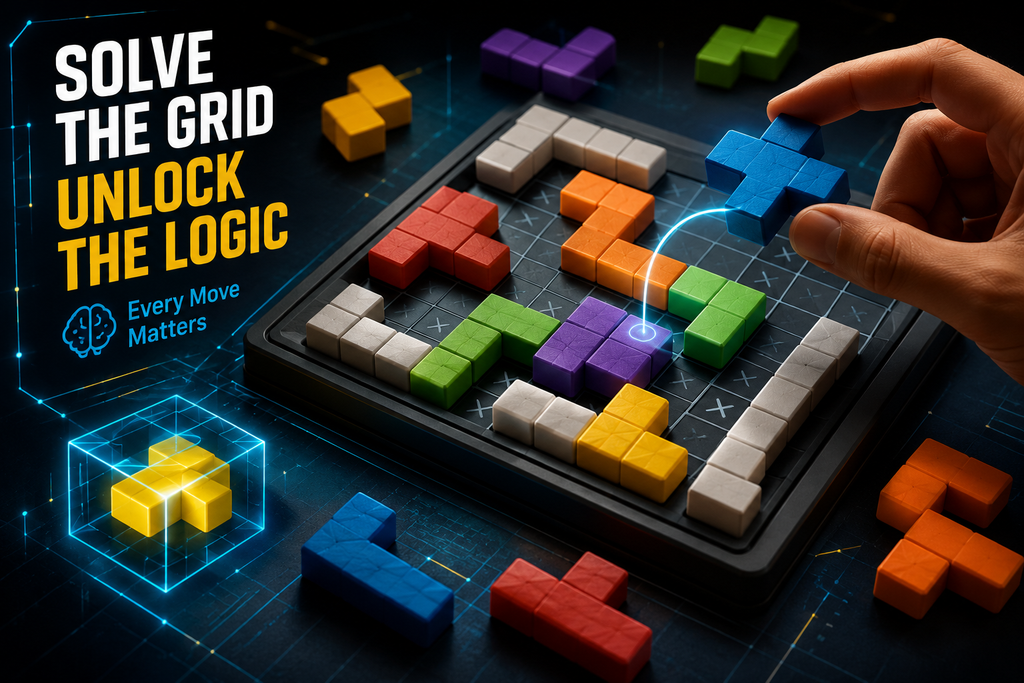
The appeal of Rubik’s Gridlock comes from constrained problem-solving.
You are not simply placing pieces wherever they look convenient. The fixed white starter blocks divide the board into unusual spaces, and every colored piece has a specific shape. The challenge is to determine the order and arrangement that allows every piece to fit.
The Basic Objective
The official gameplay structure is simple:
- Choose a challenge card.
- Place the white starter blocks in the positions shown.
- Leave those white pieces fixed.
- Use the colored pieces to fill the remaining space.
- Continue until every required piece fits on the board.
A completed puzzle is not just about finding a visually full board. The pieces must occupy the available space in the correct arrangement. The official Rubik’s product information describes one solution per challenge card.
This creates a different kind of puzzle from a standard Rubik’s Cube.
A Rubik’s Cube involves manipulating an interconnected mechanism through sequences of rotations. Gridlock is closer to a packing and spatial-placement puzzle. You are constantly asking questions such as:
- Which piece can physically fit into this space?
- If I use this gap now, where will the awkward piece go later?
- Does this corner only accept one possible shape?
- Am I creating an isolated empty space that nothing can fill?
Those questions are the foundation of successful Gridlock play.
Understanding the Challenge Cards
The challenge cards control the difficulty.
A beginner-level setup may leave large, obvious areas where several pieces could potentially fit. Harder arrangements can break the board into narrow or irregular spaces. That reduces your options and makes the order of placement increasingly important.
This is why randomly testing pieces becomes less effective as the difficulty rises.
At lower levels, trial and error can reveal useful patterns. At higher levels, a more systematic approach is usually faster. Instead of asking, “Where can I put this piece?” start asking, “Which spaces have the fewest possible pieces?”
That small change in thinking can dramatically reduce wasted moves.
Can You Play an Official Rubik’s Gridlock Game Online?
Based on the official Rubik’s product information available at the time of writing, Rubik’s Gridlock is presented as a physical puzzle game. The official product page explains the challenge-card gameplay and physical components, but it does not present a dedicated browser version of Rubik’s Gridlock for online play.
That means players should be cautious when searching for an official Rubik’s Gridlock game online.
A website may use:
- the word “Gridlock,”
- sliding blocks,
- colored puzzle pieces,
- grid-based gameplay,
without having any official relationship to Rubik’s or Spin Master.
The safest approach is to check the source. The official Rubik’s website lists Rubik’s Gridlock among its products and is the best starting point for verified information about the puzzle.
This does not mean online alternatives cannot be useful. It simply means they should be described honestly.
A generic online packing puzzle may help you practice spatial reasoning, but it is not automatically the same game.
How to Find Gridlock-Style Puzzles Online
If your goal is to play digitally rather than specifically use an official Rubik’s version, search for the mechanics instead of relying only on the title.
Useful search terms include:
- spatial block puzzle
- block fitting puzzle online
- polyomino puzzle
- shape packing puzzle
- logic puzzle with fixed blocks
- sliding block puzzle
These terms are often more useful because they describe what makes Rubik’s Gridlock interesting: constrained space and piece placement.
Before opening an unfamiliar browser game, check whether the website clearly identifies:
- the game developer or publisher,
- whether an account is required,
- whether the game is free or ad-supported,
- whether downloads are necessary,
- whether the title is actually related to Rubik’s.
Avoid downloading random executables simply to play a puzzle. A browser-based game should not require unnecessary software installations.
For younger players, parents and teachers may also want to choose well-known puzzle platforms rather than clicking through unofficial sites with aggressive advertising.
Rubik’s Gridlock Rules and Core Mechanics
The central rule is also the most important one: the white starter pieces stay where the challenge card places them.
That restriction turns a simple fitting exercise into a logic puzzle.
Imagine that the fixed pieces create three separate empty regions. You may have several colored blocks left, but perhaps only one of them can fit into the smallest region. If you fail to recognize that early and use the compatible piece somewhere else, the puzzle may become impossible.
The challenge is therefore not just placement. It is constraint management.
A useful mental model is to divide the board into:
- fixed spaces,
- flexible spaces,
- restricted spaces.
Fixed spaces
These are occupied by the white starter pieces. They define the puzzle and cannot be changed.
Flexible spaces
These are larger open areas where several different colored pieces might fit.
You generally do not need to solve these immediately because they offer options.
Restricted spaces
These are narrow, irregular, or isolated areas where only one or two pieces can possibly fit.
These spaces deserve your attention first.
The strongest Gridlock players are not necessarily the people who move pieces fastest. They are often the players who identify constraints before making their first serious placement.
Practical Strategies for Solving Gridlock Puzzles
There is no universal move sequence because every challenge card changes the board. However, the same strategic principles apply across the puzzle set.
Start With the Most Restricted Space
Look for:
- narrow corridors,
- small corners,
- unusual gaps,
- spaces with awkward shapes.
Ask which remaining piece could fit there.
If only one piece appears compatible, that is strong evidence that the placement should be investigated first.
This is a classic constraint-solving approach: deal with limited options before spending time on flexible areas.
Work From the Board, Not From Your Favorite Piece
A common beginner mistake is choosing a colored piece that looks easy to place.
That can feel productive, but it may be strategically wrong.
Instead of starting with a piece, examine the empty spaces created by the white blocks. The board should tell you what it needs.
If a particular area can only accommodate one shape, that shape has a higher priority than a piece that could fit almost anywhere.
Identify Blocking Chains
Some pieces cannot be placed until other spaces have been resolved.
For example, imagine Piece A can fit in two locations, but one of those locations would prevent Piece B from ever fitting. Piece A is not actually as flexible as it initially appears.
Think ahead one or two placements.
Before committing to a move, ask:
What empty spaces will remain after this piece goes here?
You do not need to calculate every possible board state. Just check whether the move creates an obviously unusable gap.
Use Corners Carefully
Corners can be valuable because they often reduce the number of possible orientations.
If a piece naturally matches the shape of a corner, test that placement. But do not assume every corner must be filled immediately.
Some larger pieces may depend on that open area.
The better rule is: prioritize corners when they create a highly restricted placement.
Avoid Creating Tiny Leftover Gaps
This is one of the fastest ways to lose a Gridlock puzzle.
Before placing a piece, inspect the empty cells it leaves behind. If the remaining space becomes an isolated shape that none of your remaining pieces can fill, undo the move mentally before committing.
A board that looks almost complete can still be unsolvable.
That is why “fill the biggest area first” is not always a winning strategy.
A Simple Solving Process for Difficult Challenges
For tougher cards, use a repeatable process.
First, place the white starter blocks exactly as shown.
Then pause.
Do not immediately begin testing colored pieces.
Scan the board and identify the smallest or strangest empty regions. Compare those spaces against the shapes you still have available.
Next, make a short list in your head:
- Which piece has the fewest possible locations?
- Which empty area has the fewest possible pieces?
- Which move would create an impossible leftover space?
Start testing the most constrained option.
After each placement, reassess the entire board. Do not continue following an old plan if the geometry has changed.
This is especially useful when an early placement opens or closes new possibilities.
If you become stuck, remove the most recent assumption rather than dismantling the entire board. Often the problem is not your whole strategy; it is one piece placed in a location that looked reasonable but consumed a critical space.
Common Mistakes That Make Rubik’s Gridlock Harder
Randomly Trying Every Piece
Trial and error is not inherently bad, especially for beginners. The problem is unstructured trial and error.
If you repeatedly place pieces without considering the remaining shapes, you may cycle through the same failed board states.
Instead, test a hypothesis.
For example:
This L-shaped piece may be the only one that fits this corner.
Then see what follows from that placement.
Ignoring Piece Orientation
A piece may look useless in one orientation and essential in another.
Before rejecting a block, mentally rotate it. Try to understand its geometry rather than memorizing its appearance from one angle.
Filling Large Open Spaces Too Early
Large areas are flexible. Small awkward spaces are not.
Using a versatile piece in a large open area may leave you with a difficult region that only that piece could have solved.
Restarting Too Quickly
When a puzzle seems impossible, do not automatically clear the board.
Look at the last few placements and ask which one created the bad space.
Working backward from the mistake is usually faster than starting from zero.
Assuming the Puzzle Is About Speed
Rubik’s Gridlock can certainly be played competitively or as a race with another person, but the core challenge is spatial reasoning.
Rushing through a difficult card can actually increase your solving time because careless placements create more resets.
For a hard challenge, spending an extra 20 seconds analyzing the board may save several minutes of experimentation.
Is Playing Online the Same as Playing the Physical Puzzle?
Not exactly.
A digital Gridlock-style puzzle can reproduce the logical challenge of fitting shapes into constrained spaces. In some cases, a digital interface may even make experimentation easier because pieces can be moved and reset quickly.
But the physical Rubik’s Gridlock puzzle has a different tactile experience.
You physically manipulate the pieces, see the board from different angles, and interact directly with the challenge-card setup. The official version is also designed as a portable puzzle, with a storage system built into the case.
The choice depends on what you want.
Choose a physical puzzle if you want:
- tactile interaction,
- the official challenge-card experience,
- a travel-friendly puzzle,
- offline play,
- a screen-free brain teaser.
Choose an online puzzle alternative if you want:
- quick browser access,
- easy resets,
- unlimited digital practice,
- no physical pieces to carry.
The strongest approach may actually be using both. An online spatial puzzle can help train the same type of reasoning, while the physical Gridlock game provides its own specific challenge layouts and pieces.
Who Will Enjoy Rubik’s Gridlock?
Rubik’s Gridlock is a good match for players who enjoy solving through observation rather than reflexes.
You may particularly enjoy it if you like:
- Sudoku-style logical elimination,
- Tetris-like spatial awareness,
- block-placement puzzles,
- tangram-style shape fitting,
- single-player brain teasers,
- compact travel games.
The official product positions Gridlock for puzzle fans aged 7 and up.
However, difficulty depends more on spatial reasoning and patience than on age alone. A younger player may solve some layouts quickly, while an experienced adult can still get stuck on a more restrictive challenge.
It is also a useful puzzle for families because the challenge-card format creates a clear shared objective. One player can solve while another observes, suggests placements, or races to find the solution first.
How Rubik’s Gridlock Differs From Other Rubik’s Games
The Rubik’s brand is strongly associated with the classic Cube, but Gridlock uses a very different style of problem-solving.
The traditional Rubik’s Cube focuses on manipulating a three-dimensional object until each face is solved. Gridlock focuses on arranging separate shapes within a fixed two-dimensional space.
Rubik’s Race is different again. Its official format is a head-to-head game where players shift and slide tiles to match a 3×3 pattern shown by the scrambler.
The distinction matters when searching online.
A search for “Rubik’s game” can produce Cube simulators, speedcubing tools, race games, physical product pages, and unrelated block puzzles. If you specifically want the Gridlock experience, look for challenge-card-based spatial placement rather than assuming every Rubik’s puzzle uses the same mechanics.
Is Rubik’s Gridlock Worth Playing?
If you enjoy spatial puzzles, yes.
Its main strength is clarity. The rules are easy to understand, but the challenge configurations can demand careful planning. You do not need to learn complicated controls, memorize long move sequences, or understand a large progression system.
You simply need to solve the space in front of you.
The potential weakness is also obvious: players who prefer action, story progression, or constantly changing objectives may find a purely spatial puzzle repetitive.
But for its intended audience, that focus is a strength.
Every challenge asks the same fundamental question in a new form: How can all of these pieces fit without moving what is already fixed?
That question becomes surprisingly difficult when the available space starts disappearing.
Final Verdict
Searching for Rubik’s Gridlock game online can be confusing because “Gridlock” is also used by unrelated games and digital projects. The verified Rubik’s Gridlock product is a physical spatial puzzle built around 88 challenge cards, four difficulty levels, fixed white starter pieces, and colored blocks that must all fit onto the board.
If you are looking specifically for an official browser version, use the official Rubik’s website as your reference point rather than assuming that similarly named games are licensed adaptations.
If your main goal is to practice the puzzle style online, look for legitimate spatial and shape-packing games. The mechanics to focus on are constrained placement, fixed obstacles, rotation, and efficient use of limited space.
And if you are stuck on a difficult physical challenge, remember the most useful Gridlock principle: solve the spaces with the fewest options before filling the spaces where almost anything can go.
FAQ
What is Rubik’s Gridlock?
Rubik’s Gridlock is a spatial puzzle game where challenge cards determine the position of fixed white blocks. Players must fit the remaining colored pieces onto the board without moving those starter blocks. The official product lists 88 puzzles across four difficulty levels.
Can I play Rubik’s Gridlock game online?
The official Rubik’s product page currently presents Gridlock as a physical puzzle game and does not show a dedicated browser version. Be careful when using websites with “Gridlock” in the title, as they may be unrelated games.
How many puzzles are in Rubik’s Gridlock?
The official Rubik’s product page states that the game includes 88 unique puzzles across four difficulty levels.
What is the best Rubik’s Gridlock strategy?
Start by identifying the smallest or most restricted spaces. Determine which pieces have the fewest possible placements and avoid filling large flexible areas too early.
Can the white blocks be moved?
No. The white starter pieces are placed according to the selected challenge card and remain fixed while you arrange the colored pieces.
Is every Gridlock puzzle solved the same way?
No. Each challenge card creates a different board configuration. The official Rubik’s page states that each challenge has one solution.
Is Rubik’s Gridlock suitable for children?
The official product is listed for ages 7 and up. The easier challenge levels can help players learn the mechanics before moving to more difficult spatial layouts.
Is Rubik’s Gridlock similar to a Rubik’s Cube?
Both are logic puzzles, but their mechanics are very different. A Rubik’s Cube is solved by rotating connected sections, while Gridlock involves placing separate shaped pieces into a constrained board.
LEAVE A PIXEL ZINE COMMENT