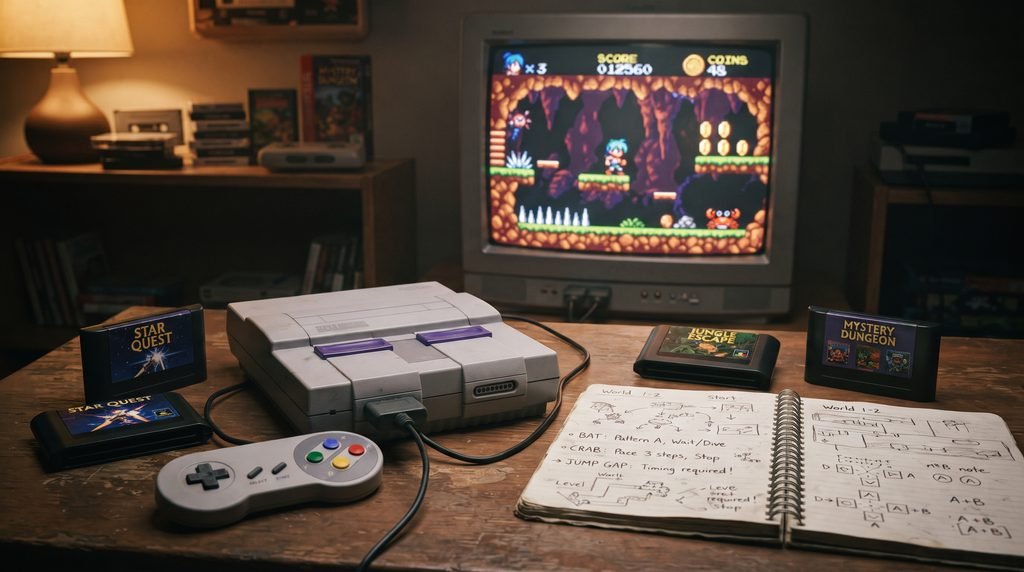
Retro games often feel difficult for a reason. Many NES, SNES, Sega Genesis, arcade, PlayStation, and early 3D games were built around observation, repetition, memorization, and precise input rather than constant tutorials or generous checkpoints.
That does not mean you need perfect reflexes to enjoy them.
The most useful retro video games tips and tricks are usually simple habits: learn enemy behavior, understand the rules of a level, stop wasting limited resources, practice one difficult section at a time, and pay attention to information the game gives you. Once those habits become natural, many supposedly brutal classics become much more manageable.
This guide focuses on techniques that work across different generations and genres. The goal is not to remove the challenge with cheats. It is to help you understand what older games are actually asking you to do.
Why Retro Games Often Feel Harder Than Modern Games
A modern game may introduce a mechanic with a tutorial, display a quest marker, provide frequent checkpoints, automatically save progress, and explain an objective through several layers of interface design.
Older games often expected players to figure things out through experimentation.
That difference is particularly noticeable in early console games. Limited memory and simpler interfaces meant developers had fewer ways to communicate information. Manuals therefore played a larger role than many modern players realize. Nintendo still provides digital manuals for games included with its NES and Super NES Classic Edition systems, while Sega maintains online manuals for Genesis Mini games.
Difficulty was also frequently connected to repetition.
A player might reach a difficult stage, lose, restart, and gradually learn:
- Which enemy appears first
- Where a projectile comes from
- Which platform is safe
- When a boss changes behavior
- Where health or ammunition can be found
- Which route is faster
- Which attacks are worth avoiding rather than blocking
The important shift is to stop thinking of failure as wasted time.
In many retro games, failure is part of the information gathering process.
25 Retro Video Games Tips and Tricks That Actually Help
1. Learn the game’s movement before trying to move quickly
Speed is usually a consequence of understanding control, not a substitute for it.
Spend the opening section learning how quickly the character accelerates, how far a jump travels, how long an attack animation lasts, and how much control you have while airborne.
This matters especially in platformers. A player who understands jump distance can plan a landing before pressing the button instead of making a desperate correction halfway through the jump.
2. Stop treating every enemy as a reaction test
Many classic enemies follow predictable behavior.
An enemy may patrol between two points, attack when you enter a specific range, jump at regular intervals, or move toward your position using a simple rule.
Watch the enemy for a few seconds before attacking.
Ask yourself:
- What triggers its attack?
- How far can it reach?
- Does it turn around at an obstacle?
- Can you manipulate its position?
- Is defeating it necessary?
Once you recognize a pattern, an enemy that previously looked unpredictable becomes much easier to manage.
3. Control space instead of waiting for danger
Positioning is one of the most transferable retro gaming skills.
If an enemy is approaching from the right, do not always wait until it is directly beside you. Move to a position where its attack becomes predictable.
This principle is particularly useful in side scrolling action games and beat ’em ups.
You are not simply responding to enemies. You are shaping where the encounter happens.
4. Learn the difference between safe damage and risky damage
Not every opportunity to attack is a good opportunity.
A boss may expose itself after an attack, but striking immediately could leave you standing inside the range of its next move.
Sometimes the correct strategy is:
Avoid → observe → attack → retreat.
This is especially important in games where health is difficult to recover.
5. Stop wasting limited resources early in a level
Older games often make resources meaningful.
A powerful weapon, healing item, special attack, bomb, or ammunition pickup may be useful later.
That does not mean you should save everything forever.
A better rule is to establish what the resource is for.
If a weapon dramatically reduces the difficulty of ordinary enemies, use it. If it is particularly effective against bosses, reserve enough for the encounter.
Resource management should reduce risk, not become another source of anxiety.
6. Memorize danger, not the entire level
You do not need to memorize every pixel of a stage.
Remember the important information:
- Enemy ambushes
- Blind jumps
- Moving platforms
- Trap locations
- Safe areas
- Boss patterns
- Important item locations
This creates a mental map without turning the game into homework.
7. Use short practice sessions for difficult sections
Repeating an entire game after every mistake is inefficient.
When possible, isolate the problem.
If a boss has three attacks you cannot consistently avoid, practice identifying those attacks. If a platforming sequence keeps killing you, concentrate on jump timing instead of worrying about the entire level.
This approach turns vague frustration into a specific skill problem.
8. Watch the environment for clues
Retro games often communicate through visual repetition.
A suspicious wall, unusual platform arrangement, isolated object, different tile pattern, or strangely empty room may be worth investigating.
Developers had fewer interface tools, so level design frequently carried information.
Not every suspicious object is a secret, but curiosity is a valuable skill in classic games.
9. Test unusual objects safely
Try interacting with things.
Push blocks. Strike suspicious walls. Walk into apparently empty spaces. Check unusual corners.
Do this when the cost of experimentation is low.
The key is controlled experimentation rather than randomly pressing every button.
10. Read the manual when a game feels confusing
This is one of the most overlooked retro video games tips and tricks.
A manual may explain controls, item functions, objectives, scoring rules, or systems that the game itself barely teaches.
Official manuals remain available for various classic collections. Nintendo’s Classic Edition documentation, for example, includes online game manuals, while Sega’s Genesis Mini manual library contains documentation for numerous games.
If a game feels strangely opaque, the problem may not be your ability. You may simply be missing information.
11. Learn the game’s scoring system when playing arcade style games
Arcade games frequently reward more than simply reaching the next stage.
Score multipliers, enemy chains, time bonuses, collectible routes, and risk reward mechanics can change how you approach a level.
If your goal is a high score, surviving is only one part of the challenge.
12. Do not assume the safest route is the fastest route
Once you understand a level, look for alternative paths.
A dangerous route may contain a valuable item or provide a shortcut. A longer route may be safer for beginners but inefficient for repeated attempts.
Good retro players gradually transition from survival to optimization.
13. Learn when to walk away from an enemy
Some enemies are distractions.
If defeating an opponent costs health, ammunition, or time and provides no meaningful reward, avoiding it may be the better strategy.
This is particularly useful in games where enemies respawn when you move between areas.
14. Treat bosses as pattern puzzles
Boss fights can look chaotic until you stop trying to attack constantly.
First identify:
- The boss’s attack cycle
- The safest position
- The moment when damage can be dealt
- The attack that causes the most danger
- What changes during later phases
Once those pieces are clear, the boss becomes a sequence rather than a wall.
15. Use sound as gameplay information
Older games often use sound effects to communicate events.
A particular sound can signal an enemy attack, item pickup, hazard, successful hit, or approaching threat.
If the visual information is limited, audio can become another source of timing information.
Playing with clear audio rather than treating sound as background music can genuinely help.
16. Keep your controller inputs deliberate
Rapid button mashing is not always effective.
Many classic games have distinct animation and input timing. Pressing a button repeatedly can sometimes create less predictable behavior than making one deliberate input.
For precision heavy games, practice:
Input → observe → adjust.
This is especially valuable for platformers, fighting games, and games with charge based attacks.
17. Learn the difference between difficulty and unfamiliarity
A game may feel impossibly hard during the first hour because its rules are unfamiliar.
After learning the movement system and enemy behavior, the same game can become much easier.
Before concluding that a classic game is badly balanced, ask whether you understand what the game expects from you.
That does not mean every old game has perfect difficulty design. Some genuinely contain harsh checkpoints, awkward controls, or punishing mechanics.
The distinction is still useful.
18. Use save states as a learning tool when available
Modern retro collections sometimes include suspend points or save state like features.
Nintendos NES and Super NES Classic Edition systems, for example, provide suspend point functionality, while the Super NES Classic Edition also includes a rewind feature.
Used thoughtfully, these features can make difficult games more accessible without replacing the original experience.
A good approach is to save before a difficult section, practice it, then attempt the section normally once you understand it.
The goal is learning, not simply removing every consequence of failure.
19. Do not save immediately before every mistake
If you are practicing with save states, avoid creating dozens of states after every successful action.
That can make your progress dependent on constant resetting.
Instead, create a useful checkpoint before a meaningful challenge.
This preserves the structure of the game while reducing unnecessary repetition.
20. Learn the game’s economy
In an RPG, adventure game, or strategy title, ask what your resources are actually doing.
Money, experience, equipment, healing items, ammunition, and consumables should support a plan.
For example, buying every available item may leave you without enough currency for something genuinely important later.
Think in terms of opportunity cost rather than collecting everything.
21. Talk to characters more than once in exploration games
Older adventure and RPG games sometimes hide useful information in dialogue.
If the world changes after an event, revisiting an important character can reveal new information.
Do not assume every NPC has a single permanent conversation.
22. Experiment with equipment instead of following one setup
If a game allows multiple weapons, armor pieces, characters, spells, or items, test them.
The option with the highest numerical value is not always the most useful.
A weaker weapon with better range may outperform a stronger weapon against a particular enemy.
Good retro strategy comes from understanding interactions, not simply chasing the largest number.
23. In fighting games, learn one reliable sequence before learning everything
You do not need an enormous move list to start improving.
Choose:
- One reliable normal attack
- One anti air option
- One safe approach
- One simple combo
- One defensive response
Once those become automatic, expand your options.
This approach works better than memorizing dozens of moves without knowing when to use them.
24. Adjust your expectations when moving from 2D to early 3D
Early 3D games often have different camera behavior, movement systems, and spatial problems from modern games.
Do not expect contemporary camera control.
Learn how the original game handles movement relative to the camera, how targeting works, and how the environment communicates depth.
That adjustment alone can make early 3D games substantially more comfortable.
25. Keep a personal record of what you learn
For particularly complex games, write down useful information.
It can be as simple as:
- Boss weakness
- Password
- Important item location
- NPC clue
- Useful route
- Puzzle solution
- Stage order
- Resource strategy
This recreates one of the social aspects of older gaming culture: sharing discoveries.
It also prevents you from repeatedly solving the same problem.
How to Approach Different Retro Genres
The best strategy depends heavily on the type of game.
Platformers
Prioritize movement, jump timing, enemy positioning, and level memorization.
Do not rush simply because the screen scrolls continuously. Learn where the game expects you to slow down.
In precision platformers, the ability to predict where you will land is more important than having extremely fast reactions.
Action Games and Run and Gun Titles
Focus on enemy spawn points, weapon ranges, movement, and resource management.
Learn which enemies must be defeated and which can be bypassed.
In games with limited continues, consistency is more valuable than spectacular individual plays.
RPGs and Adventure Games
Read dialogue, understand progression systems, and maintain useful resources.
Do not automatically sell or discard unusual items simply because their purpose is unclear.
Older RPG design can sometimes make the player responsible for remembering information that a modern game would place directly in a quest log.
Fighting Games
Learn spacing before advanced combos.
Knowing when your character can safely attack, retreat, jump, or punish an opponent is more useful than memorizing a complicated sequence that you cannot reliably execute.
Racing and Arcade Games
Learn the track or course.
Identify braking points, shortcuts, dangerous corners, and sections where speed can safely be maintained.
For score based arcade games, learn the scoring system as carefully as the basic controls.
How to Use Manuals, Saves, and Modern Features Properly
Modern conveniences can improve the experience without destroying the character of a classic game.
The important thing is how you use them.
If you are playing a game through an official modern collection, check its documentation first. Nintendo’s Classic Edition systems include manuals and suspend points, and the Super NES Classic Edition includes rewind functionality.
A sensible progression is:
First attempt: Play normally.
Second attempt: Use the manual or documentation if a mechanic is unclear.
Practice: Use suspend points or rewind when available to learn a difficult section.
Mastery: Return to a normal run once you understand the challenge.
This approach keeps the game challenging while removing unnecessary friction.
It is also worth distinguishing between original hardware and modern reproductions, collections, emulation, or FPGA based systems. The experience can differ in controller latency, display behavior, save functionality, and available conveniences. Modern retro hardware has expanded considerably, giving players several legitimate ways to revisit older games.
Common Mistakes That Make Retro Games Harder
One of the biggest mistakes is rushing.
Players accustomed to modern games may expect frequent checkpoints and forgiving recovery systems. Classic games often reward slower observation.
Another mistake is attacking everything.
If an enemy is not blocking your route and provides little benefit, avoiding it may be smarter.
Another common problem is spending valuable items too early. New players often use their strongest resources whenever they are available instead of recognizing the situations where those resources provide the greatest advantage.
There is also a tendency to blame controls immediately.
Sometimes old controls genuinely have limitations. But before deciding that a game is poorly controlled, spend time learning its intended rhythm. A jump that initially feels strange may become predictable once you understand its acceleration and landing behavior.
Finally, do not confuse nostalgia with quality.
Some classics remain excellent because their mechanics still work. Others are historically important but may feel rough by modern standards.
You can appreciate a game’s importance while acknowledging its limitations.
How to Build a Better Retro Gaming Practice Routine
If you are struggling with a difficult classic, use a simple practice structure.
Start with a normal attempt.
Do not worry about winning. Your first objective is information.
On the next attempt, focus on one problem. Maybe that is a boss attack, a platforming sequence, or an enemy encounter.
Then repeat the specific section until the correct response becomes familiar.
After that, make another full attempt.
This creates a useful cycle:
Attempt → identify problem → practice → apply → repeat.
The process is particularly effective because retro games often contain a finite set of challenges. Once you understand them, improvement can happen quickly.
The goal is not to become perfect immediately.
The goal is to reduce the number of things that can surprise you.
What Modern Players Can Learn From Retro Game Design
Retro games remain useful teachers of game design because their limitations forced developers to communicate through mechanics and level structure.
A strong classic often teaches without stopping the player.
The first enemy may demonstrate movement. A safe platform may establish jump distance. A later version of the same obstacle may test whether the player understood the earlier lesson.
That structure still influences modern level design.
Retro games also demonstrate the value of readable rules.
A player can forgive a game for being difficult if the rules are consistent. What becomes frustrating is unpredictability that feels unrelated to skill.
That is why pattern recognition is so central to classic gaming.
Once the player understands the rules, difficulty becomes a question of execution.
That distinction explains why some extremely difficult retro games remain enjoyable decades later.
Final Verdict
The best retro video games tips and tricks are not secret codes or shortcuts. They are habits that help you understand how classic games communicate.
Learn enemy patterns. Understand movement. Manage resources. Watch the environment. Practice difficult sections separately. Read the manual when the game does not explain itself. Use modern save and rewind features as learning tools when they are available.
Most importantly, slow down enough to recognize the rules.
A retro game can initially feel unfair because it gives you less information than a modern game. Once you learn how that information is presented, the experience changes. The enemy that seemed random has a pattern. The impossible jump has a consistent landing point. The boss has a predictable cycle. The mysterious item finally makes sense.
That is the real advantage of mastering classic games.
You are not simply becoming faster at pressing buttons. You are learning to read a game.
FAQ
What are the best retro video games tips and tricks for beginners?
Start by learning movement, enemy patterns, level layouts, and resource management. Avoid rushing, and treat early failures as opportunities to identify patterns rather than simply losing progress.
Why do retro games feel harder than modern games?
Many classic games provide fewer tutorials, checkpoints, automatic saves, and interface explanations. They often expect players to learn through repetition, observation, experimentation, and manuals.
How do you get better at difficult retro games?
Break difficult sections into smaller problems. Learn enemy behavior, practice specific jumps or attacks, and repeat the section until your response becomes consistent.
Should I use save states when playing retro games?
Yes, if your version of the game provides them. Save states can be useful for practicing difficult sections. They are most valuable when used as a learning tool rather than simply eliminating all consequences.
Are retro game manuals actually useful?
Yes. Manuals can explain controls, objectives, item functions, scoring systems, and mechanics that may not be clearly explained inside the game. Nintendo and Sega continue to provide manuals for various classic game collections.
What is the most important skill in retro gaming?
Pattern recognition is one of the most useful skills. Learning how enemies, bosses, levels, hazards, and movement systems behave lets you replace reaction with prediction.
Should I defeat every enemy in a retro game?
Not necessarily. If an enemy can safely be avoided and defeating it consumes health, ammunition, or time, bypassing it can be the better strategy.
Are old games still worth playing today?
Yes, particularly when their core mechanics, level design, progression, or challenge remain enjoyable. However, not every classic has aged equally well, so it is worth judging games individually rather than relying entirely on nostalgia.
LEAVE A PIXEL ZINE COMMENT