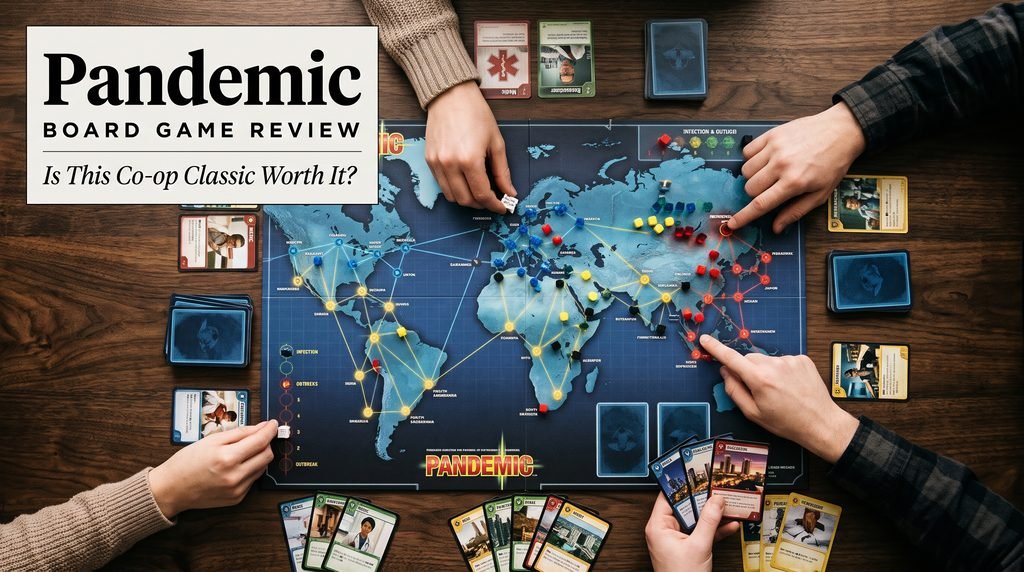
Pandemic is a cooperative strategy board game in which two to four players work together to discover cures for four diseases before outbreaks overwhelm the world. Designed by Matt Leacock and published by Z Man Games, it turns a straightforward objective into a tense puzzle involving limited actions, careful card management, and constant decisions about which threats deserve immediate attention.
Unlike competitive tabletop games, Pandemic does not ask players to defeat one another. Everyone wins together, and everyone loses together. That shared objective creates a different kind of tension: one player’s mistake can affect the entire team, but a well coordinated plan can turn a seemingly hopeless situation around.
This Pandemic Board Game Review examines what makes the original game enjoyable, how its mechanics work, where its strategic depth comes from, and which players are most likely to appreciate it. It also considers the drawbacks, including the possibility of one experienced player dominating the discussion.
Pandemic Board Game Review: Quick Verdict
Pandemic is an excellent choice for players who enjoy cooperative strategy, shared problem solving, and decisions that become increasingly difficult as a game progresses. Its rules are approachable, but winning consistently requires planning, communication, and an understanding of how quickly small problems can become major threats.
The game’s strongest feature is its pressure system. Players must develop cures while preventing infections from spreading beyond control. Every action spent treating a disease is an action that cannot be used for travel, research, or helping another player.
That tension makes even familiar situations interesting. Should your team eliminate disease cubes from a crowded city, move a specialist toward a research station, or spend a valuable card to reach a distant location?
There is rarely a perfect answer.
Quick verdict
- Genre: Cooperative strategy board game.
- Players: 2–4.
- Playing time: Approximately 45–60 minutes, depending on the edition and group.
- Recommended age: Commonly listed as 8+ for the standard edition.
- Designer: Matt Leacock.
- Publisher: Z-Man Games.
- Best for: Families, friends, strategy fans, and players who enjoy working toward a shared objective.
- Main drawback: Players can lose control of the experience when one person makes every decision for the group.
These specifications reflect commonly listed details for the standard game; check the product information for the edition you intend to purchase.
What Is Pandemic?
Pandemic is a tabletop game about coordinating a global response to four fictional diseases. Players take the roles of specialists who travel between cities, treat infections, establish research stations, exchange information, and collect the cards needed to discover cures.
The objective is not to remove every disease cube from the board. Instead, the team must discover cures for all four diseases before one of the game’s losing conditions is triggered.
That distinction is central to the design. Treating infections buys time, but research is what ultimately wins the game. Players must balance immediate containment against long term progress.
The board represents a connected network of cities across the world. Colored cubes indicate infections, while cards and player pieces track the resources and specialists involved in the response.
The rules create an understandable fictional crisis without requiring players to memorize a complicated narrative. Most of the game’s storytelling comes from the decisions unfolding on the table: a city becomes a hotspot, an epidemic accelerates the spread, and the team must reorganize its plans.
Pandemic was originally released in 2008. Its core cooperative system has since inspired expansions and standalone games, but the original remains a useful starting point for understanding this style of tabletop design.
How Pandemic Board Game Gameplay Works
Pandemic is built around three connected activities: taking actions, drawing player cards, and spreading infections. The interaction between these systems creates the game’s escalating difficulty.
Actions and movement
On a turn, a player can perform up to four actions. Available actions include moving between connected cities, taking certain flights by discarding the appropriate cards, treating disease cubes, building research stations, sharing knowledge under the relevant rules, and discovering cures.
Because actions are limited, movement becomes a strategic decision rather than a routine activity.
Imagine that your character is in a city with several disease cubes, while another region is close to triggering an outbreak. You could spend actions treating the first city, but doing so might leave your teammates without enough time to respond to the more dangerous region.
Movement abilities and the cards in your hand influence these decisions. A direct flight can save several actions, but discarding a city card may mean giving up a card that could eventually help discover a cure.
This creates a useful question for every turn: which action will provide the greatest benefit to the entire team?
New players sometimes spend too many actions moving around without a clear objective. Experienced players generally try to connect movement to a specific task, such as delivering a needed card, treating a dangerous hotspot, or positioning a specialist near a research station.
Collecting cards and discovering cures
Player cards are essential to Pandemic’s progression. City cards represent locations, while other cards provide special event effects or contribute to the game’s escalating difficulty.
To discover a cure, a player generally needs to collect five city cards of the same color and perform the cure discovery action at a research station. The Scientist role has a special ability that changes the usual card requirement.
This means the team must do more than control the board. It must also build the right card combinations while making sure that infections do not become unmanageable.
Card management is one of Pandemic’s most interesting challenges. A card can be useful for several reasons: it may help with travel, contribute to a cure, or be needed when sharing knowledge with another player.
Discarding it for convenience can solve an immediate problem but create a bigger one later.
The hand limit also matters. Players cannot simply collect every useful card and wait until the perfect opportunity arrives. They need to coordinate who should collect particular colors and where those cards should eventually be used.
A good team therefore treats card collection as a shared objective rather than four separate personal projects.
Infection cards, epidemics, and outbreaks
At the end of a turn, infection cards determine which cities receive new disease cubes. The infection rate controls how many cards are drawn, and that rate can increase as the game progresses.
Epidemic cards make the situation more dangerous by intensifying the infection system. They increase the infection rate, introduce infection to a heavily affected city, and intensify pressure on the infection discard pile.
Outbreaks occur when a city cannot receive another cube of a disease because it already contains the maximum number of cubes of that color. The infection then spreads to connected cities under the outbreak rules.
Chain reactions can be devastating. One outbreak may push a neighboring city over its limit, causing another outbreak and spreading the crisis across several connected locations.
The team loses if eight outbreaks occur, if it must place disease cubes but cannot because the supply is exhausted, or if it must draw a player card but the player deck has run out.
These conditions explain why treating infections is important even though it does not directly complete the main objective. Players must keep the situation under control long enough to find all four cures.
Strategy and Decision Making
Pandemic is easy to understand at a basic level, but its strategic decisions become more demanding as players learn to recognize the consequences of their actions.
The most effective teams do not simply react to every new infection. They identify the most dangerous areas, coordinate their card collection, and plan their turns around the resources needed to win.
Prioritizing threats
A common beginner mistake is to treat every disease cube as equally urgent.
The better approach is to consider how a city’s condition might affect nearby cities and how much time remains before another infection phase. A heavily infected city connected to several vulnerable locations may deserve immediate attention, particularly when an outbreak could create a chain reaction.
However, treating a city is not automatically the best move. If a cure is one card away and the board is stable, moving a player into position to complete that cure may offer greater long term value.
A useful priority order is:
- Prevent an outbreak that could cause a dangerous chain reaction.
- Protect the team from an imminent losing condition.
- Complete a cure when the required cards and position are available.
- Reduce infections in strategically important cities.
- Prepare movement and card exchanges for the next round.
This is a flexible guideline, not a fixed rule. The correct priority depends on the board, the available roles, the infection rate, and the cards currently in circulation.
Making the most of player roles
Each player receives a role with a special ability. These powers encourage players to approach the shared problem differently.
For example, the Medic is especially effective at treating disease cubes, while the Scientist needs fewer cards to discover a cure. Other roles improve movement, card sharing, or the team’s ability to manage information and research.
The best use of a role is not always obvious. A Medic might be more valuable traveling toward a high risk region than remaining near a research station. A player collecting cure cards may need another teammate to handle disease containment so the research plan can continue.
Role abilities are strongest when the team plans around them.
Instead of asking what each character can do independently, ask how their abilities complement one another. One player might control outbreaks while another concentrates on gathering the cards needed for a cure.
This cooperation is where Pandemic becomes more than a sequence of individual turns.
Difficulty and Learning Curve
Pandemic has a relatively approachable ruleset, but its difficulty comes from managing several competing priorities.
New players can usually understand the basic turn structure without much trouble. Learning when to treat infections, when to travel, and when to focus on research takes longer.
The standard game also allows players to adjust the difficulty by changing the number of Epidemic cards included during setup. This provides a straightforward way to make later sessions more demanding.
At lower difficulty settings, groups have more room to learn the roles and develop a shared strategy. Higher difficulty leaves less room for wasted actions and poor card management.
An important point for beginners is that losing does not necessarily mean the team played badly. Pandemic contains uncertainty, and the infection deck can create difficult situations. Still, repeated losses often reveal practical lessons: players may have ignored a dangerous region, spent too many cards on travel, or delayed cure research for too long.
The game works best when the group treats those outcomes as information for the next attempt.
Components, Artwork, and Table Experience
The standard game uses a world map, role cards, player cards, infection cards, disease cubes, research stations, pawns, and markers to track important information.
The components support the rules without requiring elaborate miniatures or a large collection of accessories. Disease cubes are easy to identify, and the map makes the relationships between cities visible.
That clarity matters because players need to scan the board quickly. They must notice where infections are accumulating, which cities are connected, and where a research station or teammate could make a difference.
The presentation is functional rather than flashy. The world map and colored cubes communicate the game’s central problem, while the cards provide most of the information players need to plan their turns.
The main practical limitation is table space. The board, player cards, infection deck, discard piles, and role areas can spread across a table, particularly when players keep reference materials nearby.
A reasonably sized table and an organized card layout make the experience smoother.
Replayability and Long Term Appeal
Pandemic’s replayability comes from changing roles, card draws, infection patterns, and player decisions.
The same opening can lead to very different games. One session may produce a dangerous cluster of infections in a connected region, while another may give the team more time to collect cure cards before the board becomes difficult to manage.
Different role combinations also change the team’s priorities. A group with strong treatment abilities may approach disease containment differently from one that relies more heavily on efficient movement and card sharing.
However, replayability has limits.
The objective remains broadly consistent from session to session, and players who prefer a new story, extensive character progression, or a completely different challenge every time may eventually want something more varied.
Expansions and standalone games in the Pandemic line add different mechanics and themes, but buyers should distinguish between expansions that require the original game and standalone products that can be played independently.
The original game is particularly appealing to groups that enjoy improving their decisions over multiple sessions. Learning how to manage the infection deck and coordinate roles can make familiar situations feel increasingly tactical.
The Biggest Strengths of Pandemic
Cooperation has a real mechanical purpose. Players need one another because the game presents more problems than a single character can efficiently handle. Team discussion can directly improve the outcome.
The pressure builds naturally. Infection cards, outbreaks, and epidemics make the board more threatening over time. The tension emerges from the rules rather than a scripted story.
The rules support meaningful decisions. Movement, treatment, research, and card collection all compete for limited actions. Players must decide what matters most rather than simply completing a checklist.
It accommodates different experience levels. Beginners can learn the basic actions while experienced players discuss more advanced priorities. Adjustable difficulty also helps groups develop gradually.
It encourages improvement. Losing can reveal weaknesses in a team’s approach, making subsequent attempts more informed. Players can experiment with roles and strategies rather than relying on a single fixed solution.
Together, these qualities make Pandemic a strong introduction to cooperative strategy games.
The Main Weaknesses
Pandemic is not ideal for every group.
Its biggest social weakness is the possibility of quarterbacking: one player takes control of the discussion and tells everyone else what to do. Because the game is fully cooperative and players can openly discuss their plans, a confident or experienced participant may dominate the table.
Groups can reduce this problem by asking each player to explain their intended action, inviting quieter participants to contribute, and allowing people to make their own decisions.
The game’s uncertainty can also frustrate players who want complete control. Even a sensible plan may be disrupted by an epidemic or a series of unfortunate infection draws. Strategic play improves the team’s chances, but it cannot guarantee a win.
Another limitation is the absence of direct competition. Players who enjoy bluffing, negotiation, hidden objectives, or the satisfaction of defeating a rival may find Pandemic less engaging.
Finally, the core experience can become familiar. Once a group understands the major priorities and has played many sessions, it may want expansions or a different cooperative game to provide a fresh challenge.
These drawbacks do not undermine the design, but they matter when deciding whether the game fits your group.
Pandemic Compared With Other Cooperative Games
Pandemic is a useful starting point for comparing cooperative tabletop games because its central objective is clear and its main challenge is managing a shared crisis.
Unlike a cooperative adventure game built around character progression or a campaign, Pandemic concentrates on a compact strategic puzzle. Players move, manage cards, treat infections, and work toward four cures within a limited window.
It is also different from a cooperative game that emphasizes hidden information or individual secret objectives. Pandemic generally rewards open communication and a shared understanding of the board.
The original game is a good fit if you want:
- A structured cooperative challenge rather than player versus player competition.
- Meaningful decisions without a long campaign commitment.
- A game that can be taught to newcomers.
- A strategy experience that fits into roughly an hour.
If your group prefers narrative discovery, hidden roles, elaborate character development, or extensive scenario variety, another cooperative title may suit you better.
Pandemic’s strength is focus. It takes a small set of interconnected systems and makes the team work hard to keep them under control.
Who Should Buy Pandemic?
Pandemic is worth considering for families with older children, friends who enjoy solving problems together, and tabletop players looking for a strategic cooperative game.
It is especially suitable for groups that like discussing possible moves and changing plans as circumstances develop. Players who enjoy recognizing patterns, managing limited resources, and coordinating specialized abilities will find plenty to appreciate.
It may be a poor fit for groups in which one person regularly takes over shared decisions, or for players who dislike losing because of unpredictable events.
Competitive players should also consider whether they genuinely enjoy shared victories. Pandemic’s central appeal is the team’s combined success, not individual rankings.
Before buying, check the exact edition, player count, age recommendation, component language, and included content. The original game and other products in the Pandemic family are not interchangeable, and expansions may require a compatible base game.
Practical Tips for New Players
Treat research as the route to victory. Removing disease cubes is important, but the team ultimately needs to discover all four cures. Avoid spending every turn on containment while allowing cure collection to stall.
Discuss priorities, not just moves. Agree on the biggest current threat and the team’s next research goal. This helps each player understand how their actions contribute to the overall plan.
Use travel cards carefully. Discarding a city card can save actions, but that card may be needed to complete a cure. Before using it, consider whether another player needs it or whether it is part of a valuable collection.
Watch connected cities. A crowded city can be dangerous because an outbreak may spread infections to neighboring locations. Consider the potential chain reaction when deciding where to treat disease cubes.
Coordinate role abilities. Let the player best equipped for a task handle it when practical. Efficient use of the Medic, Scientist, and other specialists can save valuable actions.
Do not ignore the player deck. Epidemics and normal card draws create pressure on the team’s time. Delaying research too long can leave the group with fewer opportunities to complete its objective.
Learn from a loss. Identify the turning point. Was the team too slow to cure a disease? Did it spend too many actions traveling? Did an avoidable outbreak consume the remaining margin for error? Use that lesson in the next session.
These habits will not make every game easy, but they help players understand the relationship between immediate threats and long term objectives.
Final Verdict
Pandemic remains a compelling cooperative board game because it makes teamwork essential rather than optional. Players must coordinate movement, manage cards, contain infections, and discover cures before the situation becomes impossible to control.
Its rules are approachable, but the decisions have real consequences. A few poorly timed actions can create a dangerous chain reaction, while a coordinated plan can turn a difficult board into a manageable one.
The main drawbacks are its dependence on group communication, the possibility of one player dominating decisions, and a core experience that may eventually feel familiar to regular players.
Even so, Pandemic is worth considering if you want a cooperative strategy game that rewards planning, communication, and adaptation. It is particularly appealing to families and friends who want to work toward a shared goal without committing to a lengthy campaign.
For players who prefer direct competition or story driven adventures, it may not be the right choice. For groups that enjoy solving a demanding puzzle together, the original Pandemic offers a focused and rewarding tabletop experience.
FAQ: Pandemic Board Game Review
Is the Pandemic board game worth buying?
Yes, Pandemic is worth considering if you enjoy cooperative strategy, shared problem solving, and games that reward teamwork. Its combination of card management, disease containment, and cure research creates meaningful decisions. However, competitive players or groups that dislike unpredictable outcomes may prefer another game.
How many players can play Pandemic?
The standard Pandemic board game supports two to four players. The experience changes with the number of participants because different player counts affect team coordination, role combinations, and the distribution of responsibilities.
How long does a game of Pandemic take?
A typical session takes approximately 45–60 minutes, although learning the rules, discussing strategies, and playing at higher difficulty levels can extend the session.
Is Pandemic suitable for beginners?
Yes. The basic rules are relatively accessible, and players can learn the main actions during their first session. However, understanding how to prioritize outbreaks, manage cards, and coordinate character abilities takes practice.
Can you play Pandemic solo?
The standard game is designed for two to four players, but it can be adapted for solo play by controlling multiple roles. Players should follow the rulebook’s guidance for their edition and understand that controlling several characters changes the experience.
What is the main objective of the Pandemic board game?
The objective is to discover cures for all four diseases before the team loses. Players must also prevent eight outbreaks, avoid running out of disease cubes when new cubes are required, and ensure the player deck does not run out when a card draw is required.
Is Pandemic difficult to win?
Pandemic can be challenging because infections continue to spread while players collect cards and work toward cures. The difficulty depends on the number of Epidemic cards used, the roles in play, the card draws, and the team’s decisions.
What makes Pandemic different from competitive board games?
Pandemic is cooperative rather than competitive. Players share the same objective, discuss strategies, and win or lose together. Its challenge comes from managing limited actions and responding to a growing crisis rather than defeating another player.
LEAVE A PIXEL ZINE COMMENT