Icebreaker games for students help classmates get to know one another, start conversations, and feel more comfortable working together. They are particularly useful on the first day of school, during college orientation, at the beginning of a group project, or whenever students meet a new class.
The best activities are easy to explain, quick to organize, and comfortable for students with different personalities. Some encourage students to share simple facts about themselves, while others use puzzles, teamwork, drawing, or friendly competition to get people talking.
This guide covers 15 classroom-friendly activities, including instructions, recommended group sizes, estimated playing times, and practical variations. Most require little or no equipment, making them suitable for classrooms, student clubs, orientation events, and online lessons.
Why Icebreaker Games Matter for Students
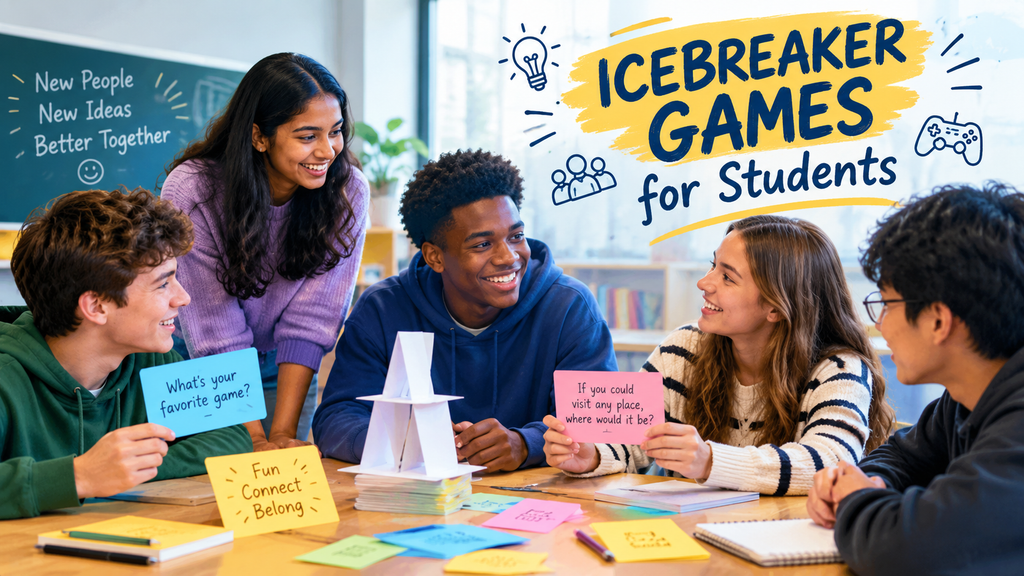
Walking into a room full of unfamiliar people can feel awkward. A student might want to make friends but not know how to begin a conversation. Another may be comfortable speaking one-to-one but reluctant to address an entire class.
A well-chosen icebreaker gives students a shared activity to focus on instead of putting all the attention on formal introductions. It creates a natural reason to talk, listen, and discover common interests.
These activities can help students:
- Start conversations: Simple prompts give classmates something specific to discuss.
- Learn names: Repeated introductions help students remember who is who.
- Practice teamwork: Group challenges encourage listening, planning, and cooperation.
- Discover shared interests: Students may find common ground through hobbies, favorite games, music, or creative activities.
- Participate in different ways: Writing, drawing, guessing, and problem-solving offer alternatives to speaking in front of everyone.
Icebreakers are not a complete solution to social anxiety or classroom exclusion. Their purpose is to create a manageable first opportunity to interact. Teachers should select activities that encourage participation without forcing students to reveal personal information.
How to Choose the Right Student Icebreaker
Before choosing an activity, consider the students’ ages, class size, available time, and classroom environment.
| Classroom situation | Suggested activity | Approximate time |
|---|---|---|
| First day of school | Name and Gesture | 5–10 minutes |
| New classmates | Find Someone Who | 10–15 minutes |
| Small seminar | Two Truths and a Lie | 10–15 minutes |
| Group project | Paper Tower Challenge | 10–15 minutes |
| Energetic class | This or That | 5–10 minutes |
| Online lesson | Emoji Check-In | 5–8 minutes |
| College orientation | Speed-Friending Questions | 8–15 minutes |
These times are estimates. Larger classes may need additional time for instructions, transitions, and sharing.
For younger students, choose short activities with concrete instructions. Older students often enjoy open-ended questions, collaborative puzzles, and games that let them make decisions as a group.
Explain the rules before beginning and demonstrate an example if necessary. If a game requires movement, provide clear boundaries and a seated alternative. The goal is to make social interaction easier, not to introduce unnecessary pressure.
Best Icebreaker Games for Students
The following activities combine conversation, creativity, teamwork, and friendly challenges. You do not need to run all 15 at once. Choose one or two that suit your class and leave enough time for students to interact naturally.
Quick Introduction Games
Name and Gesture
Time: 5–10 minutes Group size: 6–20 students Materials: None
Each student says their name and adds a simple gesture, such as a wave, a thumbs-up, or a small hand movement. The group repeats the name and gesture before the next person takes a turn.
Why it works: It connects names with a visual cue and encourages students to pay attention to one another.
Variation: Let students introduce themselves without a gesture if they prefer. In a large class, play in smaller circles.
Two Truths and a Lie
Time: 10–15 minutes Group size: 4–12 students per group Materials: Paper optional
Each student shares three statements about themselves. Two are true and one is invented. The other players discuss which statement they think is the lie before the speaker reveals the answer.
Why it works: Students learn memorable details about each other and have a natural reason to ask follow-up questions.
Variation: Use light topics such as hobbies, favorite foods, books, or skills. Avoid asking students to disclose personal history or information they would rather keep private.
Find Someone Who
Time: 10–15 minutes Group size: 8–30 students Materials: Prepared worksheet
Give each student a sheet with prompts such as “likes drawing,” “enjoys a team sport,” or “has read a fantasy book.” Students talk to classmates and find someone who matches each prompt, writing down names where appropriate.
Why it works: It encourages several short conversations instead of one long introduction.
Variation: Use a smaller grid if time is limited. Choose prompts that do not reveal sensitive information, and allow students to skip any question.
This or That
Time: 5–10 minutes Group size: Any class size Materials: Optional signs
Present two choices, such as books or movies, mountains or beaches, sweet or savory snacks, or working alone or in a team. Students choose their preferred option and can explain their reasoning if they wish.
Why it works: Everyone can respond quickly, and differences in preference naturally create discussion.
Variation: Students can raise a hand, point to a sign, move to one side of the room, or answer through a digital poll. Provide a seated response option.
Speed-Friending Questions
Time: 8–15 minutes Group size: 6–30 students Materials: Optional question cards
Pair students for short conversations, giving each pair one or two minutes per prompt. Questions might include:
- What hobby would you like to learn?
- What type of game do you enjoy?
- What is a skill you would like to develop?
- If you could plan a school activity, what would it be?
Rotate partners after each round, depending on the class size and available time.
Why it works: Short conversations can feel more manageable than speaking in front of the whole class. Students also get to meet several classmates.
Variation: Keep students seated and rotate partners, or allow fixed pairs if moving around is difficult.
Teamwork and Problem-Solving Games
Paper Tower Challenge
Time: 10–15 minutes Group size: Teams of 3–5 Materials: Paper and tape
Give each team the same amount of paper and tape. Set a time limit and ask students to build the tallest freestanding tower they can.
After the challenge, ask each team what it planned, what went wrong, and how members adjusted their designs.
Why it works: Students cooperate around a concrete goal, making conversation easier than a direct introduction exercise.
Variation: Remove the tape to increase the challenge, or ask teams to build a tower that can support a small, safe object.
Classroom Puzzle Relay
Time: 10–20 minutes Group size: Teams of 3–5 Materials: Simple puzzles or printed clues
Prepare several short puzzles, such as word scrambles, picture patterns, or basic logic questions. Teams solve one puzzle to receive the next.
Keep the puzzles accessible and make sure success depends on cooperation rather than specialist knowledge.
Why it works: Students contribute different ideas and discover how their teammates approach problems.
Variation: Give each team the same puzzles and compare approaches instead of racing. This makes the activity more welcoming for students who need extra time.
Build-a-Story Card Game
Time: 8–12 minutes Group size: 4–8 students Materials: Picture or word cards
Give each group a set of unrelated pictures or words. Students take turns adding one sentence to create a shared story, using at least one card for inspiration.
Why it works: There is no single correct answer, so students can contribute humor, imagination, and different perspectives.
Variation: Use a theme such as a school mystery, a space expedition, or an imaginary video game. Students who prefer not to speak can contribute a written sentence or choose a card.
Team Scavenger Hunt
Time: 10–15 minutes Group size: Teams of 3–5 Materials: Checklist
Create a list of safe, easy-to-find classroom items or visual details: something blue, a book with an illustration, or an object shaped like a circle. Teams work together to find or identify each item.
Why it works: Students observe their surroundings, share ideas, and work toward a common goal.
Variation: Run a seated visual hunt using a projected image or printed classroom scene. Never ask students to search through other people’s belongings.
Friendly Team Trivia
Time: 10–15 minutes Group size: Teams of 3–5 Materials: Question sheet or slides
Prepare easy questions about general knowledge, fictional worlds, books, music, or everyday topics. Teams discuss their answers before submitting them.
Why it works: Students share knowledge without needing to talk about themselves, while the common challenge gives them a reason to communicate.
Variation: Include a mixture of visual, word-based, and general-interest questions. Avoid making specialist knowledge the only way to contribute.
Creative and Movement-Based Activities
Draw and Guess
Time: 8–15 minutes Group size: Teams or whole class Materials: Paper and pencils
One student draws a word or concept while classmates try to guess it. Use accessible words such as “rainbow,” “bicycle,” “robot,” or “football.”
Why it works: Drawing creates opportunities for laughter and collaboration without requiring students to share personal stories.
Variation: Use a whiteboard or digital drawing tool. Explain that artistic skill is not the objective; the point is to communicate an idea.
Silent Line-Up
Time: 5–10 minutes Group size: 8–25 students Materials: None
Ask students to arrange themselves in order according to a low-stakes category, such as the first letter of their first name or their favorite season. They must communicate without speaking.
Why it works: Students experiment with gestures and nonverbal communication while working toward a shared outcome.
Variation: Use cards or a seated ordering activity instead of asking everyone to stand or move. Avoid categories that reveal private information.
Common Ground
Time: 8–12 minutes Group size: Teams of 3–5 Materials: Paper optional
Each group has a few minutes to find three things every member has in common. Encourage everyday interests or preferences, such as enjoying a certain type of music, liking puzzles, or preferring outdoor activities.
Why it works: Students discover shared interests without needing to agree on everything.
Variation: Ask groups to create a small poster showing their common interests. Do not require sensitive similarities or treat differences as a problem.
Online Icebreaker Games for Students
Emoji Check-In
Time: 5–8 minutes Group size: Any online class size Materials: Chat or reaction tools
Ask students to choose an emoji that describes their current energy or how they feel about the lesson. They may share the emoji alone or add a short explanation.
Why it works: Students can participate quickly without turning the activity into a long personal introduction.
Variation: Use colors, numbers, or simple weather words instead of emojis. Let students choose a neutral response or skip explaining their choice.
Virtual Mystery Object
Time: 8–12 minutes Group size: Small online groups or whole class Materials: Prepared clues or images
The teacher describes an everyday object through three clues. Students discuss what it might be in the chat or a breakout room, then suggest their own objects for classmates to guess.
Why it works: It gives students a shared problem and a natural reason to communicate online.
Variation: Use a prepared image or a simple slide instead of asking students to show something from home. This avoids pressure to reveal their surroundings or personal belongings.
How to Make Classroom Icebreakers Inclusive
An activity can be fun for one student and uncomfortable for another. Good facilitation means giving students a fair chance to participate without forcing them to disclose personal information or perform in front of everyone.
Use these practical approaches:
- Offer a pass option. Students should be able to skip a question or choose an alternative without embarrassment.
- Give thinking time. Allow students a few seconds to prepare an answer before asking for responses.
- Mix participation methods. Speaking, writing, drawing, pointing, and typing can all count as participation.
- Keep prompts appropriate. Avoid questions about family income, relationships, health, religion, or other sensitive subjects.
- Avoid elimination. Students should not be removed from a game because they give a wrong answer.
- Use balanced groups. For team activities, consider assigning groups rather than always letting students choose their friends.
- Respect accessibility needs. Provide seated options for movement activities and alternative ways to participate in visually or verbally demanding tasks.
- Set a friendly tone. Make clear that the purpose is connection, not judging students’ popularity, confidence, or performance.
For younger classes, explain the rules in short steps and demonstrate one example. For older students, explain the purpose of the activity and let them choose from a few options.
Common Mistakes to Avoid
Even a simple game can lose its value if it is poorly matched to the group.
Choosing an activity that takes too long. A complicated game can frustrate students if only a few minutes remain. Start with a quick activity and extend it only if the class is engaged.
Forcing everyone to speak publicly. Some students need time to become comfortable with a new group. Pair discussions, written responses, and optional sharing can achieve the same goal.
Making every game competitive. A little friendly competition can add energy, but constant scoring may make quieter students feel less comfortable. Use cooperative goals when the main purpose is building relationships.
Using prompts that are too personal. Students should not have to reveal private experiences to participate. Keep questions light and let people decide what to share.
Skipping the debrief. After a teamwork challenge, ask one brief question: “What helped your group work together?” A short reflection connects the activity to communication and collaboration.
Ignoring the classroom setup. Check the space, materials, noise level, and accessibility before beginning. For virtual classes, make sure students can participate without a camera if necessary.
Final Thoughts
The most effective icebreaker games for students are not necessarily the loudest or most elaborate. A quick introduction game, a shared puzzle, or a short team challenge can create a useful first connection when the rules are clear and participation feels safe.
For a new class, start with Name and Gesture or This or That. For students who already know each other a little, try Common Ground or the Paper Tower Challenge. For remote learning, Emoji Check-In and Virtual Mystery Object are easy to organize.
Choose one activity that fits your students, explain it clearly, and leave enough time for a short conversation afterward. The aim is not to make every student an instant friend; it is to make the next interaction a little easier.
Frequently Asked Questions
What are the best icebreaker games for students?
Name and Gesture, This or That, Find Someone Who, Common Ground, and Two Truths and a Lie are useful choices. Select an activity based on students’ ages, class size, and comfort with sharing information.
What are some quick icebreakers for a classroom?
This or That, Name and Gesture, and Emoji Check-In can usually be completed in five to ten minutes with minimal preparation.
How do you break the ice with students who are shy?
Begin with pairs, small groups, written prompts, or activities focused on a shared task. Give students time to think and allow them to pass rather than requiring public speaking.
Which icebreaker games work for college students?
Speed-Friending Questions, Common Ground, team puzzles, and student bingo-style activities can work well during college orientations, seminars, and club meetings. Adapt the prompts to the group.
What are good icebreaker games for large classes?
This or That, Find Someone Who, and short team trivia can accommodate large groups. Use clear instructions and smaller teams to keep participation manageable.
How can teachers run icebreakers online?
Teachers can use chat-based Emoji Check-In, virtual guessing games, digital polls, breakout-room discussions, and collaborative whiteboards. Offer camera-free participation where possible.
How long should a student icebreaker last?
Most introductory activities work well in five to fifteen minutes. More involved team challenges may need up to twenty minutes, including instructions and a brief reflection.
Are icebreaker games useful for group projects?
Yes. A short activity can help students learn names, share ideas, and begin communicating before tackling a project. Choose a cooperative game that encourages listening rather than simply rewarding the fastest team
LEAVE A PIXEL ZINE COMMENT