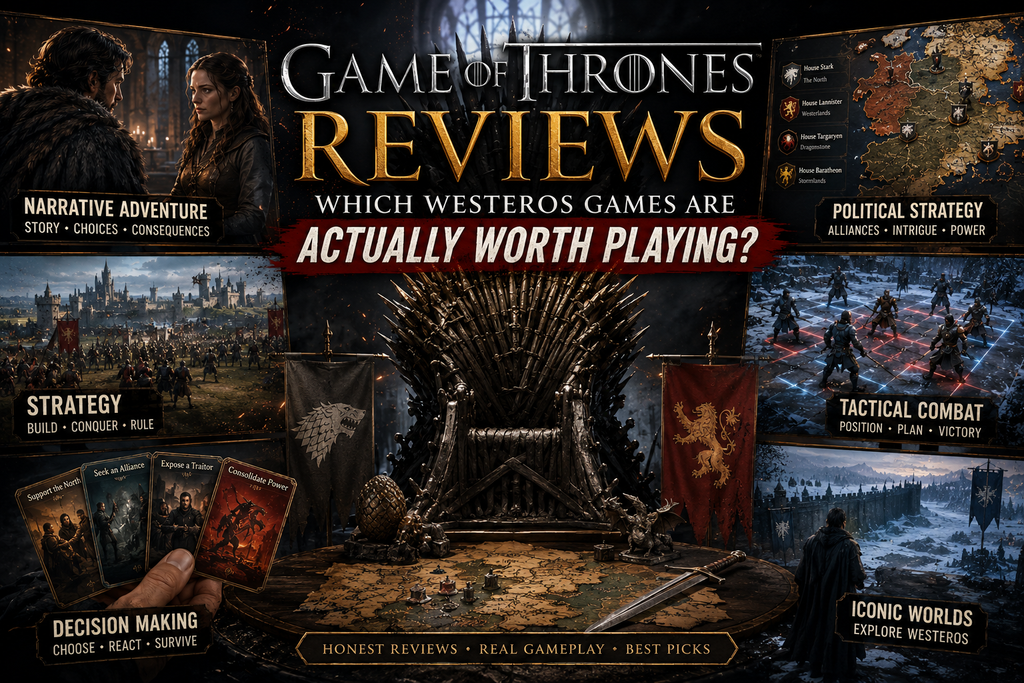
The Game of Thrones universe has inspired surprisingly different types of video games. Some focus on political decisions, others on real time strategy, mobile progression, card based choices, or tactical combat. That variety makes Game of Thrones reviews more complicated than simply asking which title has the best graphics or most recognizable characters.
The strongest adaptations understand that Westeros is fundamentally about difficult decisions, competing interests, fragile alliances, and consequences. The weaker ones take a familiar mobile or strategy formula and add the franchise’s names and locations.
That distinction matters in 2026. Some older games remain interesting precisely because their design fits the world unusually well, while others feel dated or difficult to recommend. Meanwhile, Game of Thrones: War for Westeros is now scheduled for early 2027, giving fans a new reason to look back at the franchise’s gaming history while waiting for a modern PC strategy experience.
Here is how the major Game of Thrones games stack up.
What Makes a Good Game of Thrones Game?
A successful Westeros adaptation needs more than recognizable characters.
The television series and George R. R. Martin’s books are built around competing motivations. Characters rarely have perfectly good or evil choices. Political decisions can create military problems, military victories can create political enemies, and personal loyalty can conflict with survival.
That gives game developers several strong directions to explore.
Political choices should matter
This is where Telltale’s Game of Thrones and Reigns: Game of Thrones have an advantage. Their mechanics are built around decisions rather than simply sending armies into battle.
A good Westeros game should make the player consider questions such as:
- Who can be trusted?
- Which alliance is worth maintaining?
- Is short term survival more important than reputation?
- What happens if a powerful character becomes an enemy?
- Should resources be spent on military strength or political influence?
These questions fit the setting naturally.
Strategy should involve more than upgrading numbers
Strategy games can also work extremely well with the franchise, but the political context needs to support the mechanics.
A Game of Thrones: Genesis attempted something interesting by making espionage, alliances, influence, and political manipulation important parts of its RTS design. Critics recognized the concept but criticized the execution, particularly its interface, campaign, and combat. GameSpot described its political mechanics as fascinating but found the campaign and battles disappointing.
That makes Genesis an interesting historical experiment rather than an easy recommendation for every strategy fan.
Game of Thrones: A Telltale Games Series
For players primarily interested in storytelling and difficult decisions, Telltale’s Game of Thrones remains one of the most interesting adaptations.
Released as a six episode adventure, the game introduces House Forrester and places its characters into the political chaos surrounding the television series. Rather than letting players simply control a famous hero throughout the campaign, Telltale uses several characters and locations to create a story that runs alongside established events.
That structure works because it gives the player a position that feels appropriately vulnerable.
You are not an unstoppable warrior who can solve every problem with a sword. You are frequently dealing with people who have greater political power, larger armies, or more information.
Why the storytelling works
The strongest part of the game is its decision making.
Telltale’s traditional dialogue choice format is well suited to Westeros because many decisions are intentionally uncomfortable. Saving one relationship can damage another. Supporting one faction can create consequences elsewhere.
The first episode establishes this tone particularly well. GameSpot’s review highlighted the tension surrounding choices that can affect both personal survival and the future of House Forrester.
The game also benefits from the presence of established characters from the television series. Their appearances give the story a direct connection to the show’s world.
Where it falls short
The biggest weakness is that Telltale’s adaptation does not always create an entirely independent identity.
PC Gamer praised its ability to capture the atmosphere of Martin’s universe but criticized its dependence on familiar themes.
There is also a major practical issue for anyone discovering the game today: availability.
The title was delisted from Steam following licensing issues, making it considerably less straightforward to obtain than many older PC games.
Verdict: One of the better Game of Thrones adaptations for narrative game fans, but its availability makes it difficult to recommend as the easiest starting point in 2026.
Reigns: Game of Thrones
Reigns: Game of Thrones takes a radically different approach.
Instead of building an army or controlling a large adventure game, you manage the problems of ruling Westeros through a sequence of binary decisions. Situations appear as cards, and you swipe left or right to make choices.
It sounds simple because it is simple.
The clever part is what happens underneath that simplicity.
A surprisingly good match for Westeros
The Reigns formula works because political survival is the actual game.
You constantly balance competing interests, and a decision that benefits one side can create problems elsewhere. The result is closer to managing a fragile kingdom than playing a traditional RPG.
That makes the game especially effective for short sessions.
You do not need a two hour uninterrupted gaming block. A few decisions can produce a complete little political story, making it particularly suitable for mobile and handheld play.
Nintendo Life gave the Switch version a positive reception, emphasizing how well the card swiping structure fits the franchise’s themes of betrayal, political maneuvering, and consequence.
The main weakness
Repetition eventually becomes the limiting factor.
GameSpot praised the concept but noted that repetition could cause the experience to stumble.
This is not the game to choose if you want cinematic combat, exploration, or a large scale RPG.
Verdict: One of the smartest Game of Thrones spin-offs because its mechanics naturally reflect political survival. It is particularly good for players who enjoy short, choice driven sessions.
A Game of Thrones: Genesis
A Game of Thrones: Genesis is one of the most ambitious adaptations conceptually, even though its execution is uneven.
Released for PC in 2011, it is a real time strategy game developed by Cyanide. Instead of focusing purely on battlefield combat, Genesis tries to reproduce the political manipulation that defines Westeros.
Players can use spies, envoys, assassins, nobles, alliances, rebellions, and other political tools.
That is a fascinating foundation.
The strategy systems are its biggest strength
Genesis understands something that many licensed strategy games miss: armies are only one way to win a political war.
Influence and deception can be just as important as military strength. That gives the game a distinctive identity within the RTS genre.
Game Informer’s contemporary review specifically praised the game’s deep representation of multi faction politics and intrigue while criticizing its interface and technical execution.
Why it is difficult to recommend broadly
The problem is that the interface and campaign can get in the way of the ideas.
PC Gamer found the larger levels prone to overwhelming micromanagement and criticized the campaign’s pacing and presentation.
GameSpot similarly concluded that its most interesting mechanics could not compensate for its weak campaign and combat.
So Genesis is best viewed as a cult curiosity for strategy fans, rather than a universally good introduction to Westeros gaming.
Verdict: Worth examining if you specifically enjoy unconventional RTS mechanics and political strategy. Casual players should probably start elsewhere.
Game of Thrones: Conquest
Game of Thrones: Conquest takes the franchise into mobile strategy.
The basic structure is familiar: build a stronghold, develop resources, create an army, expand influence, and interact with other players.
The problem is that the underlying formula feels much more familiar than the Westeros setting suggests.
Pocket Gamer criticized the game’s reliance on conventional mobile strategy mechanics, including building upgrades, timers, and simple battles.
The franchise connection is the strongest reason to play
For someone who enjoys persistent mobile strategy games and wants a Westeros theme, Conquest can still have appeal.
The problem is that the Game of Thrones identity does not fundamentally transform the gameplay.
You are still spending much of your time managing buildings, waiting for upgrades, developing an army, and working through the familiar progression structure of the genre.
That can make the game feel more like a standard mobile strategy title wearing a Westeros costume.
What to consider before playing
Mobile strategy games also deserve a different evaluation from premium single player games.
The question is not simply whether the combat is good. Players should consider:
- How much time the progression requires
- How the game handles waiting and upgrades
- How important spending becomes at higher levels
- Whether PvP is enjoyable without heavy investment
- How much actual interaction the licensed setting provides
Those considerations are more important than the presence of famous characters.
Verdict: Best suited to players who already enjoy mobile kingdom building games. It is not the strongest choice if you want a deep standalone Game of Thrones adventure.
Game of Thrones: Beyond the Wall
Game of Thrones: Beyond the Wall moves into tactical mobile RPG territory.
Its concept is immediately appealing: players command characters in grid based battles while developing a roster of heroes. The game uses turn based tactical positioning rather than traditional real time combat.
Tactical combat gives it some personality
The grid based system provides more direct gameplay interaction than Conquest.
Players can position characters, manage abilities, develop heroes, and work through different modes. That makes the game more recognizable as a conventional tactical RPG.
The problem is progression.
Pocket Tactics described the game as a standard gacha RPG, with many of the genre’s familiar issues surrounding character collection, upgrades, resource management, and monetization.
That means the tactical battles are not necessarily the reason a player stays.
The long term loop is heavily connected to collecting and improving characters.
Verdict: A reasonable choice for fans who already enjoy tactical gacha RPGs, but not the best pick for players who dislike that monetization and progression structure.
Game of Thrones: Tale of Crows
Tale of Crows takes a quieter approach.
Instead of recreating the political battles of King’s Landing or offering traditional RPG combat, it focuses on the Night’s Watch and uses an idle narrative structure.
That makes it an unusual entry in the franchise.
Critics found genuine charm in its exploration of one of the more interesting corners of the setting, although its storytelling was also criticized for being relatively shallow.
Who should try it?
This is better for players who enjoy:
- Short mobile sessions
- Passive progression
- Narrative events
- Night’s Watch lore
- Low pressure management
- Exploring lesser used parts of Westeros
It is not designed to compete with a traditional RPG or strategy game.
Verdict: A niche but interesting choice for fans who want a relaxed Westeros experience rather than complex combat.
Game of Thrones Reviews: Winter Is Coming
The browser based Game of Thrones: Winter Is Coming focuses on kingdom management and strategy.
Its premise is straightforward: develop your territory, manage resources, build forces, and compete for control within a Westeros themed environment.
The game combines kingdom building with real time strategy elements and uses locations and characters associated with the television series.
The appeal is persistent strategy
This type of game is less about finishing a campaign and more about maintaining a growing kingdom.
That makes it fundamentally different from Telltale’s adventure game.
If you enjoy long term resource management, alliances, and competitive progression, the format can be appealing.
If you want a tightly written narrative with meaningful character development, it is not the right place to start.
Verdict: A reasonable option for browser strategy fans, but its appeal depends heavily on whether you enjoy the underlying kingdom management genre.
Which Game of Thrones Game Is Best for You?
| Game | Best For | Biggest Strength | Main Weakness |
|---|---|---|---|
| Telltale’s Game of Thrones | Story fans | Difficult choices | Availability |
| Reigns: Game of Thrones | Casual/mobile players | Political decision making | Repetition |
| A Game of Thrones: Genesis | RTS enthusiasts | Intrigue mechanics | Interface and campaign |
| Game of Thrones: Conquest | Mobile strategy fans | Persistent kingdom building | Familiar gameplay |
| Beyond the Wall | Tactical RPG fans | Grid based combat | Gacha progression |
| Tale of Crows | Narrative/mobile players | Night’s Watch setting | Limited depth |
| Winter Is Coming | Browser strategy fans | Kingdom management | Genre repetition |
The best choice depends heavily on what you want from Westeros.
For storytelling, Telltale remains the obvious standout.
For political decision making in short sessions, Reigns: Game of Thrones is arguably the better designed fit.
For unusual strategy mechanics, Genesis is the most interesting experiment.
For mobile strategy, Conquest and Winter Is Coming offer the most conventional approaches, while Beyond the Wall is more appropriate for players specifically interested in tactical RPG progression.
What About Game of Thrones: War for Westeros?
This is the title worth watching if you want a modern PC strategy game based on the franchise.
Game of Thrones: War for Westeros is being developed by PlaySide and is now scheduled to launch in early 2027, not 2026. The official site describes it as a real time strategy game built around the Great Houses and the Night King, with solo play and multiplayer skirmishes.
The current design focuses on battlefield control, army movement, territory, and faction specific strategy.
The official material lists House Stark, House Lannister, House Targaryen, and the Night King as playable forces. The game is being developed for PC and is planned for Steam.
Why it could succeed where Genesis struggled
The comparison with Genesis is particularly interesting.
Genesis had a genuinely ambitious political strategy concept, but its interface and technical presentation made that concept difficult to appreciate.
War for Westeros has the opportunity to approach the problem from a modern RTS perspective.
The early material emphasizes readable battlefields, terrain positioning, army movement, and faction identity. A recent development update specifically described maps designed around lanes, defensible positions, flanking opportunities, and counterattacks.
But it would be premature to call it one of the best Game of Thrones games.
It has not released yet.
That means any review score or definitive judgment about its campaign, balance, performance, AI, multiplayer depth, or long term replayability would be speculation.
Current verdict: Promising for RTS and Westeros fans, but wait for the finished game before treating previews as a review.
Common Problems With Game of Thrones Games
Looking across these titles reveals a recurring issue.
The license is extremely strong, but that does not automatically produce strong gameplay.
Some games rely too heavily on the brand
Conquest demonstrates this problem particularly clearly. The core gameplay resembles other mobile kingdom building games, and the franchise elements do not fundamentally change that structure.
A strong adaptation should make the world part of the gameplay rather than simply the setting.
Others have excellent ideas but weak execution
Genesis is the clearest example.
Its focus on spies, influence, alliances, and political maneuvering sounds almost perfect for Westeros. The problem was the interface, pacing, campaign design, and combat.
That is an important lesson for licensed games: an original mechanic is valuable only if players can actually understand and enjoy it.
Narrative games face a different challenge
Telltale’s approach works because its mechanics naturally support political decisions.
But the game also depends heavily on familiarity with the television universe, and its licensing history makes it less accessible today.
The strongest future adaptation should ideally combine the accessibility of a modern game with the political complexity that makes Westeros interesting.
Are Game of Thrones Games Still Worth Playing in 2026?
Yes, but selectively.
If you want a single recommendation, Reigns: Game of Thrones is one of the easiest choices because its gameplay concept remains distinctive and its political decision-making fits the setting unusually well.
If you want a more traditional narrative experience and can legally access it, Telltale’s Game of Thrones is still worth considering for its choice-driven storytelling.
Strategy enthusiasts with patience may find Genesis interesting as a historical curiosity, particularly because its political mechanics were more ambitious than its final execution suggested.
Mobile players should approach Conquest and Beyond the Wall based on their tolerance for their respective progression systems rather than simply because they carry the Game of Thrones name.
And if your main interest is modern large scale strategy, War for Westeros is the one to watch, with its current release window set for early 2027.
FAQ
What is the best Game of Thrones game?
For most players interested in narrative and difficult choices, Telltale’s Game of Thrones is one of the strongest adaptations. For short form political strategy, Reigns: Game of Thrones is arguably the better fit.
Is Telltale’s Game of Thrones still available?
The game was delisted from major digital storefronts following licensing issues, so availability is considerably more limited than when the episodic series originally launched.
Is Reigns: Game of Thrones worth playing?
Yes, particularly if you enjoy decision based games. Its simple swipe based system works surprisingly well for representing the political pressure and competing interests of Westeros.
Is A Game of Thrones: Genesis a good strategy game?
It has interesting political and espionage mechanics, but its dated interface, campaign structure, and combat reduce its appeal. It is better suited to strategy enthusiasts interested in unusual older designs than newcomers.
Is Game of Thrones: Conquest worth playing?
It can appeal to players who already enjoy mobile kingdom building games, but its gameplay follows familiar mobile strategy conventions. It is not the strongest choice if you want a distinctive Westeros focused experience.
What is Game of Thrones: War for Westeros?
It is an upcoming real time strategy game for PC from PlaySide, focused on commanding major factions and fighting for control of Westeros. It is currently scheduled for early 2027.
Is War for Westeros coming in 2026?
No. Its planned release window was moved to early 2027.
Which Game of Thrones game is best for strategy fans?
War for Westeros is the most interesting upcoming option, while Genesis is the most unusual older strategy experiment. Neither should be judged by the same standards as a narrative game such as Telltale’s series.
Conclusion
The biggest lesson from these Game of Thrones reviews is that the franchise works best when a game’s mechanics reflect the world rather than simply decorating a familiar genre with Westeros names.
Telltale understood the importance of difficult choices. Reigns turned political survival into its core mechanic. Genesis attempted to make espionage and influence central to RTS strategy, even though its execution held the concept back.
Other games are more conventional, and that is not necessarily a problem if their underlying genre already appeals to you. The key is knowing what you are getting before you start.
For 2026, Reigns: Game of Thrones remains one of the easiest recommendations for fans wanting a compact political experience, while Telltale’s series is worth remembering as one of the franchise’s more ambitious narrative adaptations. Strategy fans should keep an eye on War for Westeros, but its early 2027 release means the final verdict still has to wait.
The best Westeros game is ultimately the one that understands why the setting works in the first place: power is rarely won by strength alone, and every decision has a price.
LEAVE A PIXEL ZINE COMMENT