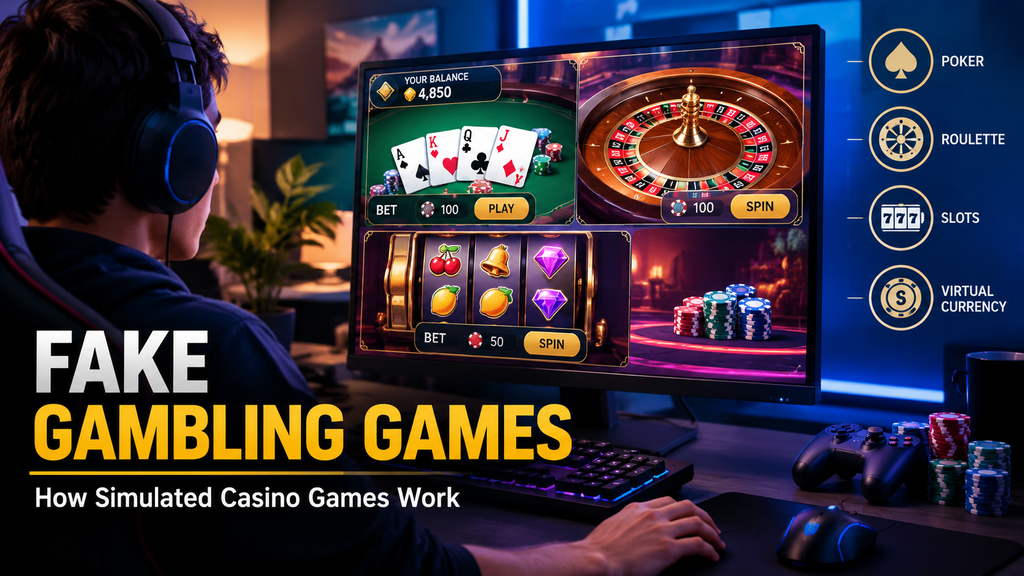
Fake Gambling Games are video games or game modes that imitate gambling without necessarily involving real money betting. They can reproduce familiar mechanics such as slot reels, poker hands, roulette wheels, card draws, dice rolls, betting systems, virtual chips, and random rewards, but the outcome may only affect a player’s progress inside the game.
That distinction matters.
A game can look and feel like a casino without functioning like a real money gambling service. Some titles use gambling as a small optional activity, while others build an entire experience around simulated casino mechanics. There are also games that use virtual currencies but connect those currencies to purchases, rewards, or other monetization systems, making the situation more complicated.
For players, the important question is not simply whether a game looks like gambling. It is what is being wagered, what can be won, whether anything has real world value, and how the game’s economy works.
This guide explains the different forms of simulated gambling, how these systems work, why developers use them, and what players should look for before spending money or time on them.
What Are Fake Gambling Games?
The phrase fake gambling games isn’t a formal industry classification. Players commonly use it to describe games that reproduce gambling style activities without functioning as conventional real money gambling.
For example, imagine a fictional RPG where your character visits an in game casino and plays poker using coins earned through quests. You cannot withdraw those coins, trade them for money, or convert them into something with real world monetary value.
That is fundamentally different from placing real money on a poker hand through an online gambling service.
The visual experience can still be remarkably similar. The game may include:
- Virtual poker tables
- Slot style reels
- Roulette wheels
- Dice games
- Blackjack style card games
- Virtual casino chips
- Randomized prizes
- Betting interfaces
- Risk-and-reward systems
- Character gambling minigames
The word fake therefore refers primarily to the simulated nature of the activity rather than whether the game is poorly designed or unconvincing.
A well designed casino simulation can accurately reproduce the atmosphere and mechanics of gambling while remaining entirely contained within a fictional game economy.
How Fake Gambling Games Simulate Gambling
Casino games are built around simple actions that create uncertainty.
A player makes a decision, commits some type of resource, receives an uncertain result, and then either gains or loses something. Video games can reproduce that basic loop very easily.
A fictional slot machine, for example, might work like this:
Virtual credits → wager → random outcome → reward or loss → updated balance
The player doesn’t necessarily need real money for the loop to work.
Developers can substitute experience points, fictional currency, tokens, collectibles, or other game resources. The underlying presentation remains recognizable because the player understands the basic risk and reward structure.
Common casino style mechanics
Several mechanics appear repeatedly in simulated gambling experiences.
Random outcomes:
The result is determined by a randomized system rather than direct player control.
Virtual currency:
Players use fictional credits, tokens, chips, or another in game resource.
Wagering:
The player commits some resource before seeing the result.
Variable rewards:
Different outcomes produce different rewards.
Risk and reward:
Players may have the option to pursue a potentially larger reward at the possibility of receiving little or nothing.
Visual feedback:
Animations, sounds, counters, lights, and celebratory effects communicate the result.
These mechanics are not exclusive to gambling. Randomness and variable rewards are common throughout video games. Loot systems, card games, randomized encounters, and procedural mechanics can all use similar principles without being gambling games.
The important distinction is the overall structure and whether something of meaningful value is being risked or won.
Different Types of Fake Gambling Games
Not every simulated gambling experience works the same way. Understanding the categories makes it easier to evaluate what a particular game is actually doing.
Pure Gambling Simulations
The most straightforward category is the dedicated simulation.
The game may recreate roulette, poker, blackjack, slots, or other casino activities, but everything happens inside a fictional environment.
The player might start with a fixed amount of virtual currency and use it to experiment with different games. There may be no connection between the virtual balance and the player’s bank account.
The appeal here is often simulation rather than financial risk.
Players may enjoy learning the rules of a card game, exploring probability concepts, competing against computer controlled opponents, or simply experiencing a casino themed setting.
Fictional In Game Gambling
Gambling can also appear as a small component of a much larger video game.
An open world game might contain a casino district. An RPG might feature card tables. A story driven game could use a poker match as part of a mission.
In these situations, gambling is not necessarily the game’s primary purpose.
The rewards might affect character progression, unlock cosmetic items, provide additional dialogue, or simply offer an optional diversion.
This approach has been used in different forms across video game genres because gambling can create a simple risk and reward minigame without requiring the developer to build an entirely separate game.
Social Casino Style Games
Another category sits closer to entertainment focused casino simulations.
These games may offer virtual credits, social competition, leaderboards, progression systems, or cosmetic rewards. Some can be played without depositing money, while others may have monetization systems surrounding their virtual economies.
This is where players need to read the game’s terms and monetization details carefully.
A game advertising itself as free does not automatically mean that every part of its economy is completely disconnected from purchases.
The important questions are:
- Can virtual currency be purchased?
- Can it be exchanged for anything outside the game?
- Can rewards be sold or transferred?
- Is real money required to continue?
- Are purchases optional or tied closely to progression?
- Are there age restrictions or regional limitations?
Those details can substantially change how the experience should be understood.
Fake Gambling Games vs. Real Money Gambling
The most important difference is what happens to the player’s money or valuable assets.
In a conventional simulated gambling game, the player may risk virtual resources that have no direct cash value.
Real money gambling involves actual financial stakes.
A simplified comparison looks like this:
| Feature | Simulated Gambling | Real Money Gambling |
|---|---|---|
| Main currency | Usually virtual | Real currency |
| Financial stake | Usually none | Yes |
| Cash withdrawal | Typically unavailable | May be available where legal |
| Primary purpose | Entertainment/simulation | Wagering for financial outcomes |
| Game economy | Controlled by developer | Connected to monetary transactions |
| Financial loss | Usually limited to in game resources | Can involve actual money |
However, the boundary isn’t always obvious.
A game can use virtual currency while still having monetization around that currency. That does not automatically make it a real money gambling platform, but it means players should examine how the system operates instead of relying on the game’s appearance.
A slot machine animation by itself does not tell you whether you’re playing a harmless minigame, a social casino experience, or a gambling service.
The economy behind the mechanic matters.
Why Video Games Use Gambling Style Mechanics
Developers have several reasons for incorporating gambling style systems.
One is simply thematic.
A game set in a casino, criminal underworld, futuristic city, or fantasy tavern may naturally include gambling activities because they fit the setting.
Another reason is gameplay variety.
A poker minigame can give players something different to do between missions. A card based activity can break up combat heavy gameplay. A dice game can provide an optional challenge that doesn’t require an entirely new progression system.
Randomized mechanics can also create tension.
Suppose a character has 100 fictional credits and must decide whether to risk 20 credits for a potentially larger reward. The decision introduces uncertainty into the gameplay loop.
That can be interesting even when no real money is involved.
The key is whether the mechanic complements the game or becomes an aggressive system designed primarily to encourage repeated spending.
What Makes a Simulated Gambling Game Feel Convincing?
Good simulation isn’t necessarily about copying a real casino perfectly.
Instead, developers can create authenticity through several layers.
Presentation is one.
Tables, cards, chips, reels, sounds, lighting, animations, and interface design can immediately communicate the setting.
Rules are another.
A poker simulation feels more credible if its card rules and betting structure behave consistently.
Feedback matters too.
Players need to understand what they wagered, what happened, and what they received afterward.
Probability is particularly important.
If a game claims to simulate a particular gambling activity, its underlying mechanics should make sense within the rules being represented. Otherwise, it may be more appropriate to describe the experience as a gambling themed minigame rather than a serious simulation.
For players, transparency is more valuable than flashy presentation.
A clear interface should tell you what resources you’re using and what an outcome actually means.
Benefits and Drawbacks for Players
Simulated gambling isn’t automatically good or bad. Its value depends heavily on how it is implemented.
Potential Benefits
A well designed simulation can introduce players to basic game rules.
For example, someone unfamiliar with poker might use a fictional game to understand hand rankings and turn structure without putting actual money at risk.
These games can also provide optional entertainment.
A casino minigame inside a larger RPG may be an enjoyable break from the main campaign.
There can also be educational value when probability, decision making, and resource management are clearly presented.
Potential Drawbacks
The biggest concern is that simulated gambling can reproduce many of the psychological elements associated with gambling.
Repeated wagers, random outcomes, near misses, variable rewards, and celebratory effects can encourage players to keep playing.
Monetization can make the issue more complicated.
If a game sells virtual currency and encourages players to spend repeatedly on randomized outcomes, players should pay attention to what they are purchasing and whether the system is designed to encourage additional spending.
This is especially relevant for younger players and anyone who wants to keep gaming expenses predictable.
A good rule is simple: understand the economy before spending money on it.
How to Tell What Kind of Gambling Mechanics a Game Uses
You don’t need to be an expert in gambling regulation to investigate a game.
Start by looking at the game’s economy.
Ask what happens when you win.
If you receive experience points, fictional coins, or an item that exists only inside the game, the reward may have no direct financial value.
Then ask what happens when you lose.
If the only consequence is losing fictional currency, that is very different from losing money from a bank account or payment method.
Next, examine purchasing.
If the game allows players to purchase virtual currency, find out exactly what that currency can do.
Also check whether rewards can be:
- Withdrawn
- Sold
- Traded
- Converted
- Transferred
- Redeemed outside the game
The answer can tell you much more than the game’s casino themed graphics.
Finally, check the platform and regional rules.
Game stores and publishers may apply different requirements depending on the type of content and the country where the player lives.
Smart Ways to Approach Casino Style Games
If you’re interested in gambling themed games but don’t want to deal with real money wagering, simulated experiences can be a straightforward alternative.
Look for games where the economy is clearly fictional and where you can play without financial deposits.
Before making purchases, read the game’s currency and monetization information.
You should also understand whether randomized mechanics are optional or central to progression.
A useful checklist is:
1. Identify the currency.
Know whether you’re using fictional credits, purchased currency, or something else.
2. Check the value of rewards.
Determine whether anything earned can leave the game’s ecosystem.
3. Understand purchases.
Find out whether real money can be used to obtain virtual currency or randomized rewards.
4. Set a spending limit.
If purchases are available, decide what you’re comfortable spending before playing.
5. Don’t confuse simulation with financial opportunity.
A game that looks like a casino isn’t automatically a way to make money.
6. Check age and regional restrictions.
Requirements can vary by game and location.
These steps are particularly useful when a game combines traditional video game progression with casino style mechanics.
Why Fake Doesn’t Always Mean Risk Free
The phrase fake gambling can create a misleading impression.
A game can use fictional currency while still employing gambling like reward structures. The absence of cash prizes doesn’t necessarily mean the experience has no psychological similarities to gambling.
For example, repeated random rewards can create a strong incentive to keep trying.
The same applies when players spend real money to acquire virtual resources used in randomized systems.
That doesn’t automatically mean the game is legally classified as gambling. Legal definitions vary by jurisdiction and depend on factors such as consideration, chance, prizes, and how the system operates.
From a player’s perspective, though, the practical question is simpler:
Do I understand what I’m spending, what I’m risking, and what I can actually receive?
If the answer is yes, you’re in a much better position to make an informed decision.
The Difference Between Gambling Mechanics and Random Game Design
This distinction is worth making because not every random mechanic should be labeled gambling.
A traditional loot system might give a player a random weapon after defeating an enemy. A card pack might contain randomized cards. A procedural game might generate a different map every time.
Randomness alone doesn’t turn a mechanic into gambling.
Gambling style design usually involves a more recognizable combination of:
- A stake or resource commitment
- An uncertain outcome
- Variable rewards
- Risk and reward
- Repeated attempts
Even then, context matters.
A game can use one or two of these characteristics without becoming a gambling simulation.
This is why describing the actual mechanic is more useful than applying a broad label to every game containing randomness.
Are Fake Gambling Games Worth Playing?
For players who enjoy casino themes, probability based games, card mechanics, or virtual economies, simulated gambling games can absolutely provide entertainment without requiring real money wagers.
Their value depends on implementation.
A good game should clearly explain its rules, communicate outcomes, and avoid making the player guess what is happening to their resources.
For someone primarily interested in learning casino game rules, a straightforward simulation may be useful.
For someone looking for strategic gameplay, poker or blackjack simulations can offer more meaningful decision making than systems based almost entirely on random results.
For someone simply looking for a casino atmosphere, a fictional casino minigame inside a larger adventure may be enough.
The important thing is choosing the experience for what it actually offers rather than assuming casino style presentation means there is a financial opportunity.
What Players Should Watch for in 2026
The broader gaming market continues to blur the boundaries between traditional gameplay systems and sophisticated virtual economies.
That makes transparency increasingly important.
Players should pay attention to how virtual currencies work, how randomized rewards are presented, and whether purchases are clearly explained.
For PC and console players, platform storefront information can provide useful context. Mobile games deserve particular attention because free to download models frequently rely on optional purchases.
None of this means every game with a randomized reward system is problematic.
It simply means players should understand the mechanics before spending money.
A game can be perfectly enjoyable when treated as entertainment. Problems begin when players misunderstand the value of virtual items or assume that game like rewards have financial significance when they do not.
Final Thoughts
Fake Gambling Games are best understood as games that reproduce gambling style experiences without necessarily involving real money wagering. They can range from simple poker or roulette simulations to casino minigames inside larger RPGs and open-world titles.
The visual similarities to real casinos can be strong, but appearance isn’t enough to determine what type of experience you’re playing.
The real questions are whether real money is being risked, whether rewards have external value, how virtual currency works, and whether purchases are connected to randomized outcomes.
For players, that distinction is useful. A fictional casino can simply be another game mechanic, while a system involving real financial stakes belongs to a very different category.
If you enjoy the strategy, randomness, atmosphere, or resource management associated with casino games, simulated experiences can offer those elements without requiring you to treat gaming as a financial activity. The smartest approach is to understand the game’s economy, know what you’re actually risking, and treat virtual rewards as part of the game—not as a substitute for real world income.
FAQ
What are fake gambling games?
Fake gambling games are video games or simulations that imitate gambling activities such as poker, roulette, blackjack, slots, or dice without necessarily involving real money wagering.
Are fake gambling games real gambling?
Not necessarily. A game using fictional currency and rewards that cannot be converted into real world value can function as a gambling simulation rather than a real-money gambling service. The exact classification can depend on how the game operates and local laws.
Can fake gambling games use real money?
Some games may allow players to purchase virtual currency or other digital items. That does not automatically make the game a real money gambling service, but players should examine how purchases, rewards, and randomized outcomes are connected.
Are casino minigames in video games considered fake gambling games?
They can be. If a larger video game includes a fictional casino or poker minigame using only in game resources, it can reasonably be described as simulated or fictional gambling.
What is the difference between fake casino games and real money casino games?
The central difference is the financial stake. Fake or simulated casino games generally use fictional resources, while real money casino games involve actual financial transactions and potentially monetary losses or winnings.
Are all random reward video games gambling games?
No. Randomness is common throughout gaming. Loot systems, procedural generation, card draws, and randomized encounters can use chance without necessarily functioning as gambling.
Can fake gambling games be educational?
Yes. Simulations can help players understand rules, probability concepts, card rankings, and risk reward decisions without requiring them to wager real money.
What should I check before playing a gambling style game?
Check what currency the game uses, whether purchases are available, what rewards are worth, whether anything can be withdrawn or traded externally, and whether the game has age or regional restrictions.
LEAVE A PIXEL ZINE COMMENT