Escape rooms have become one of the most popular forms of social puzzle entertainment, but visiting a physical venue is not always practical. Time, location, group size, cost, and scheduling can all get in the way. That is where escape room board games at home offer a compelling alternative.
These games bring many of the core ideas behind a physical escape room to your table: hidden information, interconnected puzzles, codes, objects, clues, time pressure, and cooperative problem-solving. The experience is different from simply playing a traditional board game. Instead of competing for points or controlling territory, players are usually trying to understand a scenario, solve a chain of puzzles, and reach an objective before the game ends.
The category has also grown well beyond a single style of game. Some escape room games use decks of cards and paper puzzles. Others include physical components, decoder devices, apps, maps, booklets, or reusable puzzle systems. Some are designed for families and beginners, while others can challenge experienced puzzle enthusiasts for an evening.
This guide explains what escape room board games are, how they work, how to choose the right one for your group, and how to create a better escape room experience at home.
Search Intent: What Are People Looking for?
The dominant search intent behind escape room board games at home is mixed, with a strong informational and commercial element.
Most searchers want answers to practical questions before choosing or playing a game. Common needs include:
- What is an escape room board game?
- How does an at-home escape game work?
- Which games are best for beginners, families, adults, or experienced players?
- How many people can play?
- How long does a game take?
- Are the games reusable?
- Can an escape room experience work well at home?
A useful answer therefore needs to explain the category while also helping readers understand which type of game fits their group and expectations.
What Are Escape Room Board Games?
Escape room board games are tabletop puzzle experiences designed to recreate the problem-solving structure of an escape room.
Players are typically given a scenario and an objective. They might need to escape from a locked location, solve a mystery, prevent a disaster, uncover a secret, or complete a mission. Progress depends on examining clues and solving puzzles rather than rolling dice or defeating opponents.
A typical game may involve:
- Finding hidden information
- Matching symbols, numbers, or patterns
- Solving riddles and logic puzzles
- Combining multiple clues
- Decoding messages
- Unlocking new cards or sections
- Using physical objects as part of the puzzle
- Managing a timer or limited number of attempts
The central appeal is cooperation. Players often have different observations and ideas, so discussing clues becomes part of the game itself.
How They Differ From Traditional Board Games
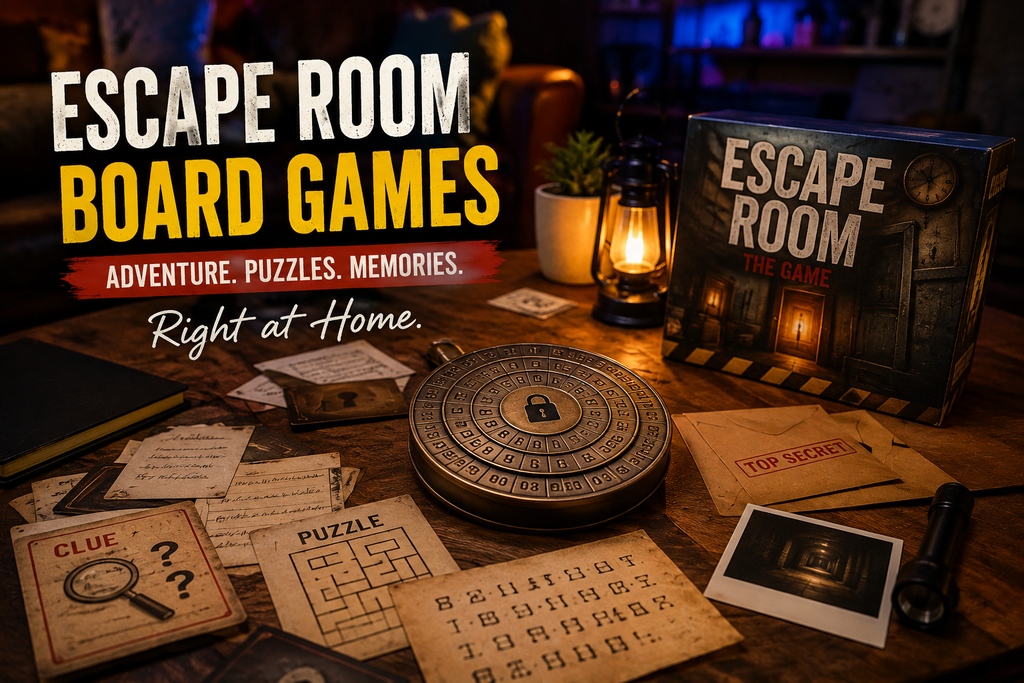
Traditional board games usually have a repeatable ruleset and a clear competitive or strategic structure. You might build an engine, control areas, collect resources, or score more points than the other players.
Escape room games place more emphasis on discovery.
At the beginning, players may not understand how the puzzle system works. A strange image, a locked deck of cards, or an apparently unimportant object can become meaningful later. The game gradually reveals information as players solve problems.
This makes the experience closer to a puzzle adventure than a conventional board game.
The Basic Gameplay Loop
Most at-home escape games follow a similar pattern:
- Read or listen to the opening scenario.
- Examine the clues and components available to the group.
- Identify relationships between the clues.
- Solve a puzzle or determine a code.
- Check the answer using the game’s system.
- Unlock new information.
- Continue until the final objective is completed or the game ends.
The best games make these steps feel connected to the story rather than like a random collection of worksheets.
Why Escape Room Board Games Work So Well at Home
The biggest advantage is flexibility. A physical escape room requires a booking, travel, and a fixed time slot. A tabletop version can usually be played whenever your group is ready.
For players in the USA and around the world, that makes the format particularly useful for game nights, family gatherings, holidays, parties, and smaller social events.
They Encourage Genuine Cooperation
A strong escape game gives every player a reason to participate.
One person may notice a visual pattern. Another may understand a word puzzle. Someone else may be better at organizing information or remembering details from an earlier clue.
This is why escape room games often work well for mixed groups. Success does not depend entirely on having one experienced board gamer at the table.
They Create a Shared Goal
Competitive games can be excellent, but they can also leave some players behind. In a cooperative escape experience, everyone is generally working toward the same outcome.
That creates a different type of conversation. Instead of asking who is winning, players ask:
“Why does this number appear here?”
“Have we used this clue yet?”
“Could these symbols be part of the same code?”
Those small moments of collective discovery are a major part of the appeal.
They Can Fit Different Budgets and Schedules
An at-home game can provide an extended group activity without requiring everyone to travel to a dedicated venue.
The value depends partly on whether the game is reusable. Some products are designed as one-time puzzle adventures because cards are written on, folded, torn, or permanently altered. Others are built for repeated play or can be reset after completion.
Checking this before buying is important, especially if you plan to share the game with friends or replay it later.
The Main Types of Escape Room Board Games
Not every game marketed as an escape experience works in the same way. Understanding the main formats makes choosing one much easier.
Card-Based Escape Games
Card-based games are often the easiest format to set up. Players draw, reveal, or unlock cards as they solve puzzles.
The cards may represent rooms, objects, clues, characters, or pieces of information. A good card-based design controls the flow of information so players do not accidentally see later solutions.
These games are often portable and convenient for smaller tables.
They are a good option if you want a focused puzzle experience without a large number of components.
Physical Puzzle and Object-Based Games
Some games include items that players physically manipulate. A component may need to be folded, arranged, rotated, assembled, or examined from an unusual perspective.
This format can feel closer to the tactile experience of a physical escape room.
The trade-off is that some of these games are designed for a single playthrough. If solving the puzzle requires marking or altering components, resetting the game may not be possible.
App-Assisted Escape Games
An app can handle timers, hints, answer checking, audio, and story progression.
This approach can reduce the risk of accidentally seeing a solution in a printed answer booklet. It can also create a more atmospheric experience through sound effects or narration.
Some players enjoy the extra immersion, while others prefer a completely screen-free tabletop experience. Neither approach is automatically better; it depends on what your group wants from the session.
Mystery and Investigation Games
Some escape-style games focus less on escaping from a room and more on solving a case.
Players may examine evidence, compare witness statements, study documents, or uncover a sequence of events. These games can overlap with detective and mystery board games, but puzzle-solving remains central to the experience.
They are especially appealing to groups that enjoy stories and deduction alongside codes and logic challenges.
Reusable Escape Game Systems
A reusable system is designed so that players can reset the game after finishing.
This can be useful for households, game groups, libraries, or anyone who wants to pass the game to another group. Reusability can also make a game feel less like a one-night purchase.
Still, replay value should be considered carefully. Even if the physical game can be reset, players who remember every solution will not experience the same challenge again.
How to Choose the Right Escape Room Game for Your Group
The best game is not necessarily the most difficult or the most elaborate. It is the one that matches the players around the table.
Consider the Group Size
Check the recommended player count, but do not treat it as the only factor.
A game designed for one to six players may technically support six, yet a puzzle-heavy experience can become crowded if too many people are trying to examine the same clue.
For smaller groups, two to four players often allows everyone to stay closely involved. Larger groups can work well when the game offers multiple puzzles or pieces of information that can be explored at the same time.
If you have a large gathering, consider dividing players into teams and giving each group its own copy of the game.
Match the Difficulty to the Players
Difficulty is one of the most important factors.
A beginner-friendly game should teach players how its puzzle language works. The challenge can still be satisfying, but the logic should feel understandable once the answer is revealed.
A harder game may expect players to make larger conceptual leaps, notice subtle details, or combine several clues before reaching a solution.
For a mixed group, choosing a moderate difficulty level is usually safer than selecting the hardest game available.
Check the Theme
Theme matters because it helps maintain interest between puzzles.
Popular settings include:
- Haunted houses
- Prison breaks
- Detective mysteries
- Space missions
- Ancient ruins
- Secret laboratories
- Historical adventures
- Crime investigations
A strong theme gives the puzzles context. A code hidden in a spaceship’s navigation system feels more natural than a random sequence of numbers with no connection to the story.
Decide How Much Story You Want
Some groups want a puzzle-first experience. Others want characters, plot twists, and a detailed narrative.
If your players enjoy role-playing games, mystery fiction, or story-driven video games, a narrative-heavy escape game may be more engaging. If the group mainly enjoys solving problems, a streamlined puzzle-focused game may be the better choice.
Look at the Expected Play Time
Most escape room board games are designed as a contained experience rather than an all-day strategy game.
The advertised play time should be treated as an estimate. Groups may finish much faster or slower depending on puzzle experience, communication, and how frequently hints are used.
Avoid planning an important event around the assumption that the game will end at an exact minute.
How to Set Up a Better Escape Room Experience at Home
The game itself matters, but the environment can significantly improve the experience.
Give the Game Enough Table Space
Escape games can become visually busy. Cards, notes, objects, maps, and puzzle pieces may all be relevant at once.
Before starting, clear enough space for players to keep clues visible. A crowded table makes it easier to lose information or accidentally cover an important detail.
Keeping solved and unsolved materials in separate areas can also help.
Use a Shared Note System
Writing things down is often useful.
A shared sheet of paper or small whiteboard can help players track:
- Numbers that may be codes
- Names and relationships
- Symbols
- Possible patterns
- Failed theories
- Clues that have not been used yet
The key is not to over-organize everything immediately. Some clues only become meaningful later, so leave room for ideas that do not yet fit anywhere.
Set the Right Atmosphere
You do not need elaborate decorations to make the game more immersive.
Simple changes can help:
- Reduce distractions
- Put phones aside unless the game requires an app
- Use appropriate background music at a low volume
- Prepare snacks and drinks before starting
- Let everyone know roughly how long the session may last
The goal is to support concentration rather than turn your home into a professional escape room venue.
Agree on Hint Rules Before Playing
Hints can dramatically change the experience.
Some groups want to solve everything independently. Others would rather keep the game moving than spend 30 minutes stuck on one puzzle.
A practical approach is to agree on a simple rule before beginning. For example, the group might discuss a puzzle for a reasonable amount of time before taking the first hint.
Using a hint is not the same as failing. In many well-designed games, hints exist to protect the pacing of the experience.
Practical Puzzle-Solving Strategies
Escape games reward observation, but good organization can prevent unnecessary frustration.
Examine Everything Before Assuming It Is Decorative
Look carefully at text, numbers, symbols, images, component shapes, and repeated details.
At the same time, do not assume every tiny mark is a hidden clue. Good puzzle design should provide enough information for players to make logical connections.
A useful question is: “What information here is unusual enough to be intentional?”
Say Your Thoughts Out Loud
Silent problem-solving can cause a group to miss connections.
If you notice something that seems irrelevant, mention it. Another player may immediately connect it to a clue they have been studying.
This is especially important when players split up to examine different parts of the game.
Do Not Force a Solution
A common mistake is finding one possible interpretation and then trying to make every clue fit it.
If a theory requires ignoring several details or inventing extra rules, step back.
Strong puzzle solutions usually explain why the relevant clues were presented in the first place.
Keep Track of Unused Clues
If the game gives you a piece of information that has not yet been explained, do not discard it mentally.
Create a small “unused” area on the table. Many escape games deliberately introduce clues before players understand their purpose.
Avoid Brute-Forcing Answer Systems
If the game uses a code checker or app, resist the temptation to enter random combinations until something works.
That may technically move the game forward, but it removes the reasoning that makes the experience satisfying.
If you are genuinely stuck, a hint is usually more rewarding than guessing every possible answer.
Common Mistakes That Can Hurt the Experience
A few avoidable mistakes can turn a good game night into a frustrating one.
Reading Components Too Far Ahead
Escape games depend on controlled information.
Opening sealed material or reading cards that have not yet been unlocked can spoil later puzzles. Before starting, make sure everyone understands how the game handles new information.
Letting One Player Control Every Puzzle
An experienced puzzle solver may naturally take the lead, but a cooperative game becomes less enjoyable if one person solves everything while everyone else watches.
Give different players opportunities to examine clues and explain theories.
Choosing a Game That Is Too Difficult
Difficulty can be appealing, but an extremely challenging game is not always better.
For a family event or casual game night, a moderately difficult game with good pacing may create a more enjoyable experience than a punishing puzzle marathon.
Ignoring the Game’s Theme and Rules
Players sometimes bring expectations from other escape games and assume the same conventions apply.
Take a few minutes to understand the specific system. One game may require physical manipulation, while another may rely entirely on deduction and card combinations.
Are Escape Room Board Games Good for Families?
Yes, provided the game matches the age range and reading ability of the players.
Family-friendly escape games can encourage communication, pattern recognition, reading comprehension, and collaborative thinking. Younger players may notice visual clues that adults overlook, while older players can help connect more complex information.
Check the recommended age and theme before choosing. Some games include mature subjects, complicated narratives, or puzzle concepts that may not be suitable for younger children.
A cooperative format can be particularly useful for families because the goal is shared rather than competitive.
Are Escape Room Games Better Than Physical Escape Rooms?
They are not necessarily better; they offer a different experience.
A physical escape room can provide larger environments, live interaction, physical exploration, and theatrical elements that are difficult to reproduce on a tabletop.
Escape room board games at home offer different strengths:
- Greater scheduling flexibility
- No travel requirement
- Easier access for smaller groups
- A more relaxed environment
- The ability to pause in some games
- A wide range of themes and puzzle formats
For many players, tabletop escape games work best as a complement to physical escape rooms rather than a replacement.
FAQs
Are escape room board games reusable?
It depends on the game. Some are designed for a single playthrough because players write on, tear, fold, or permanently alter components. Others can be reset and played by another group. Always check the product description and rules before buying if reusability matters to you.
How many people can play an escape room board game at home?
Many games work well with two to four players, although the supported player count varies by title. Larger groups may become crowded around a single puzzle, so consider splitting into teams if you have many participants.
How long do escape room board games usually take?
Many are designed to be completed in one game session, often around one to two hours, though the actual time depends on puzzle difficulty, group experience, hint usage, and setup.
Can beginners enjoy escape room board games?
Yes. Beginners should look for games with clear instructions, accessible puzzle logic, and a useful hint system. Starting with a moderate difficulty level is usually better than choosing the hardest game available.
Do you need an app to play an at-home escape room game?
No. Some games are completely physical and require no digital device. Others use an app for timers, hints, answer checking, or story elements. Check the game’s requirements before starting.
What should you do if your group gets stuck?
Review the clues, confirm that nothing has been overlooked, and discuss different interpretations. If progress has completely stopped, use a hint rather than randomly guessing answers. A good hint system should guide the group without immediately revealing the entire solution.
Final Thoughts
The appeal of escape room board games at home comes from how effectively they turn a simple game night into a shared problem-solving experience. The strongest games combine logical puzzles with clear progression, useful clues, and a theme that gives players a reason to care about the next solution.
Choosing the right difficulty, group size, and format matters more than chasing the most complicated game available. A well-matched escape game gives every player a chance to contribute, keeps the group talking, and provides satisfying moments when scattered clues finally come together.
Clear the table, keep the clues organized, agree on how you will handle hints, and choose a game that suits the people playing it. With the right setup, an at-home escape room can deliver the tension, discovery, and teamwork that make the genre so enjoyable.
LEAVE A PIXEL ZINE COMMENT