Search Intent: Informational with Commercial Consideration
The dominant search intent behind board games on mobile is primarily informational. Most readers want to understand how digital board games work on smartphones and tablets, whether they provide an experience comparable to physical tabletop games, and which types of games work best on a touchscreen.
There is also a secondary commercial element because some readers are comparing apps before deciding which games to download or buy. The most useful approach is therefore to explain the strengths and weaknesses of mobile board gaming, discuss the major types of experiences available, and provide practical advice for choosing the right game.
Why Board Games on Mobile Have Become So Popular
Board games have always depended on a simple formula: understandable rules, meaningful decisions, and interaction between players. Moving that experience to a phone changes the presentation, but it does not automatically change the core appeal.
The biggest advantage of board games on mobile is convenience. A physical game usually requires a table, components, setup time, and other players who are available at the same time. A mobile version can handle much of that work automatically. Rules can be enforced by the app, pieces can move with a tap, scoring can be calculated instantly, and online opponents can be found without organizing a game night.
That convenience is especially useful for strategy games with complicated setup or bookkeeping. A digital version can remove repetitive administrative work while leaving the important decisions to the player.
Mobile devices have also made asynchronous multiplayer more practical. Instead of requiring everyone to sit down for a two-hour session, players can take turns when they have time. This works particularly well for slower strategy games, where a single turn may involve careful planning rather than constant real-time action.
For players in the United States, mobile board games can also be a practical alternative when friends or family members live in different cities. The same benefit applies globally, where time zones and distance can make traditional tabletop sessions difficult to arrange.
What Exactly Are Mobile Board Games?
A mobile board game is a game designed for or adapted to smartphones and tablets that uses board-game-style mechanics. The category is broader than simply taking a physical board game and placing it on a screen.
Some apps are official digital adaptations of established tabletop games. Others are designed specifically for mobile devices but use familiar mechanics such as:
- Tile placement
- Card drafting
- Worker placement
- Dice rolling
- Area control
- Resource management
- Turn-based strategy
- Deck building
- Trading and negotiation
The quality of the experience depends heavily on how well the interface supports those mechanics. A complex strategy game can work extremely well on a tablet, where players have more room to view the board and manage information. The same game may feel cramped on a smaller phone screen if menus and icons take up too much space.
A good mobile adaptation does more than reproduce a physical board. It uses digital tools to make the game easier to understand and play without removing the strategic choices that made the original interesting.
How Digital Board Games Compare With Physical Board Games
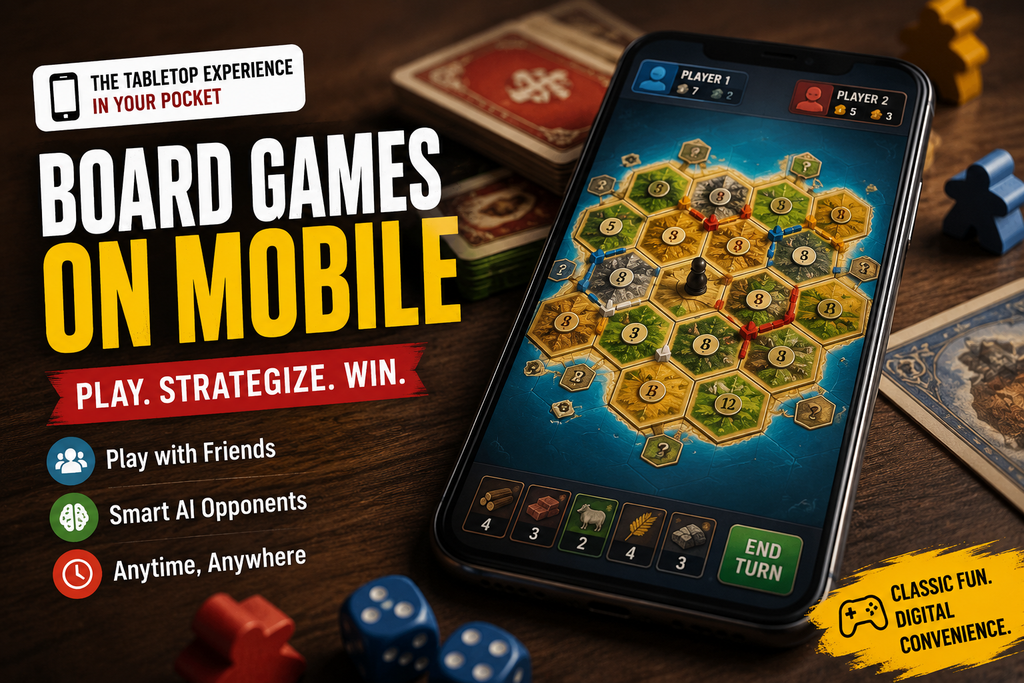
The answer to whether mobile games are as good as tabletop games depends on what a player values most.
Digital versions are often better for convenience, solo play, learning rules, and finding opponents. Physical games remain stronger when the social atmosphere and tactile experience are the main reasons for playing.
Where Mobile Versions Have an Advantage
One of the clearest advantages is automation.
Physical board games often require players to remember rules, calculate scores, shuffle decks, distribute resources, and manage multiple phases. A well-designed app can handle these tasks automatically.
This can make complicated games more approachable. Players can spend more time thinking about strategy and less time checking whether a particular action follows the rules correctly.
Tutorials can also be more interactive. Instead of reading a long rulebook before the first game, players may learn mechanics step by step while playing.
Another major benefit is artificial intelligence. A physical game requires human opponents, but a digital board game can provide AI competitors for solo practice. The quality of AI varies from game to game, but it gives players an option when friends are unavailable.
Online multiplayer is another important strength. Many board games work naturally as turn-based experiences, making them suitable for both live and asynchronous play.
What Mobile Games Cannot Fully Replace
The physical side of tabletop gaming is difficult to reproduce.
Handling cards, rolling dice, moving pieces, and gathering around a table create a different type of experience. For many groups, conversation and shared reactions are as important as winning.
A mobile version can also create a more individual experience. Players may be looking at separate screens rather than one shared game space. This can reduce some of the social energy found in a traditional board game session.
Screen size is another limitation. A game with a large board, detailed cards, and several layers of information may feel comfortable on a tablet but awkward on a phone.
The best way to think about the two formats is not that one replaces the other. They serve different situations. Mobile games are excellent when convenience, automation, solo play, or remote multiplayer matters. Physical games remain difficult to beat for face-to-face social sessions.
Which Types of Board Games Work Best on Mobile?
Not every tabletop game translates equally well to a touchscreen.
Games with clear turn structures and manageable information often work particularly well because players can easily review the board before making a decision.
Strategy and Resource Management Games
Strategy games are a natural fit for mobile platforms when the interface is carefully designed.
Resource management, worker placement, and engine-building mechanics can benefit from automatic calculations. Instead of manually tracking income or checking several cards for interactions, the app can process those systems in the background.
The risk is interface overload. If the player must repeatedly open menus to understand basic information, the digital version can become slower than the physical game.
A strong adaptation keeps important information visible while placing less frequently used details behind simple controls.
Card Games and Deck-Building Games
Card-based board games can work very well on mobile because digital interfaces handle shuffling, drawing, discarding, and hidden information efficiently.
The challenge is readability. Card text must remain large enough to read without constant zooming. Games that depend on examining many cards at once need thoughtful layouts, especially on smaller phones.
Digital versions can also speed up games with complicated card interactions by automatically resolving effects and preventing illegal plays.
Tile Placement and Puzzle-Based Games
Tile placement games are generally a good match for touchscreens. Players can drag, rotate, or tap pieces into position, and the app can clearly show valid placements.
These games are also well suited to shorter mobile sessions. A player may be able to complete a turn or even an entire match during a break without needing to set up a large physical board.
Social and Party-Style Board Games
This category is more complicated.
Some social games work well online, particularly when they include voice chat or simple communication systems. Others lose much of their appeal when players are separated by screens.
Games built around bluffing, negotiation, reading reactions, or fast group discussion often benefit from physical presence. A digital version may still be enjoyable, but it can feel fundamentally different from sitting across the table from other players.
The Best Features to Look for in Board Games on Mobile
A recognizable game name does not guarantee a good mobile adaptation. Before choosing an app, it helps to look beyond the basic description.
A Clear and Functional Interface
The interface is one of the most important parts of a mobile board game.
Players should be able to understand the current state of the game without constantly searching through menus. Important information such as available actions, resources, turn order, and scoring should be easy to find.
Touch controls should also feel natural. If a simple action requires several taps, the game can become frustrating over time.
A useful interface reduces friction without making strategic information too obvious.
Strong Tutorial and Rule Support
Board games can have complicated systems, and a digital version has an opportunity to make learning easier.
Look for tutorials that explain not only what buttons to press but why certain decisions matter. Tooltips, rule references, and action previews can help new players understand the game without constantly leaving the match to search for answers.
This is particularly valuable for players moving from casual mobile games into deeper strategy experiences.
Multiplayer Options That Match Your Schedule
Before downloading a multiplayer board game, check how matches are structured.
Real-time multiplayer is best for players who can coordinate a shared session. Asynchronous play is often better for busy schedules, international friends, and strategy games where players want time to consider their moves.
Some games support both formats, which gives players more flexibility.
Connection quality and player availability can also affect the experience. A technically excellent game can still feel disappointing if finding a match is difficult or online games are frequently interrupted.
Fair Monetization
Pricing models vary significantly.
Some mobile board games use a premium purchase model, while others are free to download with optional purchases or additional content. Neither approach is automatically better, but players should understand what they are receiving before investing time or money.
For strategy-focused games, aggressive systems that repeatedly interrupt gameplay can be particularly distracting. It is worth checking whether the core game is fully accessible and whether expansions or extra features are optional or essential.
Offline and Single-Player Support
Offline play is valuable for travel, unreliable internet connections, or players who simply prefer solo games.
AI opponents can also help players learn strategies before competing online. They are especially useful for practicing unfamiliar mechanics and testing different approaches.
Are Board Games on Mobile Good for Beginners?
Yes, and in some cases, they can be easier for beginners than physical versions.
A digital adaptation can prevent illegal moves, automate complicated rules, and provide contextual help during a match. This lowers the amount of information a new player must manage at once.
However, automation can create a different problem: players may know what action to take without understanding why the game allows it.
The best approach for beginners is to use the digital tools as a learning aid. Pay attention to scoring, available actions, and how different decisions affect later turns. If the game includes a rulebook or detailed help system, use it when something seems unclear instead of relying entirely on the app to handle everything.
Players who eventually want to move to physical tabletop games may also benefit from learning the underlying mechanics rather than simply memorizing button sequences.
Practical Tips for Getting the Best Mobile Board Gaming Experience
A few small choices can significantly improve the experience.
Match the Game to Your Device
Phone and tablet versions are not always equally comfortable.
Fast card games, puzzle games, and lighter strategy titles can work well on a smartphone. Games with large boards or extensive information may be easier to enjoy on a tablet.
Before purchasing a complex game, check screenshots and interface reviews to see how much information appears on the screen.
Start With Games That Fit Your Available Time
A mobile game does not automatically mean a short game.
Some strategy titles can still require long sessions. If you usually play in short bursts, look for games with asynchronous turns, reliable saving, or matches that can be completed in a reasonable amount of time.
Players who enjoy deeper strategy may prefer longer games but should check whether the app allows matches to be paused and resumed.
Learn the Core Rules Before Relying on Automation
Automation is convenient, but understanding the rules will improve decision-making.
For example, knowing why a move is legal or how a scoring system works helps players develop strategies rather than simply choosing from highlighted options.
Take time to examine the game state before confirming a move. Many mobile adaptations make actions quick, but quick decisions are not always good decisions.
Consider Cross-Platform Play
If you want to play with friends, platform compatibility matters.
Some games allow mobile players to compete with people using other devices, while others keep their communities separate. Checking this before everyone buys the game can prevent an unnecessary problem.
Cross-platform support can be especially useful for groups where some players prefer phones, others use tablets, and others play on computers.
How Mobile Board Games Are Changing Tabletop Gaming
Digital adaptations are not simply competing with physical board games. In many cases, they are expanding access to them.
A player might discover a strategy game through an app and later become interested in the tabletop version. Another player may already own the physical game but use the mobile version to practice strategies or play remotely.
Digital platforms can also make complex games easier to maintain. Expansions, rule updates, and new content can sometimes be integrated without requiring players to organize additional physical components.
The relationship between tabletop and mobile gaming is therefore increasingly connected. The formats have different strengths, but they can support the same game communities.
For publishers and developers, the challenge is preserving the identity of a board game while adapting it to a different interface. Simply copying every physical component onto a phone screen is not always enough. The strongest adaptations understand what makes the original game compelling and redesign the presentation around how people actually use mobile devices.
Are Board Games on Mobile Worth Playing?
For many players, yes.
The strongest reason to play is convenience. Mobile apps can provide strategy games, card games, puzzle experiences, and multiplayer competition without requiring a physical setup or a full group in the same room.
They are particularly useful for:
- Players who want solo board game experiences
- Friends living in different cities or countries
- Beginners who want help learning complicated rules
- Strategy players who enjoy asynchronous turns
- People with limited space for physical game collections
- Players who want to practice before a tabletop session
They are less effective when the main attraction is physical interaction, shared table presence, or handling detailed game components.
The value ultimately depends on what you expect from the game. A mobile app should not be judged only by whether it perfectly recreates cardboard and plastic pieces. It should be judged by whether the digital version creates clear decisions, enjoyable interaction, and a smooth way to play.
Frequently Asked Questions
Are board games on mobile the same as physical board games?
They can use the same rules and mechanics, but the experience is often different. Mobile versions automate setup and rule enforcement, while physical games provide a tactile and face-to-face social experience.
Can you play mobile board games with friends online?
Many mobile board games support online multiplayer. Depending on the game, players may compete in real time or take turns asynchronously.
Are mobile board games good for learning strategy games?
Yes. Tutorials, automatic rule enforcement, and AI opponents can make complicated games easier to learn. Players should still try to understand the underlying rules instead of relying entirely on automated prompts.
Do you need a tablet to enjoy digital board games?
No. Many games work well on smartphones. Tablets can provide a better experience for games with large boards, detailed cards, or complex interfaces because there is more screen space.
Can mobile board games be played offline?
Some can, particularly games with single-player modes or AI opponents. Offline availability depends on the individual app and its design.
Are free mobile board games worth playing?
Some are, but the pricing model deserves attention. Check whether advertisements, in-app purchases, locked content, or other restrictions affect the core experience. A paid game with a complete feature set may sometimes provide a smoother experience than a free app with frequent interruptions.
Final Thoughts
Board games on mobile are worth playing because they solve several practical problems that physical tabletop games cannot always address. They make it easier to learn complicated rules, find opponents, play across long distances, and fit strategy games into busy schedules.
They are not a complete replacement for sitting around a table with friends. The social atmosphere, physical components, and shared reactions remain major parts of traditional board gaming. Still, digital adaptations offer something equally valuable: access.
The best approach is to choose the format that fits the situation. Use physical games when the group experience is the priority. Use mobile versions when convenience, remote multiplayer, solo play, or flexible scheduling matters more. For players who enjoy both formats, they can work together rather than compete, giving you more ways to enjoy the same kinds of strategic decisions and tabletop experiences.
LEAVE A PIXEL ZINE COMMENT