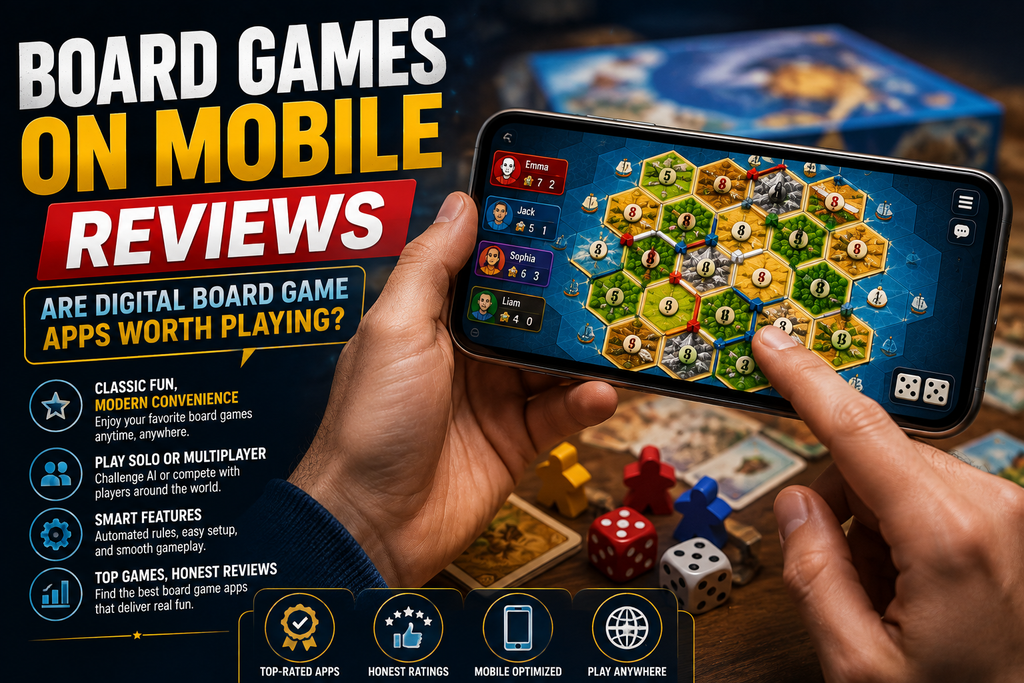
People searching for board games on mobile reviews usually want two things: an honest assessment of whether mobile board game apps are worth their time and recommendations for the types of digital board games that best suit solo, competitive, casual, or serious players.
A good mobile board game should do more than place a digital board on a phone screen. It should make the rules easy to follow, keep turns readable on a small display, handle multiplayer smoothly, and preserve the decisions that made the tabletop version interesting in the first place. The best apps can make board gaming remarkably convenient. The weaker ones reveal exactly how much interface design matters when a physical game is squeezed onto a touchscreen.
This review looks at what makes mobile board games worth playing, which types work best on phones and tablets, the strengths and weaknesses of popular digital adaptations, and how to choose an app that fits the way you actually play.
What Makes a Mobile Board Game Worth Playing?
A strong digital adaptation preserves the decision making of the physical game while removing the parts that are tedious on a screen. Shuffling decks, calculating scores, tracking resources, checking whether a move is legal, and setting up components can all be handled automatically. That convenience is one of the biggest advantages of mobile board gaming.
The problem is that automation can also hide too much. If an app performs important actions without clearly showing why, new players may struggle to understand the game. A good adaptation uses automation to reduce bookkeeping without removing the player’s understanding of the rules.
For a useful board games on mobile review, five areas matter most:
- Interface: Can you understand the board and your options on a phone screen?
- Rule implementation: Does the app handle complicated rules accurately and clearly?
- Solo play: Are the AI opponents and tutorials useful?
- Multiplayer: Does it support real time, asynchronous, local, or cross platform play?
- Value: Does the price, expansion model, or subscription structure make sense for the amount of play you expect?
A game can be excellent on a physical table and still make a poor mobile app. Small cards, dense maps, constant zooming, and hidden information can all become frustrating when the screen is the size of your hand.
The Best Types of Board Games for Mobile
Gateway and Family Games
Gateway games are often the safest place to start because their turns are usually easy to understand and their visual information is manageable.
Ticket to Ride is a good example. The basic decision loop of collecting cards and claiming routes translates naturally to a touchscreen. The current mobile version supports online play, private games, asynchronous turns, and single player matches against AI.
This type of game works particularly well for short sessions. You can take a turn during a break and return later without needing to remember a complicated sequence of actions.
The main weakness is that experienced tabletop players may miss the physical atmosphere of spreading cards and pieces across a table. On mobile, the experience is cleaner and faster, but less tactile.
Review verdict: Excellent for beginners, families, and players who want strategy without a steep learning curve.
Strategy and Engine Building Games
More complex games can actually benefit from being digital.
A physical strategy game may require players to track several resources, bonuses, ongoing effects, and scoring conditions. On a mobile device, the software can manage much of that bookkeeping.
Wingspan is a strong example of how this can work. Its mobile adaptation follows the board game’s core rules and supports AI opponents and multiplayer play, while the digital presentation keeps the bird cards and player actions visually organized.
The limitation is screen size. A complex engine can be easier to appreciate on a tablet than on a smaller phone. If you enjoy studying several cards and planning multiple turns ahead, a larger display can make a significant difference.
Review verdict: Very good for solo strategy players and people who prefer automated scoring and setup.
Heavy Strategy Games
Games with asymmetric factions, large maps, or extensive resource systems are more difficult to adapt, but digital versions have a major advantage: they can enforce complicated rules.
That matters in games where a single missed condition can affect an entire match. The software can prevent illegal moves and automatically track faction specific effects.
The trade off is accessibility. A complicated board game does not automatically become easier simply because it is on a phone. A poor tutorial or crowded interface can make the learning process even harder.
For serious strategy games, the best mobile adaptations are usually the ones that provide clear tutorials, detailed tooltips, undo options where appropriate, and a readable history of what happened during previous turns.
Review verdict: Excellent for experienced players, but phone screens are not always the ideal platform for the deepest games.
Standalone Apps Versus Board Game Platforms
One of the most important choices is whether to buy individual apps or use a larger board gaming platform.
Standalone Board Game Apps
A dedicated app is usually designed around one game. This can result in better artwork, smoother animations, clearer tutorials, and an interface tailored specifically to that game’s mechanics.
The disadvantage is cost. Buying several premium adaptations can become expensive, especially when expansions are sold separately.
Standalone apps make the most sense when you already know which game you enjoy and expect to play it regularly.
Board Game Arena on Mobile
Board Game Arena takes a different approach. Rather than focusing on one title, it offers a large collection of games that can be played in real time or turn based formats. Its current mobile service lists a broad range of games, from accessible titles such as Azul and Carcassonne to much heavier strategy games including Terraforming Mars, Scythe, and Ark Nova.
The variety is the main attraction. You can try different mechanics without purchasing a separate dedicated app for every game.
The interface, however, may not feel as polished as a purpose built adaptation. Some complex games are easier to manage on a tablet or computer, particularly when the board contains many cards, tokens, or menus.
Review verdict: One of the strongest choices for players who want variety and online opponents rather than a single premium app.
How Popular Mobile Board Games Compare
Ticket to Ride
Best for: Beginners and quick strategy sessions
The digital version of Ticket to Ride succeeds because the central gameplay remains easy to read. Routes, cards, and destinations all have a clear role, and the app can handle setup and scoring automatically.
Its asynchronous multiplayer is particularly useful for busy players because a match does not require everyone to remain online at the same time.
Strengths: Accessible rules, recognizable gameplay, AI opponents, and flexible multiplayer.
Weaknesses: Players looking for very deep strategy may eventually want something more complex.
Wingspan
Best for: Relaxed strategy and engine building
Wingspan is visually suited to digital presentation, particularly because its illustrated cards are central to the experience. The mobile version allows players to focus on building combinations rather than managing physical cards and tokens.
The game rewards planning, but its visual style is calmer than many competitive strategy games.
Strengths: Attractive presentation, satisfying strategic combinations, and strong solo potential.
Weaknesses: Players may need time to learn how the different card abilities interact.
Catan
Best for: Trading, negotiation, and competitive multiplayer
Digital Catan changes some of the practical challenges of playing the physical game. There is no need to distribute resources manually or manage a large table full of components.
The important question is whether the digital format can preserve the social side of trading and negotiation. That depends heavily on the platform and the people you play with.
Official CATAN content is also available through Board Game Arena, where games can be played in real time or paused and continued later.
Strengths: Familiar strategy, resource management, and online play.
Weaknesses: Negotiation can feel less natural when players are communicating through a screen.
Carcassonne
Best for: Casual strategic play
Tile laying games often translate extremely well to mobile devices. The basic action of selecting and placing a tile is intuitive on a touchscreen, while the app handles complicated scoring.
The biggest benefit is convenience. Physical Carcassonne requires space, setup, and score tracking. A digital version removes those barriers.
Strengths: Simple core mechanics, fast turns, and easy digital scoring.
Weaknesses: The physical tiles can be part of the game’s appeal, and that tactile element disappears.
RISK: Global Domination
Best for: Players who enjoy long term territorial strategy
Digital RISK demonstrates how classic board game ideas can be adapted for a more modern online audience. Mobile play makes it easier to find opponents and continue matches without gathering everyone in the same room.
The downside is that matches can become time consuming, and the game’s presentation and progression systems may appeal differently to traditional tabletop players than a straightforward board game adaptation would.
Strengths: Accessible online multiplayer and recognizable strategic gameplay.
Weaknesses: Not every player will enjoy the pace or the broader mobile game structure.
Are Mobile Board Games Better Than Physical Board Games?
They are better for some situations and worse for others.
Mobile games win on convenience. There is no setup, no missing pieces, and no need to coordinate everyone’s physical location. A player in the United States can take an asynchronous turn against someone elsewhere in the world and return hours later.
Physical games win on social presence. Reading reactions, negotiating face to face, moving pieces, and sharing a table are experiences that an app cannot completely reproduce.
The strongest approach is not to treat one format as a replacement for the other.
A mobile app can be ideal for learning rules, practicing strategies, playing solo, or keeping a long distance group connected. The physical version can remain the better choice for game nights and in person social play.
The Biggest Advantages of Playing Board Games on Mobile
No Setup or Cleanup
This may sound like a minor benefit until you play a complex strategy game with hundreds of components.
A mobile version can open directly into a match. The app handles setup, shuffling, scoring, and cleanup.
That makes heavier games more realistic for short sessions.
Rules Are Enforced Automatically
Digital rule enforcement is especially valuable for beginners.
Instead of constantly checking a rulebook, players can often see only the actions that are currently legal. This reduces mistakes and allows new players to concentrate on strategy.
There is a downside: automatic systems can sometimes make players dependent on the app. Someone who learns a game entirely digitally may not fully understand how certain rules work when they later play the physical version.
Asynchronous Multiplayer
This is one of the best reasons to play board games on mobile.
A traditional game night requires everyone to be available at the same time. Asynchronous play allows a match to continue over hours or days, depending on the game and platform.
For adults with work, school, family responsibilities, or friends living in different time zones, that flexibility can make multiplayer possible when a live session would not be.
Solo Practice
Many board game apps include AI opponents.
This gives players a way to learn strategies without needing to organize a group. You can test an unfamiliar game, restart a match, or practice a particular approach before playing against other people.
The quality of AI varies, however. Strong AI can create a useful challenge, while predictable AI may become repetitive.
The Problems With Board Games on Phones
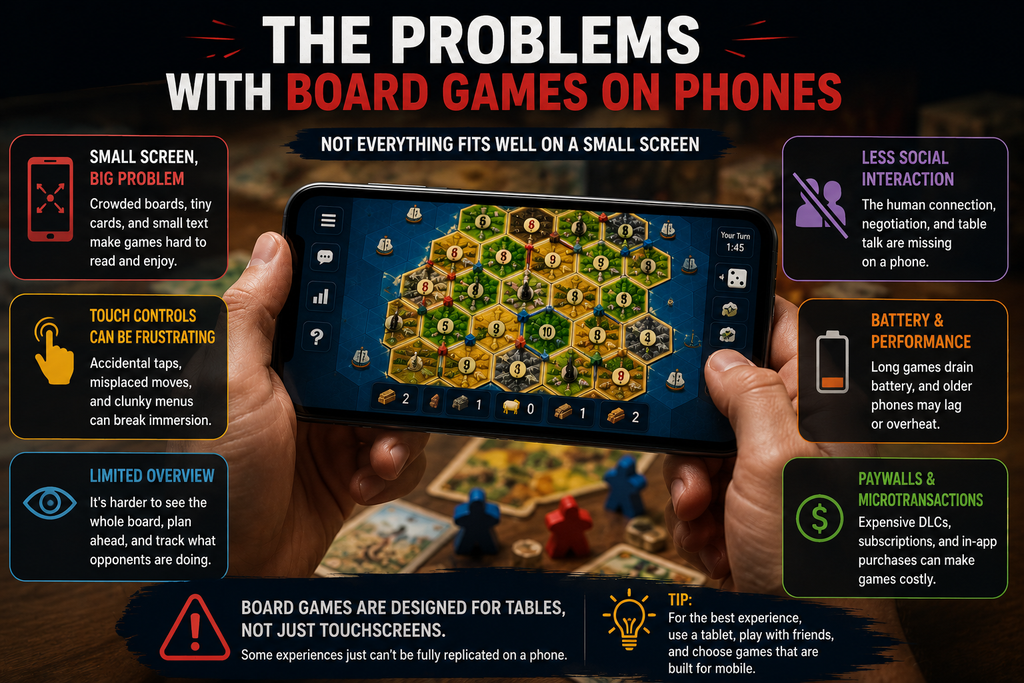
Small Screens Can Hurt Complex Games
This is the most obvious limitation.
A detailed strategy game designed around a large table may require constant zooming on a phone. Cards become smaller, maps require scrolling, and important information can disappear behind menus.
For complex titles, tablets are often a better compromise between portability and readability.
Digital Interfaces Can Hide Information
A physical board gives you a complete view of the game state.
On a phone, information may be divided between several screens. You might need to tap an icon to inspect a card, open another menu to review an opponent’s position, and return to the main board to make your move.
The best apps minimize this problem by prioritizing important information and making secondary details easy to access.
Monetization Requires Attention
Not every mobile board game uses the same business model.
Some are premium purchases. Others are free to download but offer expansions, cosmetics, subscriptions, or additional content. Before buying, check exactly what is included in the base version.
A free download is not automatically a better value, and a premium game is not automatically expensive if you plan to play it for years.
Multiplayer Communities Can Vary
An excellent game needs opponents.
Popular titles usually offer faster matchmaking, while smaller communities can make it harder to find a game at your preferred time or skill level. This is particularly relevant for niche or older adaptations.
If online multiplayer is your main reason for buying an app, check the current platform activity and supported modes before committing to expansions or subscriptions.
How to Choose the Right Mobile Board Game
The best choice depends less on an overall ranking and more on how you plan to play.
Choose a Lighter Game if You Want Short Sessions
Games with straightforward turns and clear objectives work well during commutes, breaks, or quiet evenings.
Ticket to Ride, Carcassonne, and similar accessible titles are strong starting points.
Choose a Strategy Game if You Enjoy Long Term Planning
If you want to study card combinations, manage resources, or develop a multi turn plan, games such as Wingspan and other engine builders provide more depth.
Just consider using a tablet for games with information heavy boards.
Choose a Platform if You Want Variety
Board Game Arena is especially useful for players who enjoy trying different games. Its library includes a wide range of complexity levels, and its turn based options can suit players who cannot commit to long live sessions.
Choose Official Adaptations for Specific Favorites
If you already love a particular tabletop game, a dedicated official adaptation is often worth considering because the interface is designed around that one experience.
Check the current app store listing, supported devices, multiplayer options, and expansion model before purchasing.
What Should You Look for in a Board Game App Review?
A useful review should go beyond saying that a game is fun or boring.
Look for answers to practical questions:
- Is the tutorial good enough for a new player?
- Does the interface work well on a phone, or is a tablet recommended?
- Are games available against AI?
- Is online multiplayer active?
- Can you play asynchronously?
- Does the game require a constant internet connection?
- What is included with the initial purchase?
- Are expansions optional or necessary for the full experience?
- Is the app updated and supported?
These details matter more than screenshots alone.
A beautiful interface cannot compensate for unstable multiplayer. Likewise, a faithful rules implementation can still be frustrating if every turn requires excessive tapping and menu navigation.
FAQs
Are board games on mobile worth playing?
Yes, especially if you value convenience, automated rule enforcement, solo play, or online multiplayer. The experience is strongest when the app is designed specifically for mobile rather than simply copying a tabletop layout onto a small screen.
What are the best board games to play on mobile?
The best choice depends on your preferences. Ticket to Ride is a strong starting point for accessible strategy, Wingspan suits engine building fans, and Board Game Arena offers a large selection of different games through one platform.
Can I play board games online with friends on my phone?
Yes. Many mobile board games support private online matches, while platforms such as Board Game Arena offer real time and turn based options.
Are mobile board games good for learning the physical game?
They can be excellent learning tools because the app often enforces rules and handles scoring. However, automated systems may hide some rule details, so reading the game’s explanations can still help if you plan to play the physical version later.
Is a phone or tablet better for digital board games?
Phones are better for portability and simpler games. Tablets are generally more comfortable for complex games with large boards, detailed cards, maps, or multiple resource areas.
Do board game apps work offline?
Some standalone games offer offline AI or local modes, while browser based and online focused platforms require an internet connection for many features. Always check the current store listing because offline functionality can differ between games and platforms.
Final Thoughts
The best board games on mobile reviews should not ask only whether a tabletop game is enjoyable. The more useful question is whether the digital version improves the experience for the way you want to play.
Mobile board gaming is at its best when it removes friction without removing strategy. Automated setup, rule enforcement, AI opponents, asynchronous turns, and instant access can make games easier to enjoy regularly. At the same time, small screens, crowded interfaces, monetization models, and the loss of face to face interaction are real limitations.
For newcomers, a clear and accessible game such as Ticket to Ride is a sensible starting point. Players looking for deeper strategy may prefer Wingspan or another well designed premium adaptation, while a broad service such as Board Game Arena is particularly useful for exploring many different games.
The strongest mobile board game is ultimately the one that fits your habits. If you want five minute sessions, choose simplicity. If you enjoy planning over several days, look for asynchronous multiplayer. If your goal is to explore the wider world of tabletop gaming, prioritize variety. With the right app and the right format, a phone can become far more than a substitute for the board on your table.
LEAVE A PIXEL ZINE COMMENT