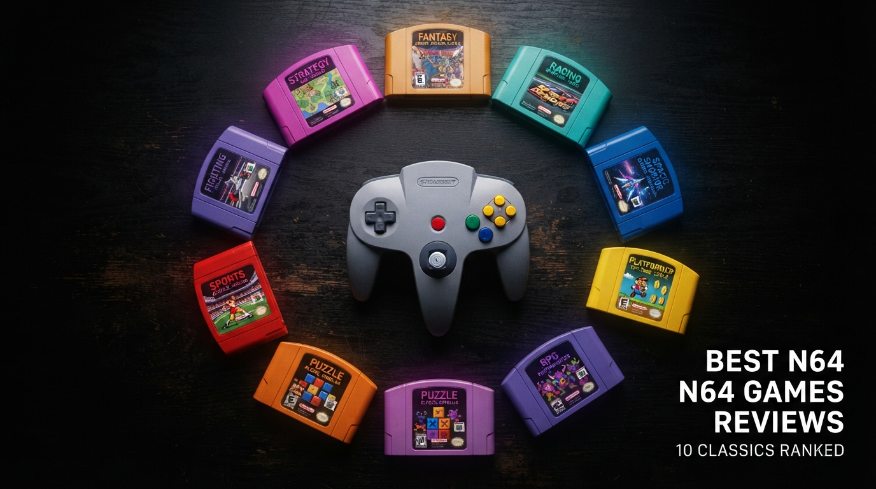
The best N64 games Reviews are not simply games remembered because they were popular in the 1990s. The strongest titles still work because their core mechanics remain enjoyable, their level design encourages experimentation, or their multiplayer systems continue to create memorable sessions.
The Nintendo 64 launched in the United States on September 29, 1996, alongside Super Mario 64. Nintendo describes the system as having more than 300 games across its lifetime, covering a remarkably broad range of genres. Its hardware also helped establish 3D movement as a central part of console game design.
That makes choosing the best N64 games surprisingly difficult. Some were technically impressive but have aged poorly. Others look primitive by modern standards yet remain incredibly playable.
This ranking focuses on that distinction. The goal is not to manufacture review scores but to examine which games still deserve your time based on gameplay, design, replayability, multiplayer value, and historical importance.
What Makes an N64 Game Worth Playing Today?
N64 games have a particular challenge when revisited decades later. Early 3D design often came with awkward cameras, limited draw distances, simple character models, and control systems that modern players may need time to understand.
A good retro game does not have to overcome every technical limitation. What matters more is whether its underlying design remains strong.
For this ranking, five factors matter most:
Gameplay: Does the central mechanic remain enjoyable?
Level design: Are environments interesting to explore rather than simply impressive for their time?
Replayability: Is there a reason to return after finishing the main content?
Multiplayer: Where applicable, does the game remain fun with other players?
Legacy: Did the game meaningfully influence its genre or establish ideas that still work today?
The Nintendo 64 controller itself was designed around analog movement, with Nintendo highlighting its Control Stick as a major part of the system’s approach to 3D games. The console also featured four controller ports, making local multiplayer a major part of its identity.
Those characteristics help explain why the best N64 games often fall into two categories: groundbreaking single-player adventures and exceptional local multiplayer games.
Best N64 Games Reviews Ranked
Super Mario 64
Why it ranks: The defining 3D platformer of the system.
Super Mario 64 remains the easiest N64 game to recommend because its fundamental idea is still excellent: give the player a responsive character, a three dimensional space, and freedom to decide how to approach objectives.
Instead of forcing players through a strictly linear series of stages, the game builds large environments around collectible objectives. Stars provide structure, but exploration provides much of the enjoyment.
The movement system is the real star. Running, jumping, diving, wall jumping, long jumping, swimming, and other moves give Mario a surprisingly broad movement vocabulary.
Some camera behavior can feel dated, especially for players accustomed to modern third person games. Yet the underlying movement remains satisfying.
Nintendo launched the N64 in the United States with Super Mario 64, making it one of the defining early examples of the platform’s transition into 3D.
Best for: Platforming fans, retro newcomers, completionists, and players interested in the history of 3D game design.
Main weakness: The camera occasionally fights against the player.
Verdict: Still one of the most important N64 games and one of the best starting points for the system.
The Legend of Zelda: Ocarina of Time
Why it ranks: A remarkably complete 3D adventure built around exploration, combat, puzzles, and progression.
Ocarina of Time demonstrated how an established 2D adventure formula could be translated into a three dimensional environment.
Its targeting system helped make 3D combat more manageable, while dungeons provided a structured contrast to the game’s broader exploration. The result was an adventure where equipment, environmental puzzles, enemies, and exploration all support one another.
Its age is more visible in some interface elements and camera behavior than in its basic design philosophy.
The game is also an excellent example of how the N64 could combine exploration with cinematic presentation without abandoning traditional game mechanics.
Nintendo continues to include Ocarina of Time in its Nintendo 64 Classics library.
Best for: Adventure fans, puzzle solvers, Zelda newcomers, and players interested in classic 3D design.
Main weakness: Some systems and presentation choices feel dated.
Verdict: An essential N64 game whose fundamental structure remains highly playable.
GoldenEye 007
Why it ranks: One of the defining local multiplayer experiences of its generation.
GoldenEye 007 deserves attention not simply because it was a popular first person shooter, but because of how effectively it translated FPS mechanics into a console environment.
Its single player campaign offered mission objectives beyond simply eliminating every enemy. Local multiplayer then gave the game an entirely different purpose.
Four player sessions became one of the clearest demonstrations of the N64’s multiplayer philosophy. Nintendo itself has historically emphasized the system’s four controller setup and its importance for games such as Mario Kart 64 and Mario Party.
Modern FPS players will immediately notice limitations in aiming and movement compared with contemporary shooters. That does not erase its importance.
Best for: Retro FPS fans and local multiplayer groups.
Main weakness: Modern FPS controls make its original aiming system feel restrictive.
Verdict: A landmark N64 shooter that remains particularly interesting as a multiplayer time capsule.
Mario Kart 64
Why it ranks: Simple racing mechanics combined with excellent local multiplayer.
Mario Kart 64 understands what makes arcade racing enjoyable. The controls are accessible, races are easy to understand, and items introduce enough unpredictability to keep matches from becoming purely technical competitions.
Its strongest feature may still be the multiplayer structure. The four controller capability of the N64 was particularly well suited to games such as Mario Kart 64. Nintendo specifically cites the title as one of the games that could turn the system into a multiplayer party machine.
The physics and track design are obviously products of their era, but that can actually be part of the appeal for retro players.
Best for: Couch multiplayer, arcade racing fans, and casual groups.
Main weakness: Its racing mechanics lack the refinement of later entries.
Verdict: One of the safest N64 recommendations when multiplayer is the priority.
Banjo Kazooie
Why it ranks: A polished collectathon platformer with varied environments and strong character movement.
Banjo Kazooie took the exploration heavy 3D platforming formula popularized during the N64 era and gave it its own identity.
The game rewards players for searching environments rather than simply moving from one checkpoint to another. Different abilities open up new possibilities, while collectibles give exploration a tangible purpose.
It is also a useful comparison with Super Mario 64. Both games embrace open ended platforming, but Banjo Kazooie leans more heavily into collectibles, character abilities, environmental puzzles, and humor.
Nintendo’s current N64 Classics library includes Banjo Kazooie and its sequel Banjo Tooie in supported regions.
Best for: Collectathon fans and players who enjoy exploration heavy platformers.
Main weakness: The amount of collecting can become repetitive.
Verdict: One of the strongest examples of late 1990s 3D platforming.
The Legend of Zelda: Majora’s Mask
Why it ranks: Its time based structure gives the Zelda formula a distinctive strategic layer.
Majora’s Mask is very different from Ocarina of Time despite sharing many mechanical foundations.
Its central time cycle changes how players approach the world. Instead of treating the environment as something that simply waits for the player, the game creates a sense that events continue according to a schedule.
That design can be demanding. Players have to learn how locations, characters, quests, and events interact with the game’s time structure.
For some players, that makes it more interesting than Ocarina of Time. For others, it creates unnecessary pressure.
Nintendo’s current N64 Classics lineup includes Majora’s Mask.
Best for: Players who enjoy unusual quest structures, atmosphere, and exploration.
Main weakness: The time system can be intimidating for newcomers.
Verdict: One of the N64’s most distinctive adventures and a particularly rewarding choice for patient players.
Star Fox 64
Why it ranks: Focused arcade style action with excellent replay value.
Star Fox 64 succeeds because it understands the value of keeping a game focused.
Rather than overwhelming the player with dozens of systems, it centers the experience around fast paced vehicle combat, movement, aiming, enemy encounters, and branching routes.
That makes it particularly easy to replay. Players can improve their performance, experiment with different routes, and try to master encounters that initially seemed difficult.
Its design also benefits from short bursts of action. You can play a session without committing to a massive campaign.
Nintendo’s N64 documentation still lists Star Fox 64 among the system’s games, while Nintendo’s modern N64 controller supports rumble functionality for compatible titles such as Star Fox 64.
Best for: Arcade action fans and players who enjoy replaying compact campaigns.
Main weakness: Its focused structure may feel limited compared with modern large scale games.
Verdict: A superb example of focused arcade game design.
F Zero X
Why it ranks: Fast, aggressive futuristic racing with an emphasis on speed.
F Zero X is not a traditional racing simulator. Its appeal comes from speed, aggressive positioning, track awareness, and the constant possibility of disaster.
The game asks players to balance speed with control. Driving conservatively may keep you alive, but aggressive movement can be necessary to compete.
That risk reward relationship gives the racing system more depth than its simple presentation might suggest.
The N64 Classics library continues to include F Zero X.
Best for: Arcade racing enthusiasts and players who want something faster and more aggressive than Mario Kart 64.
Main weakness: Its visual presentation is considerably more dated than its gameplay.
Verdict: A great example of gameplay carrying a game beyond its technical limitations.
Perfect Dark
Why it ranks: A technically ambitious FPS with a deeper single player structure.
Perfect Dark expanded on ideas established by earlier console shooters, placing greater emphasis on mission objectives, weapons, gadgets, and multiplayer.
Its approach is less immediately accessible than GoldenEye 007, but that complexity can be an advantage for players who want more structure.
The game’s reputation is also tied closely to its technical ambition for the hardware. Its requirements and performance characteristics make it a particularly interesting example of how developers pushed the N64.
For players approaching it today, the control scheme takes adjustment, but the mission design remains worth examining.
Best for: FPS fans who want deeper mission structure and multiplayer options.
Main weakness: The original control layout takes time to adapt to.
Verdict: A strong choice for players who want a more sophisticated N64 era shooter.
Paper Mario
Why it ranks: A creative RPG that combines turn based combat with accessible progression.
Paper Mario demonstrates that the N64 was capable of delivering more than action and platforming.
Its visual style remains distinctive because of its paper inspired presentation, while the RPG mechanics are approachable enough for players who are not normally RPG specialists.
The combat system combines turn based decision making with timing based interactions, giving battles more player involvement than simply selecting commands.
Exploration, characters, abilities, and story progression provide a slower paced alternative to the system’s action heavy classics.
Nintendo’s N64 Classics library currently includes Paper Mario.
Best for: RPG fans, story focused players, and anyone wanting a slower N64 experience.
Main weakness: Players looking for fast action may find its pacing slow.
Verdict: One of the most complete RPG experiences available on the platform.
How These N64 Classics Hold Up Today
The biggest difference between playing an N64 game now and playing it during the original hardware era is expectation.
Modern games generally provide more sophisticated cameras, higher resolution assets, smoother animation, extensive accessibility options, and more flexible control schemes.
That does not automatically make older games worse.
A game such as F Zero X remains effective because its core gameplay does not depend on visual realism. Mario Kart 64 still works because the fundamental pleasure of racing and using items is immediately understandable.
Platformers such as Super Mario 64 are more interesting from a historical perspective because modern 3D platforming owes so much to the design experimentation of that era.
The controls are where newcomers are most likely to struggle.
The N64 controller’s three pronged shape and unusual button arrangement were built around the system’s approach to 3D games. Nintendo describes the original Control Stick as providing 360 degree movement, while the Z button sat underneath the central grip.
Once players adjust, many of these games become considerably easier to appreciate.
Which N64 Game Should You Play First?
If you have never played the N64 library before, the best starting point depends on what you want.
For platforming: Start with Super Mario 64.
For adventure: Choose Ocarina of Time.
For multiplayer: Try Mario Kart 64.
For shooters: Start with GoldenEye 007.
For collecting and exploration: Choose Banjo Kazooie.
For unusual adventure design: Try Majora’s Mask.
For arcade action: Play Star Fox 64.
For high speed racing: Choose F Zero X.
For FPS depth: Try Perfect Dark.
For RPGs: Start with Paper Mario.
If you are completely new to retro gaming, Super Mario 64 is probably the best first choice because its basic objective is immediately understandable. If multiplayer is the reason you are interested in the N64, Mario Kart 64 is the more natural introduction.
N64 Games That Are Still Excellent for Multiplayer
The N64 deserves special attention for local multiplayer.
The hardware was designed with four controller ports, and Nintendo specifically positioned the system around multiplayer games.
That makes several N64 titles particularly valuable for group sessions.
Mario Kart 64 is the obvious racing choice. GoldenEye 007 works for FPS fans, while the Mario Party series provides a different style of competitive play.
Nintendo’s modern N64 Classics service also supports multiplayer for compatible titles, including online multiplayer for some games depending on the title and service configuration. Nintendo has specifically highlighted online multiplayer support for games added to the N64 collection.
This is one reason the N64 library remains relevant rather than simply nostalgic.
Are N64 Games Still Worth Playing Today?
Yes, but not every N64 game has aged equally well.
The strongest titles are worth playing because their fundamental mechanics remain effective. They are not dependent entirely on nostalgia.
Players should expect compromises, particularly with camera systems, graphics, control layouts, loading behavior, and visual presentation.
It is also worth remembering that modern versions of classic N64 games can differ from the original hardware experience. Nintendo notes that games in its Nintendo 64 Classics software are reproductions of the original games and that there can be differences in performance and presentation compared with the originals.
For players who want an accessible way to explore the library, Nintendo currently provides a selection of N64 games through Nintendo Switch Online + Expansion Pack. The available lineup includes several titles discussed in this article, although the exact library can vary by region.
Final Verdict
The best N64 games are not necessarily the ones with the most impressive graphics or the biggest historical reputation. They are the games where the underlying design continues to make sense decades later.
Super Mario 64 remains an essential platformer. Ocarina of Time demonstrates how successfully an adventure game could transition into 3D. Mario Kart 64 and GoldenEye 007 show why four controller multiplayer became such a defining part of the console.
Meanwhile, Banjo Kazooie, Majora’s Mask, Star Fox 64, F Zero X, Perfect Dark, and Paper Mario demonstrate how broad the N64 library actually was.
If you are searching through Best N64 games reviews, the most useful approach is not to ask which game is objectively number one. Ask which design style you want to experience.
For a first time player, Super Mario 64 is the strongest starting point. For an adventure, choose Ocarina of Time. For a group, pick Mario Kart 64. For something more unusual, Majora’s Mask is difficult to beat.
The N64 may belong to another hardware generation, but its best games remain valuable because good game design ages much more slowly than graphics.
FAQ
What is considered the best N64 game?
Super Mario 64 and The Legend of Zelda: Ocarina of Time are among the strongest candidates. The better choice depends on whether you prefer platforming or adventure.
Which N64 game is best for multiplayer?
Mario Kart 64 is one of the strongest choices for local multiplayer because its racing and item mechanics are easy to understand while still providing plenty of competition.
Are N64 games still worth playing?
Yes. The best N64 games still have strong mechanics and level design, although players should expect older camera systems, controls, and visual presentation.
What is the best N64 game for beginners?
Super Mario 64 is an excellent starting point because its movement and objectives are relatively easy to understand.
Which N64 games are available on Nintendo Switch?
Nintendo’s N64 Classics library includes titles such as Super Mario 64, Ocarina of Time, Mario Kart 64, Banjo Kazooie, Paper Mario, Majora’s Mask, F Zero X, and others, with availability varying by region.
Was the Nintendo 64 designed for multiplayer?
Yes. The original console included four controller ports, and Nintendo promoted multiplayer as one of the system’s defining features.
Which N64 game is best for racing fans?
Mario Kart 64 is the best choice for accessible arcade racing, while F Zero X is better suited to players who want extreme speed and more aggressive racing.
What makes N64 games different from modern games?
N64 games were designed around early 3D technology, the system’s analog Control Stick, cartridge based software, and local multiplayer. Their design often emphasizes compact mechanics and replayability rather than the huge worlds common in many modern games.
LEAVE A PIXEL ZINE COMMENT