What Does Best Gaming Transformation Actually Mean?
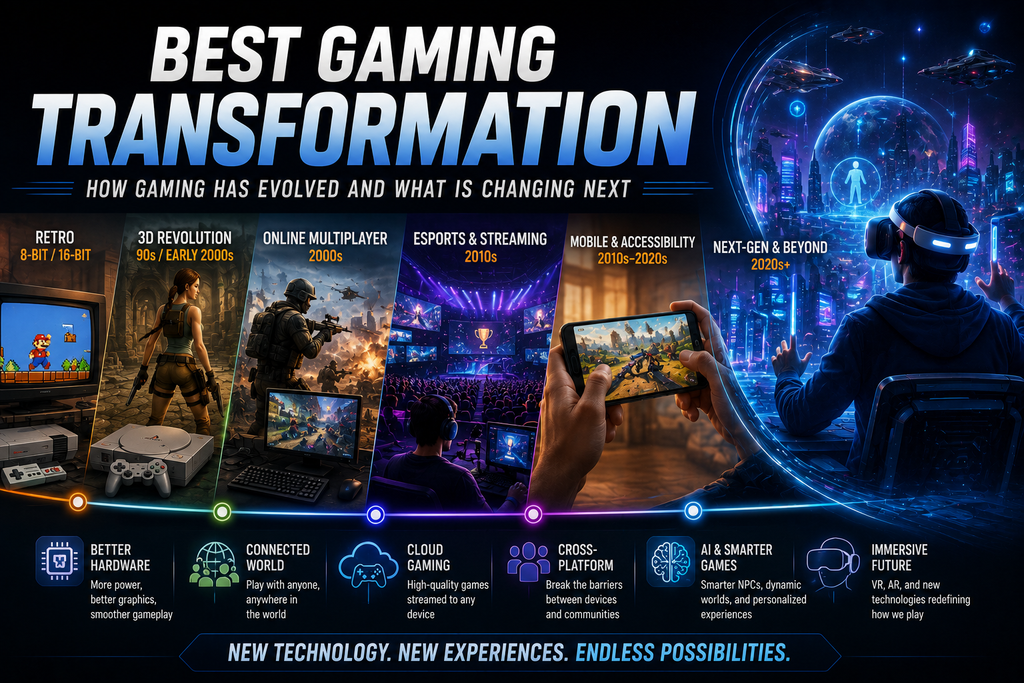
The best gaming transformation is not simply a jump in graphical quality or a faster console generation. The biggest transformations are the changes that alter how players access games, interact with other people, create content, or experience a game world.
By that standard, several major shifts stand out:
- Gaming moved from local hardware toward connected ecosystems.
- Multiplayer expanded from couch and LAN sessions into global communities.
- Cross platform play reduced barriers between PC, console, and mobile players.
- Digital distribution changed how games are discovered and updated.
- Accessibility features broadened who can comfortably play.
- Cloud technology made some games playable across devices that do not run them natively.
- AI is beginning to affect both game development and the design of interactive experiences.
No single change matters equally to every player. A competitive PC player may consider high refresh displays and low latency networking transformative. Someone who mainly plays with friends may value cross play more. For a player with accessibility needs, customizable controls can have a far greater impact than ray tracing or higher resolution textures.
That is why the best way to evaluate gaming transformation is to look at how a technology changes the actual experience of playing.
From Standalone Games to Connected Gaming Ecosystems
One of the largest changes in modern gaming is the shift away from treating every platform as a completely separate environment.
A player can now build a digital library, maintain a friends list, communicate across devices, and in some cases continue the same game on different hardware. This has gradually changed the meaning of choosing a platform.
The traditional model was simple: buy a console or PC, buy a game designed for that system, and play primarily within that ecosystem. Modern gaming is more interconnected. Digital storefronts, subscriptions, cross save systems, cloud streaming, and cross platform multiplayer have created broader ecosystems around individual games.
The transformation is especially useful for players whose gaming habits change throughout the day. A game might begin on a console, continue on a PC, or be streamed to another supported device. Xbox Cloud Gaming describes its service as supporting play across phones, tablets, PCs, consoles, selected TVs, and other compatible devices, illustrating how the boundaries between hardware categories have become less rigid.
This does not mean hardware no longer matters. Native performance, storage, controllers, display quality, and network conditions still affect the experience. The transformation is that hardware is increasingly one part of a larger gaming ecosystem rather than the only gateway to a game.
The Transformation of Multiplayer Gaming
From Local Competition to Global Communities
Early multiplayer gaming was often tied to physical proximity. Players shared a screen, connected computers locally, or gathered around arcade machines.
Online connectivity changed that structure completely.
Modern multiplayer games can connect friends living in different cities or countries, create long term communities around a single game, and support competitive events that attract global audiences. Voice chat, streaming, social platforms, community servers, and in game events have made gaming a more persistent social activity.
The important change is not simply that players can connect online. It is that many games are now designed around ongoing interaction.
A game can remain part of a players routine for months or years through seasonal content, ranked competition, cooperative activities, and social groups. This model has helped create stronger communities, but it also brings challenges such as moderation, toxicity, privacy, and pressure to keep up with constantly changing content.
The best gaming transformation in multiplayer is therefore connection, but connection works best when developers provide effective tools for communication, safety, reporting, and player control.
Cross Play Has Changed Who You Can Play With
Cross platform multiplayer has been another important step.
In the past, friends often needed to own the same game on the same platform. Today, many major games support some form of cross play, allowing players on different systems to participate together.
This is particularly valuable for global gaming communities. A group no longer has to reorganize itself simply because one player prefers PC while another uses a console.
Current industry reporting also identifies cross play as an important factor in player engagement. Unitys 2026 development report lists cross play and competition among the major shifts shaping how studios approach the market.
Cross play is not automatically simple. Developers must consider input differences, performance variations, competitive balance, account systems, and platform policies. Still, when implemented well, it solves one of gamings oldest practical problems: friends owning different hardware.
Graphics Have Improved, but Better Design Matters More
Visual technology is one of the most visible transformations in gaming.
Games have moved from simple two dimensional graphics toward detailed 3D worlds, sophisticated lighting, animation systems, larger environments, and increasingly realistic materials. Modern rendering techniques can create dramatic improvements in atmosphere.
Yet graphical realism alone does not determine whether a game feels transformative.
A visually simple independent game can provide a more memorable experience than a technically advanced release if its mechanics, art direction, controls, and world design work together effectively.
This distinction matters because players sometimes confuse technological progress with better game design.
The most successful graphical improvements serve gameplay. Clear lighting can help players read an environment. Animation can communicate movement and impact. Better visibility can make a competitive game easier to understand. Art direction can create a recognizable identity without demanding maximum realism.
The real transformation is therefore broader than better graphics. Modern development gives creators more tools, but good games still depend on thoughtful decisions about how those tools are used.
AI Is Becoming a Major Gaming Transformation
AI Behind the Scenes
Artificial intelligence is already influencing how games are developed.
AI assisted tools can potentially support tasks involving prototyping, asset workflows, programming assistance, testing, localization, and content production. The practical impact will vary significantly from one studio to another.
A 2026 report from Boston Consulting Group describes generative AI as one of the forces changing game development and highlights its use across areas such as efficiency, production, and new forms of player experiences.
The key point is that AI does not automatically create better games. Faster production can be useful, but it can also lead to more generic content if creative direction and quality control are weak.
For players, the best outcome is not simply more AI. It is better games that use technology where it genuinely improves responsiveness, variety, accessibility, or development efficiency.
AI Inside Game Worlds
The more experimental side of AI involves what happens inside games themselves.
Developers are exploring systems that could make non player characters, environments, and interactive worlds more responsive. Google Cloud has described a move toward AI supported living game experiences in which characters and environments can respond and evolve in more dynamic ways.
This area deserves cautious optimism rather than hype.
Dynamic dialogue sounds impressive, but a convincing game character needs more than the ability to generate sentences. Characters need consistency, narrative purpose, appropriate behavior, and meaningful limits. The same applies to procedurally generated worlds. More content is not automatically better content.
AI could become one of the best gaming transformation forces of the coming years, but its success will depend on whether it creates genuinely better interactions instead of simply producing more material.
Cloud Gaming Is Changing Access to Games
Cloud gaming changes the traditional relationship between a game and the device used to play it.
Instead of requiring the local device to perform all processing, a game can run on remote hardware and stream the resulting video to a compatible screen. The players inputs are then sent back through the network.
The obvious advantage is accessibility. A player may be able to access a game on hardware that would not normally run it locally.
Xbox Cloud Gaming is a clear example of this model, with support for cloud play across compatible phones, tablets, PCs, consoles, TVs, and other devices.
Cloud gaming also has limitations.
Internet quality matters. Latency can affect fast paced games. Video compression can reduce image clarity. Availability depends on region and service support. Ownership and subscription models can also influence what players can access.
For these reasons, cloud gaming should not be treated as a complete replacement for local hardware. Its strongest role is flexibility.
A slow paced strategy game may feel perfectly comfortable through streaming, while a highly competitive shooter can be more sensitive to latency. The practical lesson is simple: choose the technology according to the type of game you play.
Mobile and Handheld Gaming Have Expanded What Gaming Means
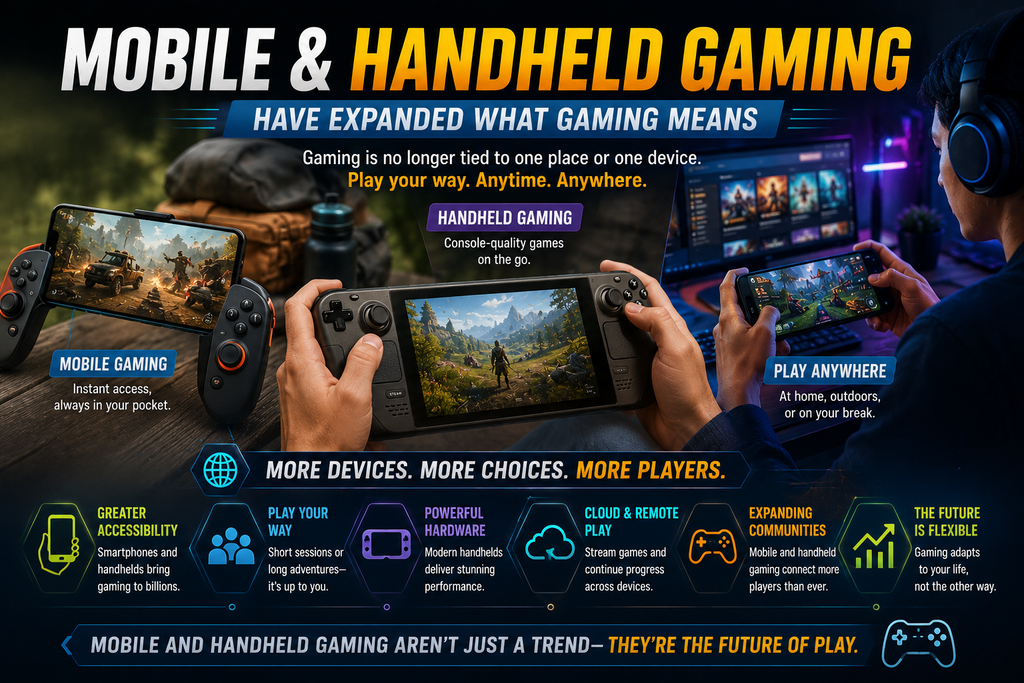
Gaming is no longer associated with one particular room or device.
Smartphones introduced games to audiences who may never have purchased a dedicated console. Handheld PCs and portable consoles have further expanded the range of games that can be played away from a traditional desk or television.
The result is a more fragmented but flexible gaming landscape.
Mobile gaming remains particularly important from a global perspective because smartphones are more accessible than dedicated gaming hardware in many markets. Sensor Towers 2026 gaming report notes the enormous scale of mobile distribution while also describing a changing relationship between downloads, monetization, PC, and console gaming.
The best transformation here is convenience, but convenience has also changed design priorities. A game designed for short touch based sessions may have very different mechanics from a game designed for hours of uninterrupted play with a controller.
Neither approach is inherently better. The important development is that players now have more ways to choose how, where, and when they play.
Accessibility Is One of the Most Meaningful Transformations
Not every important innovation is visually dramatic.
Accessibility features can fundamentally change whether a game is playable for someone.
Examples include:
- Remappable controls
- Adjustable text size
- Subtitles and caption options
- Color and contrast settings
- Difficulty customization
- Input alternatives
- Visual and audio cues
- Assistance features that reduce unnecessary barriers
These options should not be viewed as separate from game design. They are part of how players interact with a game.
A difficult game can remain challenging while offering more control over how information is presented or how actions are performed. Accessibility is not about removing every obstacle. It is about distinguishing meaningful gameplay challenges from barriers created by an interface or a rigid design assumption.
This is one area where the best gaming transformation can have a direct and immediate effect on players. Better graphics may make a game more impressive. Better accessibility can make it possible for more people to participate at all.
User Created Content Has Turned Players Into Creators
Another major transformation is the growth of player created content.
Modding communities have existed for decades, but modern creation tools, level editors, custom modes, streaming platforms, and game ecosystems have made player creativity more visible.
Some games now function partly as platforms. Players do not only consume content; they build maps, create game modes, design cosmetic items, share strategies, and produce videos around their experiences.
This can extend a games lifespan dramatically because new ideas continue to come from its community.
Industry analysis from Boston Consulting Group identifies user generated content and the creator economy as significant forces in gamings current evolution.
The challenge is moderation and quality control. Open creation systems need tools that help developers manage copyright concerns, harmful content, scams, and inappropriate material.
When those systems work well, player creativity can be one of the most sustainable forms of gaming transformation.
Live Service Games Changed the Relationship Between Release and Support
For decades, a games launch was close to the end of its development cycle from a players perspective.
Today, many games continue changing after release through patches, seasons, expansions, balance updates, events, and new content.
This has created both opportunities and frustrations.
The positive side is that developers can fix problems, add features, and respond to player feedback. A game released in rough condition can improve substantially over time.
The negative side is that some players feel pressure to return constantly or spend money within evolving monetization systems. There is also no guarantee that ongoing updates will improve every game. Changes can divide communities or move a game away from the experience players originally enjoyed.
A useful rule for players is to judge live service games by their current value, not only by promises about future updates.
How to Identify the Best Gaming Transformation for You
There is no universal answer because players value different improvements.
For Competitive Players
Prioritize transformations that improve performance and connection quality:
- Low latency networking
- High refresh rate support
- Reliable cross play systems
- Input customization
- Better anti cheat and competitive tools
A visually advanced feature is less useful if the game performs poorly or matchmaking is unreliable.
For Casual and Social Players
Focus on accessibility and convenience:
- Cross platform multiplayer
- Easy party systems
- Cloud access where network quality supports it
- Quick resume and cross save features
- Handheld or mobile compatibility
The ability to join friends quickly can matter more than technical specifications.
For Strategy and Single Player Players
Look for improvements that support immersion and flexibility:
- Better AI behavior
- Mod support
- Strong accessibility settings
- Cross save functionality
- Larger or more responsive worlds
For this group, transformation often comes from depth rather than speed.
For Players Buying New Hardware
Avoid upgrading simply because a product uses the word next generation.
Ask practical questions:
- What games will I actually play on it?
- Does it improve performance in those games?
- Will it work with my existing library or accessories?
- Does it offer useful portability or ecosystem benefits?
- Am I paying for a feature I will rarely use?
The best gaming transformation is valuable only when it improves your own experience.
What Is Likely to Change Gaming Next?
The strongest current direction is convergence.
PC, console, mobile, handheld, and cloud gaming are increasingly connected rather than operating as entirely separate categories. AI tools are entering development workflows, while cross play and broader device support continue to reduce platform barriers.
Microsoft Windowss current approach to PC gaming, for example, combines downloaded games, subscription libraries, and cloud streaming within a broader ecosystem rather than presenting a single way to access games.
At the same time, smaller and more sustainable development models remain relevant. Unitys 2026 report points to studios placing greater emphasis on smaller scale projects and broader approaches to reaching players, showing that transformation is not only about building bigger games.
The next important change may therefore be less about one spectacular device and more about flexibility: games that can reach players across multiple devices, development methods that allow smaller teams to compete, and experiences that adapt better to individual players.
FAQs
What is the best gaming transformation?
The best gaming transformation depends on the player, but the most significant industry wide changes include online multiplayer, cross platform play, digital distribution, mobile gaming, accessibility features, cloud gaming, and emerging AI tools. These developments changed how games are accessed, created, and played.
How has technology transformed gaming?
Technology has transformed gaming through improved hardware, internet connectivity, digital storefronts, mobile devices, cloud streaming, advanced graphics, accessibility tools, and AI assisted development. The biggest change is greater flexibility in where people play and who they can play with.
Is cloud gaming the future of gaming?
Cloud gaming is likely to remain an important part of gaming, but it is unlikely to replace local hardware completely in the near term. It offers convenience and device flexibility, while local gaming still provides advantages in performance, image quality, and independence from network conditions.
How is AI changing video games?
AI is being used and explored for development workflows, testing, content production, and more dynamic game systems. Its long term value will depend on how developers use it to improve gameplay and creative quality rather than simply generating more content.
Why is cross platform gaming important?
Cross platform gaming allows people using different hardware to play together when a game supports it. This can make multiplayer communities larger, help friends stay connected, and reduce the importance of owning identical devices.
Will mobile, PC, and console gaming eventually become the same?
They are becoming more connected, but each format still has different strengths. Mobile emphasizes accessibility and portability, PCs offer flexibility and performance options, and consoles provide a more standardized experience. The likely future is greater interoperability rather than complete uniformity.
Final Thoughts
The best gaming transformation is not a single console, graphical feature, or technology. The most meaningful changes are the ones that give players more freedom: freedom to play across devices, connect with friends on different platforms, access games in new places, customize controls, or participate in experiences that previously felt inaccessible.
Graphics will continue to improve, and AI will continue to attract attention. Cloud gaming, handheld devices, cross play, and creator driven ecosystems will also keep evolving. Still, technology is only successful when it makes games better to play.
That is the standard worth using when evaluating the next major change in gaming: not how futuristic it sounds, but whether it creates a clearer, more accessible, more engaging, or more enjoyable experience for real players.
LEAVE A PIXEL ZINE COMMENT