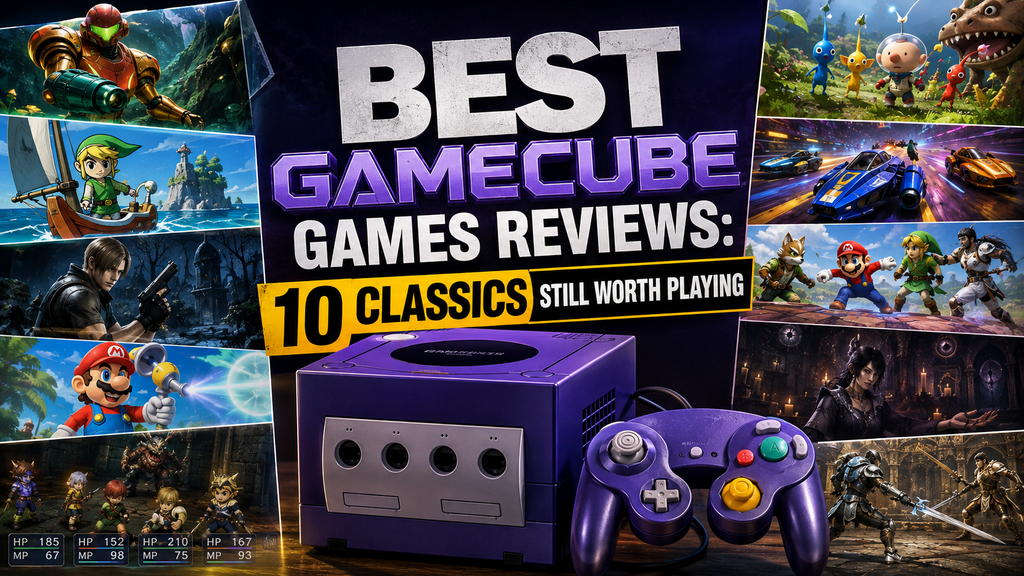
The best GameCube games reviews should not be based only on nostalgia. A game can be remembered fondly and still feel awkward decades later, while another can retain its mechanical precision long after its original hardware has disappeared from living rooms.
Nintendo’s GameCube library has an unusually strong mix of first party adventures, action games, horror, racing, RPGs, fighting games, and multiplayer experiences. Several titles remain highly regarded by critics, including Metroid Prime, The Legend of Zelda: The Wind Waker, Resident Evil 4, Super Mario Sunshine, Eternal Darkness, and SoulCalibur II. Metacritic’s current GameCube rankings place several of these among the platform’s highest rated releases.
There is also a practical reason to revisit the library in 2026. Nintendo’s GameCube Classics collection launched on Nintendo Switch 2 in June 2025 and has continued expanding. Nintendo currently lists games such as F Zero GX, SoulCalibur II, Super Mario Sunshine, The Wind Waker, and Fire Emblem: Path of Radiance among the collection’s featured titles.
This guide focuses on ten games that represent different strengths of the GameCube library. The goal isn’t to declare one universal winner. Instead, each recommendation explains what makes the game special, where it shows its age, and which type of player should try it.
What Makes a GameCube Game Worth Playing Today?
A strong retro game needs more than historical importance.
For this list, the most important factors are gameplay quality, mechanical depth, replayability, artistic identity, pacing, and how well the original design survives modern expectations.
Graphics receive less weight than they would in a contemporary review. A game released in the early 2000s obviously cannot compete technically with a current generation release. What matters is whether its art direction, controls, level design, and overall structure continue to work.
Accessibility matters too. Some GameCube games are now easier to experience through Nintendo’s GameCube Classics collection on Switch 2, while others remain tied more closely to their original hardware or later versions. Nintendo says the GameCube Classics service supports features such as suspend points, button mapping, and online multiplayer for compatible titles.
That makes this a particularly good time to separate genuine classics from games remembered mainly through nostalgia.
Best GameCube Games Reviews at a Glance
| Game | Genre | Why It Still Stands Out |
|---|---|---|
| Metroid Prime | Action adventure | Exploration and environmental design |
| The Wind Waker | Action adventure | Art direction and open ended exploration |
| Resident Evil 4 | Survival/action horror | Combat and pacing |
| Super Smash Bros. Melee | Fighting | Competitive depth and multiplayer |
| Super Mario Sunshine | 3D platformer | Movement and level challenges |
| Eternal Darkness | Psychological horror | Atmosphere and unusual mechanics |
| Pikmin 2 | Strategy | Resource management and exploration |
| F Zero GX | Racing | Speed, precision, and difficulty |
| Paper Mario: The Thousand Year Door | RPG | Combat, humor, and progression |
| SoulCalibur II | Fighting | Accessible combat with considerable depth |
The choices are supported by the historical critical reception as well as their continued relevance. For example, Metroid Prime holds a 97 Metascore, The Wind Waker and Resident Evil 4 each hold 96, Super Mario Sunshine, Eternal Darkness, and Super Smash Bros. Melee sit at 92, and SoulCalibur II reaches 93 on GameCube.
Metroid Prime Still Sets the Exploration Standard
Best for: Exploration, atmosphere, environmental puzzles, and action adventure fans.
Metroid Prime is arguably the clearest example of a GameCube game that succeeded because of design rather than hardware power.
Retro Studios translated the traditional Metroid formula into a first person perspective without turning it into a conventional shooter. Exploration remains the central activity. Players gradually acquire abilities that open previously inaccessible areas, encouraging them to remember locations and reconsider environments.
The result is a world that feels interconnected rather than divided into unrelated stages.
Combat is important, but it isn’t the sole reason to keep moving forward. Scanning environments, finding upgrades, solving spatial puzzles, and understanding how different abilities interact with the world create a steady rhythm.
Critics still rate it exceptionally highly: Metroid Prime has a 97 Metascore based on 70 critic reviews.
The downside: Some backtracking and older interface conventions can feel less convenient today.
Verdict: If you want one GameCube game that demonstrates how strong environmental design can be, start here.
The Wind Waker Remains a Brilliant Adventure
Best for: Exploration, story, colorful art direction, puzzles, and adventure.
The Legend of Zelda: The Wind Waker initially divided audiences because of its cel-shaded visual style, but that aesthetic has aged remarkably well.
The Great Sea provides a different structure from traditional land based Zelda games. Instead of moving continuously through connected terrain, players travel between islands, discover secrets, solve dungeons, collect equipment, and gradually uncover the larger story.
The combat is straightforward but responsive, while the game’s expressive animation gives characters and enemies an unusual amount of personality.
The critical response was exceptionally strong. The GameCube version currently carries a 96 Metascore from 80 critic reviews.
Its main weakness is pacing. Sailing can sometimes make progression feel slower than modern open world traversal, and parts of the late game treasure hunt are less elegant than the strongest dungeons.
Still, the core adventure remains excellent.
Nintendo’s current GameCube Classics collection also includes The Wind Waker on Switch 2, making it one of the more accessible ways to experience the original GameCube era adventure in 2026.
Verdict: One of the easiest GameCube recommendations for players who value exploration and atmosphere.
Resident Evil 4 Changed Action Horror
Best for: Action, horror, third person shooting, and tightly paced campaigns.
Resident Evil 4 occupies an unusual position in this list because its influence extends far beyond the GameCube.
The game moved the series toward more aggressive third person action while retaining resource management and horror elements. The over the shoulder camera created a stronger connection between aiming, positioning, enemy encounters, and movement.
Its pacing is particularly impressive. Combat encounters are broken up by exploration, puzzles, story sequences, and changes in environment, preventing the campaign from feeling like one continuous shooting gallery.
The GameCube release earned a 96 Metascore from 82 critics.
The original version naturally looks dated compared with modern remakes and remasters. Some controls and presentation choices also reflect its era.
But mechanically, much of the foundation remains remarkably effective.
Verdict: A must play for anyone interested in how modern third person action games evolved.
Super Smash Bros. Melee Is Still a Multiplayer Favorite
Best for: Competitive players, local multiplayer, fighting game fans, and party sessions.
Super Smash Bros. Melee demonstrates another side of the GameCube.
Its basic concept is immediately accessible: select a character, enter an arena, attack opponents, and knock them out of the stage. But beneath that simple structure is a surprisingly demanding fighting system.
Movement, spacing, recovery, defensive options, stage positioning, and matchup knowledge give experienced players enormous room to improve.
Its 92 Metascore reflects the game’s strong critical reception, while its reputation for competitive depth has continued long after the GameCube generation.
The biggest distinction between Melee and many modern fighting games is how little it needs outside its core mechanics. There is no battle pass or live service structure. The value comes from learning the game and playing against other people.
Verdict: Still one of the strongest GameCube choices for competitive multiplayer.
Super Mario Sunshine Rewards Skilled Platforming
Best for: 3D platforming, movement challenges, collectibles, and players who enjoy experimentation.
Super Mario Sunshine is sometimes overshadowed by other 3D Mario games, but that doesn’t make it a weak GameCube title.
Its defining mechanic is FLUDD, the water based backpack system that expands Mario’s movement options. It can clean surfaces, hover, propel Mario, and create new approaches to platforming challenges.
That changes the basic movement system rather than simply adding another attack.
The game earned a 92 Metascore from 61 critic reviews.
Some objectives are notably more demanding than modern Mario games, and the camera can occasionally create frustration. Certain missions also have uneven pacing.
But the movement system gives skilled players plenty to master.
Verdict: A strong pick for players who care more about movement and challenge than a perfectly smooth campaign.
Eternal Darkness Offers Something Completely Different
Best for: Horror fans, psychological tension, atmosphere, and unusual game mechanics.
Eternal Darkness: Sanity’s Requiem remains one of the most distinctive games in the GameCube catalog.
Rather than relying entirely on conventional jump scares, the game plays with the player’s expectations through its sanity system and psychological effects.
Its story moves across different historical periods and characters, giving the campaign a broader scope than a typical single location horror game.
The game received a 92 Metascore based on 41 critic reviews, with 40 of those reviews classified as positive by Metacritic.
The biggest limitation today is availability. Unlike some better known Nintendo classics, it has not received the same level of modern re release exposure.
That makes the original GameCube experience particularly interesting for collectors and retro horror enthusiasts.
Verdict: One of the strongest choices if you want something outside Nintendo’s usual family friendly image.
Pikmin 2 Shows How Creative GameCube Design Could Be
Best for: Strategy, resource management, exploration, and puzzle solving.
Pikmin 2 combines real time strategy with exploration in a way that remains difficult to categorize.
Players command groups of Pikmin with different abilities while collecting objects, fighting enemies, solving environmental puzzles, and managing limited resources.
The game’s strength comes from multitasking. You aren’t simply telling units where to move. You’re deciding which Pikmin types to use, how many to assign to a task, and how much time or risk is acceptable.
Metacritic lists the GameCube version at a 90 Metascore.
Its slower pace may not appeal to players looking for constant action, but that is part of its identity.
Verdict: An excellent recommendation for players who enjoy strategy games but want something more approachable than a traditional real time strategy title.
F Zero GX Is Built for Racing Perfectionists
Best for: High speed racing, difficult challenges, time trials, and competitive improvement.
F Zero GX is not a relaxing racing game.
Its futuristic tracks are designed around extreme speed, tight turns, hazards, jumps, and demanding precision. The game expects players to learn tracks rather than simply react to them.
That makes its difficulty part of the appeal.
The game holds an 89 Metascore from 50 critics.
Its learning curve can be steep. A player accustomed to forgiving modern racers may initially find GX punishing.
But once the controls begin to click, the high speed design becomes the game’s biggest strength.
Nintendo currently lists F Zero GX among the featured GameCube titles available through Nintendo GameCube Classics on Switch 2.
Verdict: Recommended for players who want a demanding racer rather than a casual kart style experience.
Paper Mario: The Thousand Year Door Is a Standout RPG
Best for: Turn based combat, story driven RPGs, character progression, humor, and exploration.
The original Paper Mario: The Thousand Year Door is one of the GameCube’s most recognizable RPGs.
Its combat system mixes traditional turn based commands with timing based inputs. Attacks can become more effective when the player performs actions correctly, creating a more interactive battle system than simple menu selection.
Party members also give combat more tactical variety.
The original GameCube release received an 87 Metascore from 55 critics.
A major advantage for modern players is that the game eventually received a Switch remake in 2024, so players who don’t have original GameCube hardware have another official option.
The original remains valuable for players interested in the console’s RPG history, particularly because its presentation and gameplay structure are closely tied to the GameCube era.
Verdict: One of the strongest GameCube RPG recommendations, especially for players who enjoy character driven turn based combat.
SoulCalibur II Is One of the Console’s Best Fighters
Best for: Fighting games, local multiplayer, weapon based combat, and arcade style replayability.
SoulCalibur II is a great example of a third party game fitting perfectly into the GameCube library.
Its weapon based combat is easy to understand but offers considerable depth once players start learning movement, spacing, combos, defensive techniques, and character specific strategies.
The GameCube version earned a 93 Metascore from 45 critics, slightly above the PlayStation 2 and Xbox versions according to Metacritic’s platform breakdown.
The game’s biggest strength is its accessibility. Someone can pick up a controller and understand the basic combat quickly, while experienced players have much more to learn.
Nintendo’s current GameCube Classics collection also includes SoulCalibur II, giving modern players another official way to experience it.
Verdict: One of the safest recommendations for GameCube multiplayer and fighting game fans.
How These GameCube Classics Hold Up in 2026
The most interesting thing about this group is how differently each game ages.
Metroid Prime remains strong because exploration and environmental progression are timeless design principles.
The Wind Waker benefits enormously from its distinctive visual direction. Its cel shaded presentation doesn’t depend on realistic graphics, so it remains visually recognizable rather than simply old-looking.
Resident Evil 4 has a more complicated situation because modern versions have improved presentation and controls, but the original remains historically important and mechanically strong.
Super Smash Bros. Melee has perhaps the most unusual relationship with modern gaming. Its competitive community has preserved interest in a game that was never designed around today’s live service model.
Super Mario Sunshine is more divisive. Its movement is excellent, but its camera and some objectives can feel less polished than later 3D Mario games.
Eternal Darkness remains highly distinctive but is less convenient to access.
Pikmin 2 has aged well because its strategy mechanics are not tied to visual technology.
F Zero GX remains demanding rather than outdated. Its difficulty is part of the design.
Paper Mario: The Thousand Year Door has modern accessibility through its remake, while SoulCalibur II continues to demonstrate how strong a focused fighting system can be.
This is why a good retro review should not simply ask whether a game was great in its original year. The better question is: Does its central design still work when separated from nostalgia?
For most games on this list, the answer is yes.
Which GameCube Game Should You Play First?
Your first choice should depend on what you want from the console.
Choose Metroid Prime if exploration and atmosphere matter most.
Choose The Wind Waker for a traditional adventure with a distinctive visual style.
Choose Resident Evil 4 if you want action and horror.
Choose Super Smash Bros. Melee for competitive multiplayer.
Choose Super Mario Sunshine if movement based platforming appeals to you.
Choose Eternal Darkness for psychological horror.
Choose Pikmin 2 if you prefer strategy and resource management.
Choose FZero GX if you want a serious racing challenge.
Choose Paper Mario: The Thousand Year Door for an RPG.
Choose SoulCalibur II for weapon based fighting.
For newcomers specifically, Metroid Prime, The Wind Waker, and Resident Evil 4 are probably the easiest starting points because their strengths remain immediately understandable even without prior GameCube experience.
For multiplayer, Super Smash Bros. Melee and SoulCalibur II are the obvious choices.
For something less conventional, Eternal Darkness and Pikmin 2 show why the GameCube library was more varied than its biggest Nintendo franchises might suggest.
Final Verdict
The strongest best GameCube games reviews aren’t really about choosing a single winner. The console’s library was successful because it offered very different experiences that could all work within the same generation.
Metroid Prime demonstrates exceptional exploration. The Wind Waker proves that strong art direction can age beautifully. Resident Evil 4 remains an important action game landmark. Super Smash Bros. Melee has extraordinary competitive longevity, while Super Mario Sunshine still offers distinctive movement based platforming.
Then there are the less obvious choices. Eternal Darkness delivers psychological horror, Pikmin 2 offers inventive strategy, F Zero GX provides demanding racing, Paper Mario: The Thousand-Year Door delivers a memorable RPG structure, and SoulCalibur II remains a superb fighting game.
The GameCube’s relevance in 2026 is also helped by Nintendo’s expanding GameCube Classics library on Switch 2. Nintendo says the service is continuing to add titles, with GameCube games available through Nintendo Switch Online + Expansion Pack.
If you’re discovering the system for the first time, don’t approach these games simply as historical artifacts. Play them as games. The ones that still feel good after the nostalgia wears off are the ones that truly earned their classic status.
FAQ
What is the best GameCube game overall?
There is no objective single winner, but Metroid Prime, The Wind Waker, and Resident Evil 4 are among the strongest choices based on critical reception and lasting gameplay quality. Metroid Prime currently has a 97 Metascore, while The Wind Waker and Resident Evil 4 each have 96.
Are GameCube games still worth playing in 2026?
Yes. The strongest GameCube games remain playable because their core mechanics, level design, art direction, and progression systems don’t depend entirely on modern graphics technology.
Which GameCube game is best for beginners?
The Wind Waker is an approachable starting point for adventure fans, while Super Mario Sunshine is a good introduction to 3D platforming. Metroid Prime is also a strong choice for players who enjoy exploration.
What is the best GameCube multiplayer game?
Super Smash Bros. Melee is the strongest competitive choice, while SoulCalibur II is an excellent alternative for traditional fighting game fans.
Which GameCube game has the highest Metascore on this list?
Metroid Prime leads this selection with a 97 Metascore. The Wind Waker and Resident Evil 4 follow at 96.
Can you play GameCube games on Switch 2?
Nintendo offers a GameCube Classics collection on Switch 2 through Nintendo Switch Online + Expansion Pack. The library includes titles such as The Wind Waker, Super Mario Sunshine, F Zero GX, and SoulCalibur II.
Is the original GameCube version of Paper Mario: The Thousand Year Door still worth playing?
Yes, particularly for retro collectors and players interested in the original GameCube experience. A modern remake was released for Nintendo Switch in 2024, but the original remains an important GameCube RPG.
Which GameCube game is best for horror fans?
Resident Evil 4 is the stronger choice for action focused horror, while Eternal Darkness: Sanity’s Requiem is better for players looking for psychological horror and unusual mechanics.
LEAVE A PIXEL ZINE COMMENT