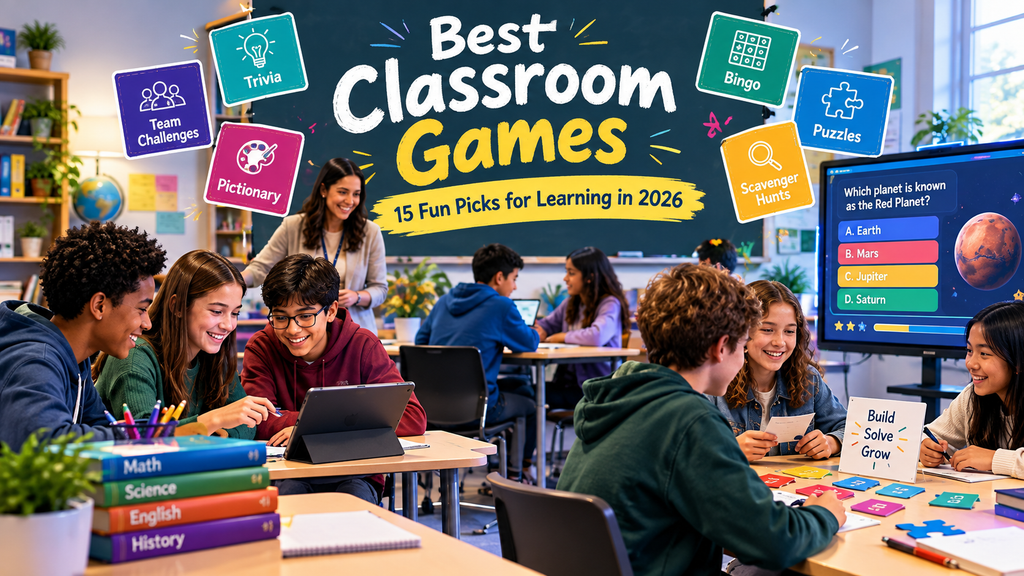
Classroom games work best when the game serves the lesson rather than distracting from it. A quick trivia round can expose knowledge gaps, a team challenge can improve communication, and a creative guessing game can get students talking when a traditional worksheet has lost their attention.
The best classroom games are therefore not necessarily the loudest or most competitive. The right choice depends on the age of the students, subject, available technology, class size, lesson objective, and amount of preparation time.
This guide covers 15 classroom friendly games, from traditional activities such as Pictionary and classroom bingo to digital platforms such as Kahoot, Blooket, and Gimkit. It also explains when to use each format, what makes it effective, and where teachers should be careful.
What Makes the Best Classroom Games Actually Work?
A classroom game needs a clear purpose. If students are having fun but the activity has little connection to the lesson, it may be better described as a break rather than a learning game.
The strongest activities usually combine three elements: simple rules, meaningful participation, and a clear learning objective.
A vocabulary game, for example, should encourage students to retrieve and use new words. A history trivia game should reinforce dates, people, events, or concepts that have already been taught. A mathematics challenge should require students to apply mathematical thinking rather than simply guess answers.
Competition can help, but it should not become the entire point.
Teachers should also consider how many students participate at the same time. A game that works brilliantly with 12 students may become chaotic with 35. Similarly, a fast paced digital quiz may suit a review lesson but be less effective when students need time to explain complicated reasoning.
The best classroom games are flexible enough to support the way students actually learn.
Best Classroom Games for Different Learning Goals
Best for review and knowledge checks
Quiz based activities are particularly useful near the end of a lesson or before an assessment. They allow teachers to identify areas where students understand the material and areas that need another explanation.
Kahoot, for example, supports live games as well as student paced activities. Its school tools include quizzes, polls, puzzles, different question formats, reporting, and team based experiences.
Traditional trivia works just as well when devices are unavailable. The important part is the quality of the questions.
Best for teamwork and communication
Team challenges can be more useful than individual leaderboards when the goal is collaboration.
Activities such as classroom scavenger hunts, team trivia, Pictionary, and problem solving races encourage students to explain ideas to classmates. A team format can also reduce the pressure on students who are uncomfortable competing individually.
Best for creativity and problem solving
Games such as Pictionary, charades, mystery challenges, and classroom escape activities require students to interpret information rather than simply recall it.
These formats work especially well for language learning, literature, history, science concepts, and interdisciplinary lessons.
15 Best Classroom Games to Try
1. Classroom Trivia
Classroom trivia is one of the easiest activities to adapt to almost any subject.
Prepare questions based on the material students have recently studied and divide the class into small teams. Each team discusses its answer before submitting it.
The format can be simple enough for elementary students or considerably more challenging for older learners.
The main advantage is flexibility. A science teacher can ask about ecosystems, a history teacher can focus on historical events, and a language teacher can build questions around vocabulary and grammar.
Keep questions varied. Mixing straightforward recall with application questions makes the activity more interesting and gives the teacher better information about student understanding.
2. Pictionary
Pictionary turns concepts into visual clues.
Instead of drawing random objects, students can draw vocabulary words, scientific processes, historical concepts, literary characters, or mathematical ideas.
For example, a science class studying the water cycle could have students draw evaporation or precipitation. A language class could use vocabulary words that students must identify.
Pictionary is particularly useful because students have to translate a concept into a visual representation.
It also works without computers, making it a practical choice for classrooms with limited technology.
3. Classroom Bingo
Bingo becomes much more useful when the squares contain learning objectives instead of random numbers.
A teacher might create a vocabulary bingo card where each square contains a word. Students could then hear definitions and identify the correct term.
Another approach is to put answers on the card and ask questions aloud.
The key is making students think before marking a square. Simply calling out words provides entertainment, but requiring students to connect definitions, examples, or clues to the correct answer adds educational value.
4. Charades
Charades can support vocabulary, language learning, literature, history, and even science.
Students act out a concept while classmates attempt to identify it.
The activity works especially well when the vocabulary involves actions or processes. It can also be used as a review activity after students have completed a unit.
Keep the rules simple and avoid forcing students who are uncomfortable performing in front of the class. Allowing teams to nominate volunteers usually creates a better atmosphere.
5. Classroom Scavenger Hunt
A scavenger hunt can transform the classroom into a problem solving environment.
Teachers can place questions, clues, definitions, or tasks around the room. Students work individually or in teams to find and solve them.
For a history lesson, each clue might point to another historical event. For science, students might match observations to concepts. For English, clues can involve vocabulary or literary analysis.
The strongest scavenger hunts require students to solve something at each stage rather than simply locate the next piece of paper.
6. Jeopardy Style Review
A Jeopardy style classroom game works particularly well before tests.
Create categories based on major topics from the unit and assign different point values according to difficulty.
Students can work in teams and discuss their answers before responding.
This format rewards strategic thinking because teams must decide which questions to attempt. It also gives teachers a straightforward way to revisit material that students may have forgotten.
Digital versions exist, but a simple board on a projector or whiteboard works perfectly well.
7. Twenty Questions
Twenty Questions is a strong choice for subjects involving identification and classification.
One student or team thinks of a person, object, concept, place, or term. Other students ask questions that can be answered with yes or no.
The educational value comes from teaching students to ask useful questions.
Instead of guessing randomly, students need to narrow the possibilities. That makes the game useful for vocabulary, science classification, geography, history, and general knowledge.
8. Two Truths and a Lie
Two Truths and a Lie can be adapted for educational review.
Give students three statements about a topic. Two should be accurate and one should be incorrect. Students identify the false statement and explain why.
The explanation is more valuable than simply choosing the answer.
Teachers can use this format to expose misconceptions. If students repeatedly accept a false statement, that tells the teacher something about what needs clarification.
9. Word Association
Word association is especially useful for language classes.
Start with a target word and ask students to provide related words. The teacher can gradually make the challenge more specific by requiring synonyms, antonyms, examples, definitions, or words from the same category.
For advanced students, the activity can become a timed team challenge.
It requires almost no equipment and can be adapted to different ability levels.
10. Mystery Object
Mystery Object is a simple guessing game with strong descriptive language potential.
Place an object in a bag or container. Students ask questions or listen to clues until they can identify it.
The object can be connected to the lesson. A science class might use a rock, scientific instrument, or model. A history class could use a reproduction or classroom prop.
Students can also create the clues themselves, turning the game into a communication exercise.
11. Hot Seat
In Hot Seat, one student sits with their back to the board while a word or concept appears behind them.
Classmates provide clues without saying the actual answer.
The student in the hot seat has to identify the term.
This works particularly well for vocabulary review because students must explain meaning without relying on the exact word.
Teachers should establish clear rules about acceptable clues to prevent students from simply giving away the answer.
12. Escape Room Challenge
Classroom escape activities can combine several subjects or concepts into one structured challenge.
Students solve puzzles, decode clues, answer questions, and complete tasks to reach the final solution.
The strength of this format is progression. Each successful task provides information needed for the next step.
The weakness is preparation. A well designed escape activity takes considerably more planning than a five minute trivia game.
Use it for special review sessions, end of unit activities, or lessons where collaborative problem solving is a major objective.
13. Kahoot
Kahoot is one of the most recognizable digital classroom game platforms.
Teachers can host live games in class or remotely, while students answer using their own devices. Kahoot also supports student paced activities for homework and independent review.
Its range of question types makes it more flexible than a basic multiple choice quiz. Teachers can use quizzes, polls, puzzles, word clouds, open ended questions, and other formats depending on the available plan and classroom needs.
Kahoot is particularly effective when a teacher wants quick feedback from an entire class.
The main consideration is that speed based competition can sometimes reward fast clicking rather than careful thinking. For difficult material, accuracy focused or student paced modes can be a better fit. Kahoot currently provides an Accuracy mode designed to emphasize correct answers over speed.
14. Blooket
Blooket takes quiz questions and places them inside different game formats.
That game first approach can be useful for review sessions where students need repeated exposure to material without feeling like they are completing another conventional quiz.
Blooket is especially worth considering for teachers who want variety in how the same question set is presented. Recent classroom comparisons continue to place it among the major game based quiz options alongside Kahoot, Gimkit, and other platforms.
The important teaching decision is to keep the question content strong. A fun game mode cannot compensate for questions that are vague, excessively easy, or unrelated to the lesson.
15. Gimkit
Gimkit adds strategy mechanics to quiz based learning.
Correct answers can feed into an in game economy, allowing students to make decisions during the session rather than simply accumulate points.
That structure makes Gimkit appealing for older students who enjoy strategy and competition. Recent comparisons describe its economy focused approach as a key distinction from more traditional quiz formats.
The trade off is complexity. A more elaborate game can require students to understand the game system before they can focus completely on the educational content.
For a short review activity, a simpler quiz may be preferable. For a longer session where strategy itself can support engagement, the additional mechanics can be useful.
Digital Classroom Games vs. No Tech Activities
There is no universal winner between digital and traditional classroom games.
Digital platforms are excellent when teachers want automatic scoring, quick participation data, student paced activities, or large scale quizzes. Kahoot, for example, provides reporting tools that can help educators review class performance and identify areas requiring follow up.
No tech games have different advantages.
They are easier to start when devices or internet access are unreliable, and many encourage direct conversation between students. Pictionary, charades, Twenty Questions, and team trivia can be launched with little equipment.
A good classroom strategy is to maintain both options.
If technology fails, the lesson should not collapse because the activity depends entirely on an online platform. Having a paper based backup can save valuable teaching time.
How to Choose the Right Classroom Game
The best classroom games should be selected according to the lesson objective, not simply popularity.
Ask five questions before choosing an activity:
What should students practice?
Choose a game that reinforces that specific skill.
How much time do I have?
A five minute vocabulary game is different from a 45 minute team challenge.
How many students are participating?
Large classes often benefit from teams, while smaller groups can support discussion heavy games.
Does the activity require technology?
Check devices, internet access, projection equipment, and student logins before class.
What happens after the game?
A strong activity should produce something useful: evidence of understanding, discussion, corrected misconceptions, practice, or reflection.
This final question is often overlooked.
If students finish a game and immediately move to something unrelated, much of the educational value can disappear. A quick discussion of missed questions or a short written reflection can turn entertainment into meaningful review.
Common Mistakes Teachers Should Avoid
The first mistake is making every activity competitive.
Competition can energize a class, but some students perform better when they are given time to think without a public leaderboard. Mixing individual, team, collaborative, and self paced formats creates a more balanced classroom.
The second mistake is using games without a learning objective.
A classroom activity should have a reason for being there. If the teacher cannot explain what students are practicing, the game may be better saved for a break.
Another common problem is excessive complexity. If explaining the rules takes longer than playing the activity, simplify it.
Digital platforms can create another issue: technology becomes the focus instead of the lesson. Teachers should test the game before class and have a backup plan.
Finally, avoid treating scores as perfect measurements of learning. A student can lose a fast paced quiz because of timing or pressure while still understanding the material. Game results should be interpreted alongside class discussion, written work, assignments, and other forms of assessment.
FAQs About Classroom Games
What are the best classroom games for students?
The best choice depends on the lesson. Trivia, Pictionary, bingo, scavenger hunts, team challenges, Kahoot, Blooket, and Gimkit are strong options because they can be adapted to different subjects and age groups.
What classroom games require no technology?
Pictionary, charades, classroom bingo, Twenty Questions, trivia, Hot Seat, word association, and scavenger hunts can all be played without computers or student devices.
What are the best online classroom games?
Kahoot, Blooket, and Gimkit are among the most recognizable options for game based classroom activities. Kahoot supports both live and student paced play, while Blooket and Gimkit use more game like mechanics around question based activities.
Are classroom games actually useful for learning?
They can be, when the activity reinforces a specific learning objective. Games are most useful as practice, review, formative assessment, retrieval activities, or collaborative exercises rather than replacements for instruction.
What is the best classroom game for large groups?
Team based trivia and digital quiz platforms are generally easier to manage with large groups because many students can participate simultaneously. The exact capacity and features depend on the platform and plan being used.
How long should a classroom game last?
There is no universal ideal length. A quick review game can take five to ten minutes, while a larger collaborative challenge can occupy most of a lesson. The activity should be long enough to accomplish its objective without becoming repetitive.
Are classroom games suitable for older students?
Yes. Older students often respond well to strategy based quizzes, debates, mystery challenges, escape room activities, competitive review games, and structured team challenges. The content and difficulty should match their academic level.
Final Verdict
The best classroom games are not defined by flashy graphics, leaderboards, or complicated mechanics. They are the activities that make students actively retrieve information, communicate, solve problems, practice skills, or explain their reasoning.
For fast digital review, platforms such as Kahoot can be particularly useful because teachers can run live activities, assign self faced work, and review performance data. Blooket and Gimkit offer more game focused approaches for teachers who want additional gameplay mechanics.
For classrooms without reliable technology, traditional activities remain highly effective. Pictionary, trivia, scavenger hunts, charades, Hot Seat, and mystery challenges require little equipment and can be adapted to almost any subject.
The smartest approach is not to pick one permanent favorite. Build a small collection of activities for different situations: a quick five minute review, a collaborative lesson, an assessment check, a vocabulary session, and a larger end of unit challenge. That gives teachers flexibility while keeping the game connected to what students actually need to learn.
LEAVE A PIXEL ZINE COMMENT