Strategy board games reward players who think beyond their next move. Some challenge you to manage scarce resources, others require careful positioning or clever card combinations, and a few make every decision depend on what your opponents are planning. The best choice depends on whether you enjoy direct competition, long-term planning, cooperative problem-solving, or learning a complex system over several sessions.
These strategy board games reviews compare seven established tabletop games with distinct approaches to strategic play. The selection includes accessible gateway games, competitive planning challenges, cooperative survival, and asymmetric conflict. Each review considers its central mechanics, strengths, limitations, replayability, and ideal audience.
Rather than treating the most complicated game as automatically the best, this guide focuses on the experience each title offers. A straightforward game with meaningful choices can be more satisfying for a new group than a demanding strategy title that takes an hour to explain.
What Makes a Great Strategy Board Game?
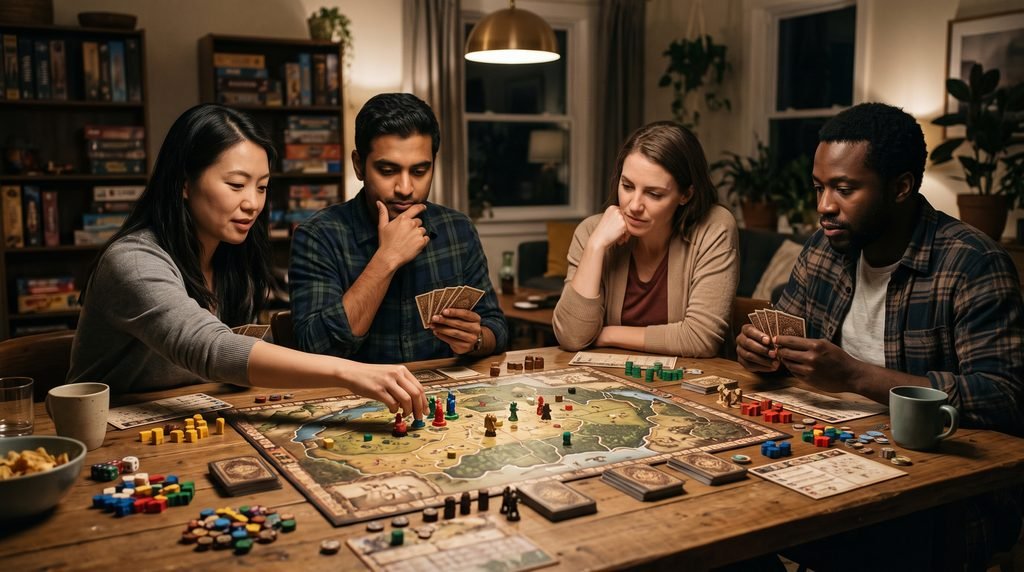
A strategy board game gives players meaningful decisions that influence the outcome. Those decisions might involve spending resources now or saving them for later, occupying a valuable location before an opponent does, building an efficient combination of cards, or predicting another player’s next move.
The important distinction is between making a decision and simply following a sequence. Strong strategy games give players several plausible options, each with advantages and risks. The challenge comes from deciding which opportunity matters most in the current situation.
Core mechanics that shape strategic play
Different games emphasize different skills.
- Resource management: Players collect, trade, or spend limited resources to develop their position.
- Area control: Players compete to influence or dominate locations on a board.
- Engine building: Early actions create systems that generate stronger benefits later.
- Card drafting: Players select cards from a shared or rotating selection, balancing immediate usefulness against future plans.
- Worker placement: Players assign limited workers or action pieces to spaces that provide particular benefits.
- Cooperative planning: Players share information and coordinate actions against a common challenge.
- Asymmetric strategy: Players use different factions or abilities, creating different objectives and tactical priorities.
Complexity is only one part of the evaluation. A game can have simple rules but still offer substantial strategic depth. Conversely, a large rulebook does not guarantee that every decision will be interesting.
A good strategy board game should also fit the people at the table. Player count, average session length, downtime between turns, interaction, and willingness to learn new rules all affect whether a game becomes a regular favorite.
Strategy Board Games Reviews: Seven Games Compared
The following games represent different approaches to strategy. The recommendations are based on their established designs and intended play experiences, not fabricated personal playtests or invented review scores.
Catan — Best for Negotiation and Resource Management
Best for: Beginners, social groups, and players who enjoy trading.
Catan, originally published as The Settlers of Catan, introduces strategic resource management through a relatively approachable ruleset. Players build settlements and roads, expand across the island, and compete to reach the victory-point threshold.
Resources such as wood, brick, wheat, sheep, and ore support different construction and development options. The locations of settlements matter because they determine which terrain hexes can generate resources for a player. Dice rolls influence production, adding uncertainty to each round.
The central strategic challenge is managing that uncertainty. A player may have a promising building plan but lack one essential resource. Trading with other players can solve the problem, but every exchange carries a risk: the opponent might use the resources to improve their own position.
Placement decisions are especially important at the beginning. Settlements near productive terrain and useful combinations of resources provide more flexibility over time. However, the best location is not necessarily the one that produces the most resources overall; it may be the one that fills a gap in your starting economy or offers access to expansion routes.
Strengths
- Introduces resource management and planning without an especially intimidating ruleset.
- Negotiation creates direct interaction between players.
- Random production results encourage players to adapt.
- Expansion creates meaningful competition for space.
Weaknesses
- Dice luck can interrupt a carefully planned strategy.
- Trading may be frustrating when opponents refuse useful offers.
- Players who fall behind can struggle to catch up.
- Downtime can increase when negotiations become lengthy.
Strategic advice: Avoid building your entire plan around one resource or one highly productive location. Diversifying production and establishing useful routes can give you more options when the dice do not cooperate.
Verdict: Catan is a strong introduction to strategic tabletop gaming for groups that enjoy negotiation and competition for limited space. Players who dislike luck or bargaining may prefer a more deterministic design.
Ticket to Ride — Best for Beginners
Best for: Families, casual strategy players, and groups learning modern board games.
Ticket to Ride builds its strategy around railway routes, destination tickets, and a shared map. Players collect colored train cards and spend matching sets to claim routes between cities. Completed destination tickets provide points, while unfinished tickets can cost points at the end of the game.
The rules are easy to explain, but the decisions can be surprisingly tense. A player must decide whether to claim a route immediately, collect cards for a longer connection, or pursue a different route that still supports their destination tickets.
The map creates competition without requiring constant direct confrontation. Opponents can claim routes you need, forcing you to adapt. A route that appears safe early in the game may become difficult to complete if another player blocks a critical connection.
This makes planning flexible rather than absolute. You need a general sense of your objectives, but you should also watch the board and revise your route when circumstances change.
Different editions use different maps and may introduce additional rules, so the precise experience depends on the version you choose.
Strengths
- Easy for new players to understand.
- Combines visible objectives with hidden information.
- Route competition creates tension without complex combat.
- Different map editions can provide varied challenges.
Weaknesses
- Blocking can feel harsh when a critical route disappears.
- Drawing cards introduces uncertainty.
- Experienced players may eventually want more complex decisions.
- The best player count and pace can vary by edition.
Strategic advice: Build toward your destination tickets while preserving alternative routes. Do not spend every turn collecting cards for an ideal path if an opponent is close to claiming the connection you need.
Verdict: Ticket to Ride is an excellent first strategic board game for people who want accessible rules and meaningful planning. It offers enough tactical tension to keep experienced casual players engaged without overwhelming newcomers.
Azul — Best for Tactical Planning
Best for: Players who enjoy pattern building, efficient choices, and compact games.
Azul asks players to draft colored tiles and arrange them into patterns on personal player boards. Tiles are taken from shared factories or a central supply, and players must decide how to distribute them across their pattern lines. Completed lines allow tiles to be placed on the wall, where scoring depends on their position and neighboring tiles.
Its rules are relatively straightforward, but the shared tile supply makes every selection consequential. Taking the tiles you want may leave unwanted pieces that create penalties, while taking too many of one color can force you to place excess tiles in a penalty area.
The game rewards planning at two levels. First, you need to build your own board efficiently. Second, you must consider what remains for your opponents. Taking a tile can deny an opponent a useful option, but doing so is only worthwhile if the choice does not damage your own position.
Azul also encourages players to think about scoring patterns rather than filling spaces randomly. A placement can contribute to a row, a column, or a color-based objective, depending on the scoring rules. The best move often supports several goals without creating an immediate problem elsewhere.
Strengths
- Clear rules with substantial tactical decisions.
- Shared drafting creates interaction without direct conflict.
- Compact sessions make it easier to replay.
- Visual patterns make progress easy to follow.
Weaknesses
- Penalties can punish poor tile management.
- Limited long-term planning may disappoint players who prefer large strategy systems.
- Opponent choices can disrupt an otherwise efficient plan.
- The puzzle-like structure may feel abstract to players who want a strong theme.
Strategic advice: Before taking a set of tiles, consider where every tile can legally go and what happens to any excess. Also pay attention to colors and quantities that could complete an opponent’s line.
Verdict: Azul is a strong choice for players who want strategic depth without a long setup or an extensive rulebook. Its challenge comes from making efficient decisions with a changing shared supply.
7 Wonders — Best for Strategic Card Drafting
Best for: Groups who want simultaneous decisions and civilization-building themes.
7 Wonders is a civilization-themed card-drafting game in which players develop their cities across three ages. Cards can provide resources, military strength, scientific symbols, commercial advantages, or points. Players select a card from their current hand and pass the remaining cards to another player, repeating the process with a changing selection.
This structure makes card evaluation central to the game. A card may be useful because of its immediate benefits, because it completes a set, or because it prevents an opponent from obtaining something valuable. Since hands circulate, players must consider both the cards they keep and the opportunities they pass along.
The game also asks players to balance competing priorities. Scientific development can reward specific symbol combinations, military strength affects conflict with neighboring players, and resource production helps support future construction. Focusing too narrowly on one path may leave a city vulnerable in another area.
A major advantage is that many decisions happen simultaneously. This reduces the feeling of waiting through lengthy individual turns, making the game suitable for groups that want substantial choices without constant downtime.
Different editions and related versions can have different player-count requirements and rules. Check the exact edition before purchasing, particularly if you mainly play with two people.
Strengths
- Card drafting creates layered decisions.
- Multiple scoring paths support different strategies.
- Simultaneous selection helps keep turns moving.
- Passing hands create interaction and uncertainty.
Weaknesses
- New players may need time to understand card symbols and scoring.
- The passing-hand structure can make some choices difficult to predict.
- Scientific combinations and military planning require attention to opponents.
- Not every edition suits every group size.
Strategic advice: Avoid collecting cards simply because they appear powerful. Look at your existing resources, your scoring direction, and the cards your neighbors may benefit from. A balanced city often has more flexibility than one that commits too early without the support it needs.
Verdict: 7 Wonders suits players who enjoy evaluating several options quickly and developing a strategy over multiple rounds. It is especially attractive to groups that dislike long waits between turns.
Terraforming Mars — Best for Long-Term Engine Building
Best for: Experienced strategy players who enjoy economic planning and longer sessions.
Terraforming Mars puts players in charge of corporations working to make Mars more habitable. Players use project cards, resources, and production systems to contribute to the planet’s development while improving their own economic position.
The central challenge is engine building. Early investments may provide little immediate benefit but generate resources or advantages in later rounds. Players must decide when to invest in future production and when to pursue objectives that provide immediate progress or points.
Project cards create variety because different combinations can support different approaches. Some improve resource production, others interact with tags or environmental conditions, and some provide points or help advance the shared terraforming objectives. The value of a card depends on timing, available resources, and the strategy developing around it.
The game’s longer structure makes planning particularly important. Spending everything on immediate gains can leave you without the resources needed for powerful later projects. On the other hand, investing too heavily in future production may leave too little time to convert that production into a winning score.
Terraforming Mars also combines personal development with a shared race toward global objectives. Players can benefit from advancing the planet while competing to maximize their own results.
Strengths
- Deep engine-building decisions.
- Multiple paths for developing an effective corporation.
- Cards create varied combinations and strategic opportunities.
- Strong appeal for players who enjoy long-term planning.
Weaknesses
- Longer sessions require more commitment.
- The volume of cards and rules can challenge beginners.
- Some turns involve considerable evaluation and calculation.
- Random card availability can affect which strategies are practical.
Strategic advice: Assess each investment by asking how much time remains to benefit from it. Production upgrades are most valuable when they can generate resources for several future rounds. Late in the game, direct points or immediate contributions may be more useful.
Verdict: Terraforming Mars is a compelling option for players who want a demanding economic strategy game. It is less suitable for groups seeking a quick introduction or a short, casual session.
Pandemic — Best for Cooperative Strategy
Best for: Families, couples, and groups that prefer teamwork over direct competition.
Pandemic changes the usual competitive structure by asking players to work together against the game. Players take on roles with different abilities and coordinate their actions to contain disease outbreaks, manage infections, and discover cures before the situation becomes unmanageable.
The difficulty comes from limited actions and competing priorities. Traveling between cities, treating infections, sharing information, and collecting the cards needed for cures all consume valuable turns. Players cannot solve every problem immediately, so they must decide which threats are most urgent.
Communication is essential. One player might have the cards needed for a cure, while another is better positioned to control infections in a critical region. Coordinating these strengths can make the difference between stabilizing the board and allowing outbreaks to spread.
Pandemic is also useful for teaching strategic prioritization. Players must distinguish between a visible problem that can wait and a small threat that could trigger a chain reaction. The right move is not always the one that removes the most infection cubes immediately; it may be the action that prevents a dangerous future outbreak.
The cooperative format has a potential weakness: one confident player may begin directing everyone else’s turns. Groups can avoid this by asking each participant to explain their reasoning and allowing everyone to make their own decisions.
Strengths
- Encourages planning and communication.
- Shared objectives make it accessible to players who dislike direct competition.
- Different roles encourage coordinated approaches.
- Threat escalation creates meaningful urgency.
Weaknesses
- Players can lose if the group fails to manage several threats at once.
- Repeated losses may frustrate less experienced players.
- One player can dominate decisions if the group is not careful.
- Replayability depends partly on changing roles, decisions, and game circumstances.
Strategic advice: Discuss the next few turns together, but do not focus exclusively on the largest visible cluster of infections. Consider outbreak risk, card requirements, travel time, and the consequences of leaving a region unattended.
Verdict: Pandemic is an excellent choice for players who enjoy shared problem-solving. It provides strategic tension without requiring participants to defeat one another.
Root — Best for Asymmetric Strategy
Best for: Experienced players who enjoy faction-specific abilities and indirect conflict.
Root is a woodland conflict game in which different factions compete for control and influence. Its defining feature is asymmetric design: factions have distinct rules, resources, actions, and ways of pursuing victory.
That difference makes Root more demanding than a typical area-control game. Learning your own faction is only the first step. You also need to understand how the other factions operate, which threats they can create, and how their goals might change the balance of power.
A move that seems strong for one faction may be inefficient for another. Some factions emphasize military presence and board control, while others pursue different forms of development or influence. Players must adapt their plans to their faction’s capabilities rather than applying one universal strategy.
The game’s interaction is a major part of its appeal. Opponents may need to cooperate temporarily against a faction that is becoming too powerful, even if they remain competitors for the final victory. Timing, negotiation, and reading the board are all important.
This depth comes at a cost. The different faction rules increase the learning burden, and a new player can struggle if others understand the matchup far better. Root is best introduced gradually, with players learning a few factions before exploring the full range.
Strengths
- Distinct factions encourage different strategic approaches.
- Strong interaction and changing board dynamics.
- Decisions depend on both personal objectives and opponents’ plans.
- High replay potential for groups willing to learn the system.
Weaknesses
- More demanding to teach than gateway strategy games.
- Faction knowledge can create an uneven first session.
- Players must pay attention to several different systems.
- The experience depends heavily on the group understanding each other’s capabilities.
Strategic advice: Learn your faction’s scoring conditions and action economy before committing to a long-term plan. At the same time, monitor opponents who are approaching victory; focusing exclusively on your own position can allow another faction to win unexpectedly.
Verdict: Root is best for groups that enjoy studying different play styles and interacting directly with opponents. It is a rewarding choice for experienced players but not necessarily the easiest first strategy board game.
How to Choose the Right Strategy Board Game
The best game for your table depends on more than its reputation. Consider the group’s experience, preferred session length, tolerance for competition, and appetite for learning rules.
Match the complexity to your experience
If your group is new to modern board games, begin with Ticket to Ride or Catan. Both introduce planning and competition without demanding extensive rules knowledge.
Azul is another useful starting point for players who enjoy making efficient decisions. Its compact structure makes it easier to replay and improve through experience.
For groups that already understand resource management, drafting, and tactical planning, 7 Wonders and Terraforming Mars provide more involved strategic choices. Root is a stronger fit for players who enjoy asymmetric systems and are willing to learn how several different factions interact.
Consider player count and session length
Always check the specific edition’s player-count requirements. Some games change substantially depending on how many people participate, while others are designed around a particular group size.
Also distinguish between the advertised playtime and the time your group will actually need. Experienced players may complete familiar games more quickly than beginners learning the rules for the first time.
If your group has limited time, a game with relatively quick turns may be preferable to one requiring extensive planning and card evaluation.
Decide how much interaction you want
Not every strategy fan enjoys the same type of competition.
- Choose Catan for negotiation and trading.
- Choose Ticket to Ride for route competition.
- Choose Azul for tactical drafting and indirect interference.
- Choose 7 Wonders for card selection and neighboring-player decisions.
- Choose Terraforming Mars for economic development and engine building.
- Choose Pandemic for shared problem-solving.
- Choose Root for direct conflict and asymmetric competition.
This distinction matters because a game can be strategically demanding without being highly confrontational. If your group dislikes aggressive blocking, a game built around shared objectives may be a better fit than a conflict-heavy design.
Common Mistakes When Buying Strategy Board Games
One of the biggest mistakes is assuming that greater complexity automatically means better gameplay. A complicated game can provide substantial depth, but only if the players enjoy its decisions. If your group spends more time checking rules than making plans, a simpler game may be more satisfying.
Another mistake is ignoring player interaction. Read the rules or watch a demonstration to understand whether players compete directly, interfere indirectly, or work together. The distinction can determine whether a game suits your group.
It is also worth considering how much randomness you enjoy. Dice and card draws can create uncertainty, while more deterministic systems place greater emphasis on planning and tactical execution. Neither approach is inherently superior; the right balance depends on your preferences.
Do not overlook setup and table space, either. Games with many cards, tokens, boards, or miniatures can require more room and organization. If you play on a small table, a compact game may be easier to bring out regularly.
Finally, avoid buying expansions before you understand the base game. An expansion may add variety or complexity, but it cannot guarantee that the underlying mechanics will appeal to your group.
Tips for Improving Your Strategy
Good strategy develops through observation and deliberate decision-making, not simply through memorizing a recommended opening.
Identify your main objective early. Understand how you earn points or achieve victory. This helps you distinguish useful actions from distractions.
Protect your flexibility. A plan should guide your decisions without becoming a commitment you refuse to abandon. If an opponent blocks your route in Ticket to Ride or your resource supply changes in Catan, reassess your options.
Watch your opponents. Their choices reveal what they value and what they may attempt next. In competitive games, understanding another player’s position can be just as important as improving your own.
Think about opportunity cost. Every action prevents you from taking another action. Collecting resources may help later, but it can be inefficient if you need to claim a critical route now. Investing in production may pay off over several rounds, but it may be too late if the game is nearly over.
Learn from losses. After a session, identify one decision that could have been better. Did you invest too late, overlook a scoring opportunity, or spend too much effort stopping one opponent? Reviewing specific decisions is more useful than simply deciding that the winner was lucky.
Explain the reasoning behind your moves. When learning a game, discuss why an action seems useful. This makes the rules easier to remember and helps newer players understand strategic relationships rather than copying someone else’s choices.
Are Strategy Board Games Worth Buying?
Strategy board games are worth considering if you enjoy planning, solving problems, and making decisions that have consequences over time. They can also provide a social experience that feels different from video games because players share the same physical space, discuss possibilities, and react directly to one another’s choices.
The value of a particular game depends on how often your group will play it. An accessible title that reaches the table every week may be a better purchase than a complex game that everyone admires but rarely has time to learn.
Replayability matters, too. Games with different strategies, changing player decisions, or asymmetric factions can offer new challenges across multiple sessions. However, replay value is not the same as sheer complexity. A compact game can remain interesting because players continually discover more efficient ways to use its simple rules.
Before buying, consider the total cost of ownership, including any expansions you genuinely need, sleeves or storage if desired, and the possibility that your group may prefer a different style. You do not need to buy several games at once. Starting with one title that fits your group’s preferences is often the most sensible approach.
Final Verdict
The strongest strategy board game is the one that delivers meaningful decisions for the people around your table. Catan makes negotiation and resource management approachable, Ticket to Ride offers accessible route planning, and Azul rewards efficient tactical choices.
For card-drafting fans, 7 Wonders provides multiple ways to develop a strategy. Terraforming Mars suits players who enjoy long-term economic planning, while Pandemic offers a cooperative challenge. Root is the more demanding choice for groups ready to explore asymmetric factions and direct interaction.
These strategy board games reviews show that depth can take many forms. Before choosing a game, consider your preferred complexity, session length, level of competition, and willingness to learn. The right match will encourage players to return, improve their decisions, and discover new approaches over time.
FAQ
What is the best strategy board game for beginners?
Ticket to Ride is an excellent starting point because its core rules are accessible while route planning and competition create meaningful decisions. Catan is another good option for groups that enjoy trading and resource management.
What is the best strategy board game for adults?
The best choice depends on experience. Azul suits players who enjoy tactical puzzles, 7 Wonders appeals to card-drafting fans, and Terraforming Mars is a strong option for groups seeking deeper economic strategy.
Which strategy board game has the most depth?
There is no universal answer. Terraforming Mars offers substantial engine-building decisions, while Root introduces asymmetric factions that require players to understand several different strategic systems. The preferred kind of depth matters more than complexity alone.
What are the best strategy board games for two players?
Azul can provide a compact tactical challenge, while two-player suitability varies across editions of other games. Check the exact edition’s supported player count and how its rules work at that count before purchasing.
Are cooperative strategy board games better than competitive ones?
Neither is inherently better. Cooperative games such as Pandemic emphasize shared planning, while competitive games such as Catan and Root focus on individual objectives and interaction with opponents. Choose according to whether your group prefers teamwork or rivalry.
How long does a strategy board game take to play?
Playtime varies by title, edition, player count, and experience. Compact tactical games may fit into a shorter session, while complex economic or asymmetric games can require a longer commitment. Allow additional time when teaching new players.
What makes a strategy board game replayable?
Replayability comes from meaningful alternative strategies, changing decisions, player interaction, variable setups, and different combinations of available options. A game does not need hundreds of rules to remain interesting.
Should beginners buy expansions for strategy board games?
Usually, it is better to learn the base game first. Once your group understands its mechanics and wants more variety, you can evaluate expansions based on their added rules, components, compatibility, and cost
LEAVE A PIXEL ZINE COMMENT