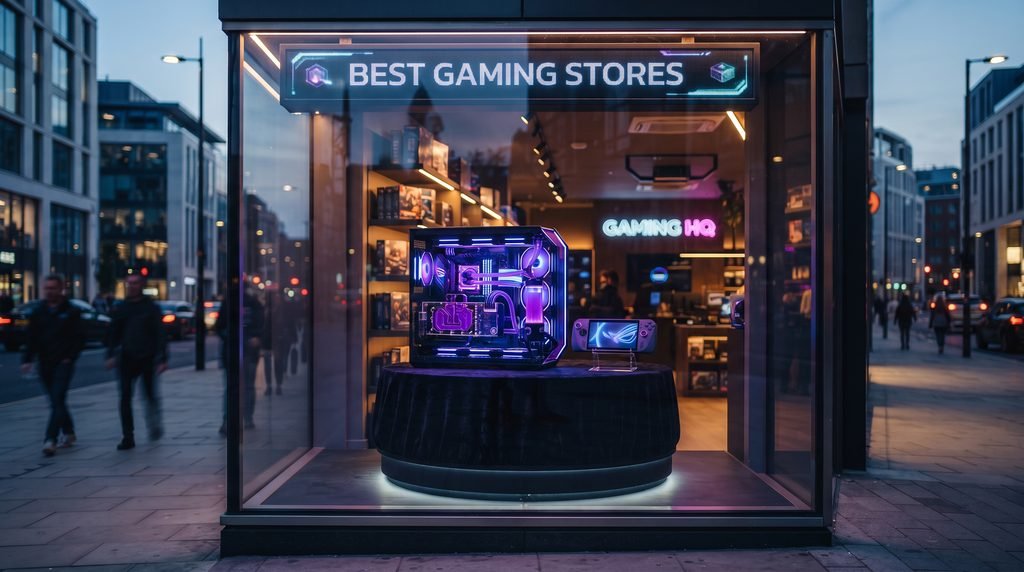
The Best Gaming Stores are not necessarily the stores with the largest catalogs. The right retailer depends on what you are buying.
Someone looking for a new PlayStation game has different priorities from a PC builder searching for a graphics card. A collector may care about physical editions and collectibles, while a competitive player might be more interested in gaming monitors, mice, keyboards, and headsets. Someone who wants a digital PC game may not need a physical retailer at all.
That is why comparing gaming stores by category is more useful than simply producing a list of names.
Dedicated gaming retailers can be convenient for games, consoles, trade ins, and collectibles. Electronics retailers often provide a wider range of gaming hardware and accessories. PC specialists can be more useful for individual components and custom builds. General retailers can offer convenient pickup and broad availability. First party digital stores are usually the most direct route when you want a game for a specific platform.
This guide breaks down those differences so you can choose the store that fits the purchase rather than assuming one retailer is suitable for everything.
What Makes a Good Gaming Store?
A good gaming store should make it reasonably easy to find the product you need, understand what you are buying, and complete the purchase with clear information about price, availability, compatibility, and returns.
The definition becomes more specific depending on the product.
For a physical game, important factors include:
- Platform availability
- New or pre owned condition
- Edition and included content
- Local pickup
- Shipping
- Return policy
For PC hardware, the priorities change:
- Component compatibility
- Technical specifications
- Warranty
- Stock availability
- Product condition
- Return policy
- Shipping protection
For accessories, compatibility becomes particularly important. A headset, controller, charging dock, or storage device may support one platform but not another.
Collectors have another set of concerns, including packaging condition, limited editions, trading cards, figures, and authenticity.
A useful gaming store therefore is not simply the one with the biggest number of products. It is the one that fits the purchase.
Best Gaming Stores for Different Types of Gamers
Several major retailers serve gaming customers in different ways. The following stores are presented by their current product categories and services rather than as a universal quality ranking.
GameStop
GameStop is one of the most recognizable dedicated videogame retailers in the United States.
Its current catalog covers video games, consoles, controllers, PC gaming, keyboards, headsets, collectibles, trading cards, toys, gift cards, digital games, and other gaming related categories. GameStop also provides options for buying, selling, and trading certain products through its retail ecosystem.
That makes it particularly relevant for gamers who want a store centered around gaming rather than general electronics.
GameStop can be useful for:
- Physical video games
- Consoles
- Controllers
- Gaming headsets
- PC gaming accessories
- Collectibles
- Trading cards
- Pre owned gaming products
- Game related merchandise
Its dedicated gaming focus is one of its most obvious advantages for shoppers who want several gaming categories in one place.
It is also relevant to collectors. The current store includes dedicated categories for collectibles, trading cards, Funko products, and other fan merchandise.
For someone primarily building a high end PC from individual components, however, a specialist PC retailer may provide a more focused selection.
Best Buy
Best Buy takes a broader electronics approach while maintaining a substantial gaming section.
Its gaming catalog currently includes gaming desktops, laptops, monitors, accessories, computer components, internal SSDs, consoles, VR products, games, and peripherals.
This makes it particularly useful for gamers building an entire setup rather than buying a game alone.
For example, a player upgrading from console gaming to PC might need:
- Gaming PC
- Monitor
- Keyboard
- Mouse
- Headset
- SSD
- Webcam
- Controller
- Desk accessories
A large electronics retailer can simplify that process by placing many of these categories under one shopping system.
Best Buy also provides store pickup and delivery options on eligible products, which can matter when availability is more important than ordering from a specialist retailer. Its gaming pages currently advertise options such as store or curbside pickup and delivery.
Another useful feature is the combination of gaming products with broader computer and home entertainment hardware.
That makes it relevant to shoppers building hybrid gaming and entertainment setups.
Micro Center
Micro Center has a particularly strong connection with PC enthusiasts.
Its gaming section covers PC parts, gaming accessories, VR hardware, gaming systems, and simulation products. Its current gaming pages also highlight graphics cards, gaming PCs, racing and flight simulation, VR, and portable gaming hardware.
For a PC builder, this type of retailer can be useful because the shopping process often involves several components rather than one finished product.
A gaming PC build may require:
- CPU
- Graphics card
- Motherboard
- Memory
- SSD
- Power supply
- PC case
- CPU cooler
- Case fans
- Monitor
- Keyboard and mouse
A specialist environment makes it easier to approach those components as parts of one system.
Micro Center also has a physical store focus, so availability can vary by location. That is an important distinction from purely online shopping.
For gamers who live near a store, local inventory and in person purchasing can be useful. For shoppers outside its store footprint, another retailer may be more practical.
Newegg
Newegg is particularly associated with PC hardware and technology shopping.
Its product ecosystem covers computer hardware, electronics, gaming products, peripherals, and related components. Newegg is especially relevant to people comparing PC components because a gaming build can require detailed filtering by socket, interface, memory type, storage technology, power requirements, and other specifications.
That makes it different from a store where the primary goal is simply choosing a finished console or game.
Newegg can be particularly useful when shopping for:
- CPUs
- GPUs
- Motherboards
- RAM
- SSDs
- PC cases
- Power supplies
- Gaming monitors
- Gaming peripherals
- Prebuilt gaming PCs
However, shoppers should pay attention to seller information where applicable. Marketplace style listings can involve different sellers, so product condition, fulfillment, warranty, and return terms should be checked before ordering.
The retailer’s presence as an official seller on Best Buy’s marketplace also reflects its broad technology retail focus.
Walmart
Walmart is a general retailer rather than a dedicated gaming specialist, but its gaming catalog is broad.
Its current video game section includes PlayStation, Xbox, Nintendo, PC gaming, accessories, collectibles, digital games, virtual reality, gift cards, refurbished consoles, and pre owned video games.
That range can make Walmart convenient for shoppers who already use the retailer for other purchases.
Its gaming category is also organized around different platforms and product conditions, which can help shoppers compare new, refurbished, and pre owned options.
The trade off is specialization.
Someone looking for an obscure PC component, enthusiast level hardware, or a highly specific gaming accessory may have more options at a dedicated PC or electronics retailer.
For mainstream console products, games, accessories, and everyday gaming purchases, however, a large general retailer can be convenient.
Target
Target also has a substantial gaming category despite being a general retailer.
Its current video game section includes PlayStation 5, Xbox Series X|S, Nintendo Switch 2, Nintendo Switch, VR, PC gaming, accessories, retro gaming, collectibles, gift cards, pre orders, and refurbished or pre owned games and consoles.
Target can therefore make sense for shoppers who want mainstream gaming products while also buying other household or electronics items.
Its gaming catalog includes consoles, games, controllers, headsets, keyboards, and other accessories.
The retailer also offers pickup and same day delivery options on eligible products, although availability varies by location and product.
For specialized PC building, however, a PC focused store can provide a more concentrated selection.
First Party Digital Gaming Stores
Not every gaming purchase requires a physical retailer.
If you are buying a digital game, the first party platform store can be the most direct option.
PlayStation Store
PlayStation provides official access to PlayStation games, consoles, accessories, and platform services. Its current site lists PS5 hardware, controllers, headsets, accessories, and games.
For PlayStation owners purchasing digital software, the platform’s own store is a natural destination.
Xbox Store
Xbox Store provides games, add-ons, season passes, indie titles, and other Xbox content directly through the platform and online.
Xbox also integrates its gaming ecosystem with accessories and PC related compatibility, making the official store useful for players who move between Xbox consoles and supported PC gaming.
Nintendo eShop
Nintendo’s first party digital storefront is designed around Nintendo hardware and its digital game ecosystem.
For Switch family players, an official platform store is useful when the objective is straightforward: purchase and download a digital Nintendo game or related content without needing a physical copy.
The important advantage of first party digital stores is platform integration.
The important limitation is that they do not replace a physical retailer for purchases such as PC components, physical games, desks, monitors, or general gaming accessories.
Dedicated Gaming Stores vs. General Retailers
The distinction between these two types of stores is easy to overlook.
A dedicated gaming retailer is structured primarily around gaming products and gaming customers.
A general retailer treats gaming as one category among many.
Neither approach automatically makes one better for every purchase.
Dedicated stores may be more useful when you want:
- Gaming specific merchandise
- Collectibles
- Used games
- Trade in options
- Specialized gaming categories
- Gaming focused staff or services
General retailers can be convenient when you want:
- Local pickup
- Broad availability
- Multiple electronics categories
- Gaming products alongside other purchases
- Mainstream consoles and accessories
PC specialists are a third category.
They become particularly useful when a purchase requires detailed hardware compatibility.
A gamer looking for a motherboard, processor, memory kit, SSD, and GPU has different shopping needs from someone buying a new console game.
What to Check Before Buying From a Gaming Store
Finding a product is only the first step.
Check compatibility
This is especially important for PC hardware and accessories.
A keyboard is relatively simple, but storage devices, power supplies, graphics cards, monitors, controllers, and headsets can have specific compatibility requirements.
Read the manufacturer’s specifications rather than relying only on a product title.
Check whether the product is new or pre owned
A used game can be a good option if you are comfortable with its condition.
For hardware, the decision requires more care.
Check:
- Condition
- Warranty
- Return period
- Included accessories
- Original packaging where relevant
- Seller identity
Compare the complete cost
A lower product price does not always produce the lower final cost.
Consider:
- Shipping
- Taxes
- Delivery charges
- Membership fees
- Accessories required separately
- Warranty or protection plans
Read return policies
Gaming hardware can be expensive.
A monitor that develops a problem, a PC component that is incompatible with a build, or a controller that does not work as expected can create a costly return process.
Understand the policy before purchasing.
How to Find the Right Store for Your Purchase
A simple decision process can make gaming shopping much easier.
Buying a new console?
Compare dedicated gaming retailers, electronics stores, and the console manufacturer’s official store.
Buying physical games?
Look at gaming retailers and general retailers, then compare new, pre owned, and local pickup options.
Building a gaming PC?
Focus on PC specialists and electronics retailers with detailed component catalogs.
Buying a monitor?
Compare dedicated electronics retailers and PC stores, paying attention to specifications rather than only price.
Buying collectibles?
Dedicated gaming and entertainment retailers can offer a broader selection.
Buying digital games?
Start with the official platform store.
Looking for convenience?
A general retailer with local pickup can be practical when the exact product is available nearby.
This approach is more useful than asking which store is universally the best.
Common Gaming Store Shopping Mistakes
One common mistake is choosing a store before deciding what you actually need.
If you need a complete PC build, starting with a retailer that specializes primarily in console games may create unnecessary limitations.
Another mistake is buying based entirely on the headline price.
A graphics card, monitor, or console should be evaluated against its specifications, compatibility, warranty, and total cost.
A third mistake is overlooking product condition.
Pre owned, refurbished, and open box do not necessarily mean the same thing. Read the listing carefully and check the applicable warranty and return terms.
Another issue is marketplace sellers.
If a retailer hosts products from multiple sellers, verify who is actually selling and fulfilling the item.
Finally, avoid assuming that a product is available simply because the store’s website displays it. Inventory can vary between online warehouses and individual physical stores.
International Gamers and Regional Availability
Many of the large retailers discussed here are particularly relevant to U.S. shoppers.
International gamers may have different local options, including regional electronics retailers, gaming specialists, official platform stores, and local marketplaces.
That matters because shipping, taxes, warranties, electrical standards, currency, regional game versions, and return rights can vary by country.
A U.S. retailer can be useful as a reference point for product selection even when it does not ship to your country.
For international purchases, always check:
- Regional warranty coverage
- Power requirements
- Keyboard layout
- Game region compatibility
- Import duties
- Shipping costs
- Local return rights
- Authorized retailer status
The cheapest listed price is not necessarily the cheapest delivered product.
A Practical Gaming Store Comparison
| Store Type | Best Suited For | Main Advantage | What to Check |
|---|---|---|---|
| Dedicated gaming retailer | Games, consoles, collectibles | Gaming focused selection | Trade in and return terms |
| Electronics retailer | PCs, monitors, consoles, accessories | Broad hardware selection | Model specifications |
| PC specialist | PC components and builds | Hardware focused catalog | Compatibility and stock |
| General retailer | Mainstream games and consoles | Convenience and pickup | Seller and product condition |
| First party digital store | Digital games and add ons | Direct platform integration | Platform restrictions |
| Marketplace | Broad product discovery | Large selection | Seller, warranty and fulfillment |
The table is intended as a shopping framework rather than a ranking. A store can be excellent for one type of gaming purchase and less suitable for another.
Conclusion
There is no single store that handles every gaming purchase in exactly the same way.
GameStop is built heavily around gaming products, games, consoles, collectibles, and related merchandise. Best Buy covers a much broader electronics ecosystem while maintaining extensive gaming categories. Micro Center is particularly relevant to PC enthusiasts and hardware shoppers, while Newegg is closely associated with PC components and technology. General retailers such as Walmart and Target can offer mainstream games, consoles, accessories, and convenient purchasing options.
For digital purchases, first-party stores such as PlayStation Store and Xbox Store provide direct access to their respective ecosystems.
The practical lesson is simple: choose the store based on the product, not just the retailer’s name.
A PC builder should prioritize component selection and compatibility. A console player may care more about physical games, pre-owned options, pickup, or platform specific accessories. A collector has different requirements again.
Once you know what you are buying, comparing the right category of retailer becomes much easier.
FAQ
What are the best gaming stores for video games?
The answer depends on whether you want physical, digital, new, pre owned, or collectible products. Dedicated gaming retailers are useful for gaming focused purchases, while official platform stores are convenient for digital games.
Which gaming stores are best for PC parts?
PC focused retailers and electronics stores with dedicated component departments are generally the most relevant choices. Look for detailed specifications, compatibility information, warranty coverage, and clear seller information.
Are gaming stores better than general retailers?
Not necessarily. Dedicated gaming stores may offer more gaming specific products, while general retailers can provide broader availability, local pickup, and competitive pricing on mainstream products.
Where should I buy digital games?
The official digital storefront for your platform is usually the most direct option. PlayStation, Xbox, and Nintendo each operate their own digital ecosystems.
Are pre owned games worth considering?
They can be useful for shoppers who want older or less expensive physical games. Before buying, check the item’s condition, included materials, return policy, and whether any required downloadable content is included.
What should I check before buying gaming hardware online?
Check compatibility, specifications, seller identity, warranty coverage, return conditions, shipping costs, and whether the product is new, refurbished, open box, or pre owned.
Are local gaming stores still useful?
Yes. A local store can provide immediate availability, pickup, trade in services, or the opportunity to inspect certain products before purchasing. Availability and services vary by location.
Can I buy gaming accessories from the same store as my console?
Usually. Major gaming and electronics retailers commonly sell controllers, headsets, charging accessories, storage products, keyboards, mice, and other gaming peripherals. Always verify compatibility with the specific platform.
COMMENTS (1)
LEAVE A PIXEL ZINE COMMENT