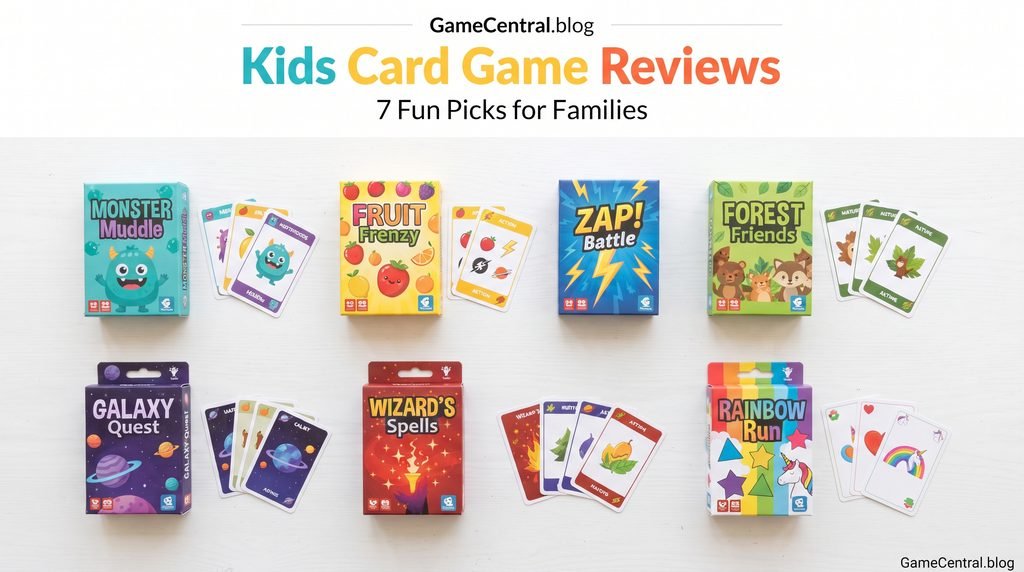
Finding a good card game for children is not as simple as choosing the game with the brightest box. A game can be popular with families and still be too complicated for a five ear old, too dependent on reading for a developing reader, or too repetitive for older children.
These Kids Card Game Reviews look at what actually matters when choosing a game for children: age suitability, rules, player interaction, decision making, speed, replayability, and how easily adults can join without turning every round into a teaching session.
The selection below covers several styles. UNO Junior focuses on simple matching for younger players, while UNO adds more traditional action card play. Taco Cat Goat Cheese Pizza is built around speed and physical reactions. Sleeping Queens introduces more strategic decisions, while Sushi Go! adds accessible card drafting. Exploding Kittens offers more direct take-that gameplay for older kids, and Spot It! emphasizes visual recognition and quick reactions.
There is no single winner for every family. The right choice depends heavily on the child’s age, reading ability, attention span, and preferred style of play.
How We Evaluated These Kids Card Games
A useful children’s card game needs more than simple rules. The best designs create a balance between accessibility and meaningful decisions.
For this comparison, the most important factors are:
- Age suitability: Does the recommended age make sense for the game’s actual complexity?
- Learning curve: Can children understand the core rules without constant adult intervention?
- Decision making: Does the game offer choices beyond simply drawing and playing cards?
- Replayability: Does it remain interesting after several rounds?
- Player interaction: Do children interact meaningfully with siblings, parents, or friends?
- Play time: Can the game fit into a child’s attention span?
- Reading requirements: Are children expected to read large amounts of card text?
- Family appeal: Can adults enjoy playing without the game becoming frustratingly simple?
- Educational value: Does the gameplay naturally reinforce memory, recognition, counting, planning, or strategic thinking?
Age recommendations are particularly important. For example, Mattel lists standard UNO for ages 7 and up, while UNO Junior is designed for children as young as 3 and introduces its rules progressively.
That distinction matters because a game that works beautifully for an eight year old may be completely unsuitable for a preschooler.
Kids Card Game Reviews: 7 Picks Compared
| Game | Listed Age | Players | Typical Style | Best For |
|---|---|---|---|---|
| UNO Junior | 3+ | 2–4 | Matching | Preschoolers |
| UNO | 7+ | 2–10 | Matching & action cards | Families |
| Taco Cat Goat Cheese Pizza | 7+ | 2–8 | Reaction/party | Energetic groups |
| Sleeping Queens | 8+ | 2–5 | Strategy & luck | Young strategists |
| Sushi Go! | 8+ | 2–5 | Card drafting | Strategy beginners |
| Exploding Kittens | 7+ | 2–5 | Take that/card management | Older kids & families |
| Spot It! | Varies by edition | Varies | Visual matching | Quick thinking players |
UNO Junior
Best for: Younger children learning basic matching games.
Why it stands out: Progressive rules and visual matching.
Potential weakness: Older children may outgrow the simplified format.
UNO Junior is one of the strongest starting points for children who are not ready for the standard UNO rules. Mattel lists the game for ages 3 and up and designed it with multiple levels of play. Younger players can match colors or animal illustrations before gradually encountering more action and penalty cards.
That progression is the important feature here.
A preschool child does not necessarily need a game filled with complicated strategy. They need to understand what a turn means, recognize matching information, wait for another player’s turn, and understand the idea of trying to empty their hand.
UNO Junior uses animal illustrations alongside numbers, which gives children another way to identify a playable card. The later levels introduce more complicated effects, allowing families to increase the challenge instead of immediately switching to a different game.
Strengths:
- Suitable for younger players
- Simple matching foundation
- Progressive difficulty
- Strong visual design
- Easy for adults to teach
Weaknesses:
- Limited strategic depth
- Older children may find it too simple
- Competitive action is lighter than standard UNO
For a first card game, however, simplicity is an advantage rather than a flaw.
Verdict: One of the better choices for introducing preschool aged children to structured card games.
UNO
Best for: Families with school age children who want a simple but competitive game.
Standard UNO remains a strong family option because its core rule is immediately understandable: match the current card by color or number, or use an appropriate action or Wild card. Mattel lists the classic game for ages 7 and up and supports 2–10 players in the referenced version.
The appeal comes from the combination of simple rules and unpredictable swings.
A child does not need advanced mathematical ability or a large vocabulary to participate, but there are still decisions to make. Should you play an action card immediately? Should you hold a Wild card? Which color gives you the best chance of playing your remaining cards?
Those choices become more meaningful as children learn to pay attention to the cards other players are holding.
The game also introduces children to an important concept in competitive games: a player can be temporarily behind and still recover through a good card sequence.
Strengths:
- Easy to learn
- Supports larger groups
- Simple matching mechanics
- Introduces basic tactical decisions
- Works for mixed age family groups
Weaknesses:
- Luck can strongly influence individual rounds
- Some games can become frustrating after repeated penalty cards
- Strategy is relatively light compared with modern card games
UNO is particularly useful when you want one deck that parents, siblings, and children can all understand quickly.
Verdict: A reliable family card game for children around the recommended age who are ready for more than basic matching.
Taco Cat Goat Cheese Pizza
Best for: Kids who enjoy fast reactions, silly mistakes, and noisy group play.
This game takes a completely different approach. Instead of focusing mainly on hand management or long term planning, players follow a spoken sequence while placing cards and react when the card and spoken word match.
The official product page describes it as a quick party game based around matching a card with the spoken word and slapping the pile.
That makes the game particularly appealing for children who lose interest during slower card games.
The central challenge is not complicated strategy. It is concentration. Players have to maintain the verbal rhythm, watch the cards, and resist reacting at the wrong time.
That creates a useful form of difficulty: the rules are simple, but executing them under pressure is surprisingly challenging.
The physical element also makes it more social than traditional turn based card games.
Strengths:
- Extremely easy to explain
- Fast rounds
- High player interaction
- Excellent for groups
- Rewards attention and reaction speed
Weaknesses:
- Can become loud
- Physical play may not suit every child
- Less strategic than games such as Sushi Go!
- Younger children may struggle with the speed
This is a particularly good choice for siblings or friends who want something active rather than a quiet tabletop experience.
Verdict: A strong party style pick for energetic kids and family gatherings.
Sleeping Queens
Best for: Children ready for more strategic card play.
Sleeping Queens is a significant step up from simple matching games. Gamewright lists it for ages 8+, 2–5 players, with games taking around 20 minutes. The game combines strategy, quick thinking, luck, and simple arithmetic.
The objective is to wake sleeping queens and collect enough valuable queens to win. Cards create opportunities to steal queens, defend them, or alter the situation.
What makes the game particularly interesting for children is that the rules encourage them to think about several possibilities rather than simply looking for a matching card.
It also gives children an early introduction to resource evaluation. A card that looks useful immediately may be better saved for a more important turn.
Gamewright specifically identifies mathematics as one of the skills reinforced by the game.
That does not mean children will feel as though they are doing homework. The arithmetic is integrated into the game’s scoring and decisions.
Strengths:
- More strategic depth
- Short enough for family sessions
- Encourages counting and planning
- Good replayability
- Strong theme for children
Weaknesses:
- Better suited to older children
- More rules than basic matching games
- Luck can influence outcomes
Verdict: One of the better choices when a child is ready to move from simple card matching toward genuine strategy.
Sushi Go!
Best for: Children who enjoy collecting sets and making decisions.
Sushi Go! is another strong option for children around age eight and above. Gamewright lists it for 2–5 players and approximately 15 minutes per game. Its central mechanic is card drafting: players choose a card from their hand, reveal it, and pass the remaining cards to another player.
That sounds more complicated than it feels.
The cards represent different sushi dishes, and players score by creating specific combinations. For example, some cards reward collecting sets while others interact with different scoring conditions.
The important educational element is not memorizing rules. It is learning to evaluate choices.
A child might have two useful cards in their hand but only enough opportunity to take one. They need to think about what they currently need, what opponents may be collecting, and which cards are likely to return.
This makes Sushi Go! an excellent bridge between children’s card games and more sophisticated tabletop strategy.
Gamewright specifically highlights strategic thinking and visual discrimination among the game’s reinforced skills.
Strengths:
- Simple drafting mechanic
- Genuine strategic decisions
- Short sessions
- Good replayability
- Works well with adults
Weaknesses:
- Scoring requires more explanation
- Children may need help understanding card combinations initially
- Less suitable for very young players
Verdict: A standout option for children who are ready to learn strategic card drafting.
Exploding Kittens
Best for: Older children who enjoy unpredictable competitive games.
Exploding Kittens combines simple card management with direct player interaction. The official publisher currently lists the Original Edition for ages 7+, 2–5 players, and roughly 15 minutes.
The concept is intentionally straightforward: players use cards to avoid drawing an Exploding Kitten while using other cards to influence their chances and disrupt opponents.
The game’s major advantage is accessibility. Children do not need to learn a complicated board, character sheet, or progression system before they can play.
However, parents should pay attention to the game’s tone. Although the publisher describes it as family friendly, the humor and elimination style tension will not appeal equally to every child.
It is also more competitive than some educationally oriented children’s card games.
Strengths:
- Fast to learn
- Short games
- Strong player interaction
- Plenty of uncertainty
- Works well with older children and adults
Weaknesses:
- Elimination can frustrate some children
- Take that mechanics may cause arguments
- Humor is aimed more toward older children
- Less useful as a first card game
Verdict: A good choice for children who already understand basic card games and enjoy competitive surprises.
Spot It!
Best for: Children who enjoy visual challenges and quick reactions.
Spot It! approaches card gaming from a different direction. The basic idea is to identify matching symbols between cards as quickly as possible. Blue Orange describes it as a high energy game where players race to spot matching images, with multiple game variations available.
This makes it especially approachable because children do not need to read paragraphs of rules during play.
The challenge comes from visual processing. Two cards may contain several different symbols, but players need to identify the relevant match quickly.
That makes Spot It! particularly useful for short sessions, travel, or situations where the family wants a game that can be explained almost immediately.
Different editions have different age recommendations, so parents should check the specific version rather than assuming every Spot It! product is identical.
Blue Orange also offers versions designed around different environments, including waterproof editions, showing how the core visual matching system can adapt to different settings.
Strengths:
- Very quick to learn
- Strong visual challenge
- Short rounds
- Easy to carry
- Good for mixed groups
Weaknesses:
- Reaction speed can dominate
- Less strategic than drafting or hand management games
- Some children may find the competition stressful
Verdict: An excellent pick when the priority is fast, accessible visual gameplay.
Which Kids Card Game Is Best for Different Ages?
Age recommendations should be treated as a starting point rather than an absolute rule. Reading ability, attention span, competitiveness, and previous gaming experience can make a major difference.
Ages 3–5
Start with UNO Junior or similarly simple matching games.
At this age, the objective should be learning the structure of a game: taking turns, recognizing matches, following a simple rule, and handling winning or losing.
A game with too many special cards can overwhelm a young child.
Ages 6–7
Children can usually begin moving toward more competitive card systems.
UNO is a natural option once a child is comfortable with numbers, colors, and basic action cards. Fast reaction games can also work if the child enjoys physical competition.
Ages 8–10
This is where games such as Sleeping Queens and Sushi Go! become particularly interesting.
Children can start evaluating combinations, anticipating what other players may do, and thinking beyond their immediate turn.
Ages 10 and Up
Older children can generally handle games with greater player interaction and more complex decision making.
Exploding Kittens, standard UNO variants, Sushi Go!, and more advanced family card games can all work depending on the child’s preferences.
The most important factor is not whether a game is labeled “educational.” It is whether the game presents the right level of challenge.
What Makes a Good Card Game for Kids?
A strong children’s card game usually succeeds in several areas at once.
Simple core rules: Children should understand the basic objective quickly.
Meaningful choices: Once the rules are learned, the game should give players reasons to think.
Appropriate game length: A 10–20 minute game is often easier to manage than something that requires an hour.
Visible progress: Children benefit when they can understand whether they are winning, collecting something, or moving toward a clear objective.
Manageable reading requirements: Younger children should not need to read extensive card text to participate.
Replayability: Randomized decks, different combinations, or meaningful decisions help prevent the game from feeling identical every time.
Family accessibility: The best games can accommodate adults without making children feel that the adults automatically have an overwhelming advantage.
That last point is important. A family game should create a shared activity rather than turn the parent into a permanent referee.
Common Mistakes When Choosing a Kids Card Game
One common mistake is choosing entirely by age rating.
A listed age is useful, but it cannot tell you whether a particular child will enjoy the game. A highly competitive eight year old may want more strategic depth, while another eight year old may prefer a quick reaction game.
Another mistake is assuming educational value automatically means better gameplay.
Children are more likely to return to a game when the learning is embedded naturally within the mechanics. Sleeping Queens, for example, incorporates arithmetic into play rather than presenting itself as a math exercise.
Parents should also consider the number of players.
A two player game may be perfect for one child and a parent, while a larger family may need something supporting four or more players. UNO, for example, can accommodate substantially larger groups than several of the strategy focused games reviewed here.
Finally, consider frustration.
Games involving stealing, penalties, elimination, or reaction speed can produce more emotional moments. That is not necessarily a weakness, but parents should know the temperament of the children who will be playing.
How to Get More Value From Family Card Games
You do not need to turn every card game into a lesson. A few simple habits can make the experience better.
Let children explain the rules. Once they understand a game, asking them to teach another family member reinforces their understanding.
Avoid correcting every mistake immediately. Let children discover some rules through play when the mistake is harmless.
Change difficulty gradually. Start with the simplest version of a game before adding optional rules.
Play short sessions. Ending while everyone is still interested is often better than forcing another round.
Talk about decisions instead of only outcomes. Asking “Why did you choose that card?” encourages children to think about strategy without turning the game into a test.
Let children occasionally beat adults. Adults do not need to play badly, but they also do not need to optimize every turn. A family game should remain enjoyable for everyone.
Conclusion
The best kids card game is not necessarily the one with the biggest brand name or the most complicated rules. It is the game that matches a child’s current ability while giving them enough challenge to stay interested.
For younger children, UNO Junior offers a gentle introduction to matching and turn based play. UNO is a stronger all-purpose family choice once children are ready for more action cards. Taco Cat Goat Cheese Pizza is better for energetic groups that enjoy fast reactions, while Spot It! delivers a similarly quick visual challenge.
For children who want more decision making, Sleeping Queens and Sushi Go! are more rewarding choices. Exploding Kittens fits older children who enjoy direct competition and unpredictable outcomes.
The biggest lesson from these Kids Card Game Reviews is that age is only one part of the decision. Think about how your child plays, what kind of challenge they enjoy, how many people will participate, and how long your family realistically wants each session to last.
A simple game that gets played repeatedly is usually a better purchase than a sophisticated game that stays in the cupboard.
FAQ
What is the best card game for young kids?
UNO Junior is a strong starting point for younger children because it uses visual matching and progressive levels. Mattel lists it for ages 3 and up.
What is a good card game for a family with older children?
Standard UNO is a practical family choice because its rules are easy to learn while its action and Wild cards add competitive decisions. Mattel lists the classic version for ages 7 and up.
Which kids card game teaches strategy?
Sushi Go! and Sleeping Queens offer more strategic decision making than simple matching games. Sushi Go! particularly emphasizes card drafting and combination building, while Sleeping Queens incorporates strategy, memory, and arithmetic.
What is a good fast card game for kids?
Taco Cat Goat Cheese Pizza and Spot It! are strong choices for quick sessions because their central mechanics are based around rapid recognition and reactions.
Is Exploding Kittens suitable for children?
The Original Edition is officially listed by Exploding Kittens for ages 7+, with 2–5 players and approximately 15 minute games. Parents should still consider whether their child enjoys competitive take that mechanics.
Are card games useful for children’s development?
They can naturally practice skills such as matching, visual recognition, counting, memory, decision making, planning, and social turn taking. The specific benefits depend on the mechanics of the individual game rather than simply being labeled a children’s game.
Should parents choose games based only on the recommended age?
No. Age ratings provide useful guidance, but reading ability, attention span, competitiveness, previous game experience, and personality also affect suitability.
How long should a kids’ card game take?
For many families, roughly 10–20 minutes is a convenient target, particularly for younger children. Longer games can work for older kids when the gameplay provides enough meaningful decisions to maintain interest.
COMMENTS (1)
LEAVE A PIXEL ZINE COMMENT