The best co-op board games give everyone at the table the same objective: beat the game together. Instead of competing for first place, players share information, manage resources, solve puzzles, and make decisions that affect the entire group.
That shared goal can take many forms. In Pandemic, players race to discover cures before outbreaks spiral out of control. Spirit Island challenges players to coordinate powerful abilities against invading forces, while Sky Team turns two players into a flight crew attempting a safe landing. Other games focus on deduction, communication, or long-term campaign decisions.
The right choice depends on your group’s experience, preferred difficulty, available time, and willingness to learn complicated rules. This guide compares 12 cooperative board games across several styles, explaining what makes each one worth considering, where it can be challenging, and who is most likely to enjoy it.
What Are Cooperative Board Games?
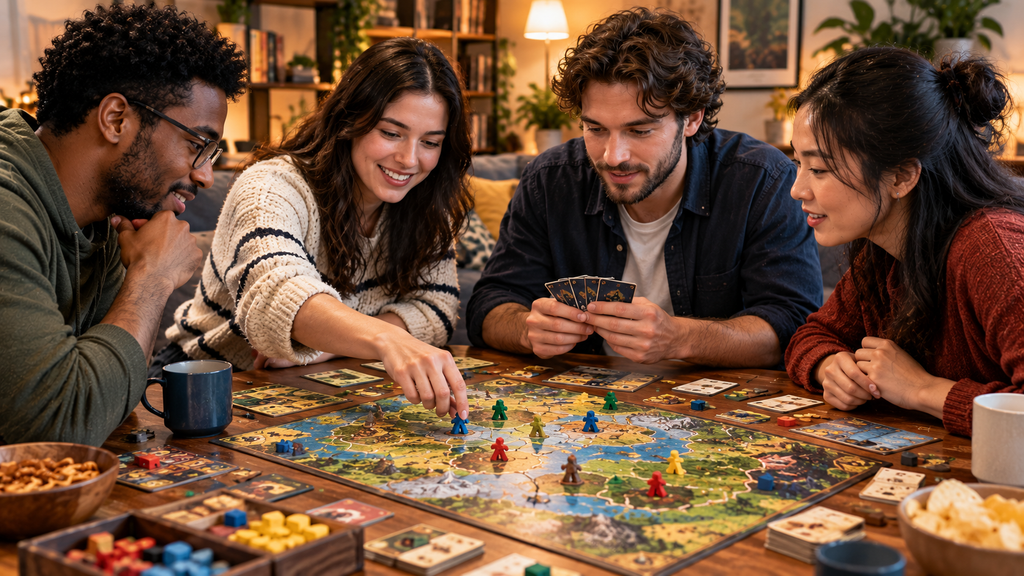
Cooperative board games, commonly called co-op games, are tabletop games in which players work toward a shared objective against the game’s rules, scenarios, or automated opponents. The group typically wins or loses together rather than competing for individual victory.
Their appeal comes from collective decision-making. Players might share resources, combine character abilities, solve clues, coordinate card plays, or decide which threat deserves attention first.
However, cooperative games are not all alike. Some allow players to discuss almost every move openly. Others restrict communication, require hidden information, or impose strict limits on what teammates can reveal.
A good cooperative game gives each participant meaningful decisions. The group should benefit from different perspectives instead of having one experienced player dictate every move.
When choosing a game, consider:
- Difficulty: Is it suitable for beginners, or does it require considerable tactical planning?
- Player count: Does it work well with two people, or is it better with a larger group?
- Session length: Can you finish a game in half an hour, or will it require a full evening?
- Communication: Does the game encourage open discussion or challenge players to coordinate with limited information?
- Replayability: Do different scenarios, variable setups, or changing decisions keep the game interesting?
- Commitment: Can you play a single session independently, or does the game require an ongoing campaign?
These distinctions matter because a brilliant game for experienced strategy fans may be a poor first purchase for a family looking for an easy introduction.
Best Co-op Board Games Worth Playing
Pandemic — Best Overall Starting Point
Players: 2–4
Playing time: Approximately 45 minutes
Best for: Families, friends, and strategy newcomers
Pandemic is one of the most recognizable cooperative board games. Players take on specialist roles and work together to contain disease outbreaks, manage infections, collect city cards, and discover cures before the situation becomes unmanageable.
The central challenge is prioritization. You rarely have enough actions to solve every problem immediately. Traveling to a threatened city may prevent an outbreak, but collecting cards or building a research station could be necessary for discovering a cure.
That creates meaningful team discussions. Should you deal with an immediate crisis, prepare for a future outbreak, or spend several turns assembling the cards needed to finish a cure?
Character abilities encourage specialization, but players must coordinate their actions to make those advantages count.
Pandemic is particularly useful as an introduction to cooperative strategy because its central objective is straightforward while its decisions become increasingly demanding. The official publisher lists the standard game for two to four players, with an approximate 45-minute playing time.
Strengths: Clear objectives, meaningful teamwork, strategic decisions, and a strong introduction to cooperative play.
Weaknesses: The rising threat level can feel stressful, and inexperienced groups may struggle to balance immediate emergencies against long-term planning.
Verdict: Start with Pandemic if you want a versatile cooperative game that rewards communication without requiring a lengthy campaign commitment.
Spirit Island — Best for Deep Strategy
Players: 1–4
Playing time: Often around 90–120 minutes, depending on experience and setup
Best for: Experienced players and fans of complex strategy
Spirit Island reverses the familiar idea of exploring and conquering a fantasy world. Players control powerful island spirits working together to protect their home from invading colonists.
Each spirit has different abilities, strengths, and limitations. Some are better at moving invaders, others at generating fear, defending vulnerable areas, or controlling the spread of settlements.
Success depends on understanding how those abilities interact. One player might prepare an area for a powerful attack, while another uses a special ability to remove threats or protect nearby land.
Timing is especially important. A powerful effect may not be immediately available, so players must anticipate future dangers rather than react only to what is happening now.
The game offers considerable strategic depth and room to experiment with different spirit combinations. However, that flexibility comes with a substantial learning curve.
Strengths: Distinct character abilities, layered strategy, meaningful cooperation, and strong replay potential.
Weaknesses: Dense rules and numerous interacting systems can overwhelm newcomers. Sessions may run long while players are learning.
Verdict: Choose Spirit Island if your group enjoys complex decisions and wants a cooperative game that rewards repeated play and tactical improvement.
Forbidden Island — Best for Families and Beginners
Players: 2–4
Playing time: Approximately 30 minutes
Best for: Families, casual players, and first-time co-op gamers
Forbidden Island gives players a straightforward mission: collect valuable treasures and escape before the island sinks.
As the game progresses, locations become flooded and may disappear, reducing the available routes and making previously accessible areas harder or impossible to reach. Players must decide which locations to protect, where to move next, and when to prioritize collecting treasures over preventing further damage.
Different character abilities create opportunities for cooperation. A player who can move efficiently around the island may help collect a treasure, while another focuses on protecting a critical location.
The game is accessible without being entirely predictable. Poor planning can leave the group with too few safe routes or insufficient time to complete the objective.
Strengths: Approachable rules, a clear shared objective, manageable session length, and useful opportunities to teach teamwork.
Weaknesses: Experienced strategy players may eventually want more complexity than its relatively compact system offers.
Verdict: Forbidden Island is a strong first purchase for families or friends who want cooperative gameplay without a lengthy rules explanation.
Sky Team — Best Dedicated Two-Player Co-op
Players: 2
Playing time: Approximately 20 minutes
Best for: Couples, close friends, and players who prefer compact tactical challenges
Sky Team is designed specifically for two players. One takes the role of a pilot and the other acts as co-pilot, working together to land an aircraft safely.
Players use dice-placement decisions to manage elements of the landing process. The challenge is that they cannot freely discuss every decision during the relevant planning phase, so each person must interpret the situation and make choices with limited information.
That restriction is the heart of the game. Instead of explaining an entire plan, players must anticipate what their partner might do and coordinate through the game’s permitted actions.
The experience is compact but tense. Even small decisions can influence the landing, making it suitable for repeated sessions without requiring a large table or lengthy setup.
Strengths: Designed for exactly two players, limited communication creates tension, and sessions fit easily into short game nights.
Weaknesses: The restricted communication may frustrate players who prefer discussing every move. It is not suitable for groups larger than two.
Verdict: If you usually play with one other person, Sky Team deserves serious consideration because its mechanics are built around that exact player count.
The Crew: Mission Deep Sea — Best Cooperative Card Game
Players: 2–5, depending on the edition and rules
Playing time: Approximately 20 minutes
Best for: Card-game fans and groups who enjoy logical communication
The Crew: Mission Deep Sea takes the familiar trick-taking card-game structure and turns it into a cooperative mission system.
Players receive cards and must complete specific objectives, such as ensuring that a particular player wins a designated card. The group must coordinate its decisions, but communication about the cards in each hand is restricted by the rules.
That creates an interesting challenge. Players need to understand the current mission, estimate what their teammates can accomplish, and avoid taking tricks that interfere with someone else’s objective.
Each mission changes the team’s priorities, making the game feel different from a conventional card game in which everyone tries to maximize their own score.
Its compact components also make it a practical option for travel or a short session before a longer board game.
Strengths: Portable, quick to set up, mission-based replayability, and a distinctive approach to cooperative communication.
Weaknesses: Players unfamiliar with trick-taking games may need time to understand the card logic. Communication restrictions can also be confusing initially.
Verdict: Choose The Crew: Mission Deep Sea if you want a cooperative card game that rewards careful planning without demanding a large table or a long evening.
Gloomhaven: Jaws of the Lion — Best Tactical Campaign
Players: 1–4
Playing time: Commonly around 60–120 minutes per scenario, depending on experience
Best for: Dungeon-crawler fans and groups who enjoy character progression
Gloomhaven: Jaws of the Lion offers a tactical fantasy adventure built around scenario-based combat, character abilities, and campaign progression.
Players control distinct mercenaries with different abilities and tactical roles. Encounters require careful movement, attack selection, and resource management rather than simply charging toward the nearest enemy.
A major part of the challenge comes from managing ability cards. Choosing which actions to use now can affect what remains available later, so every turn requires consideration of both the immediate encounter and the wider scenario.
Cooperation matters because enemies can threaten different areas, allies may need support, and the group must balance offensive pressure against survival.
The campaign structure provides a reason to return regularly. Characters develop, scenarios introduce new challenges, and the group’s decisions shape how it approaches future encounters.
Strengths: Tactical combat, character development, coordinated abilities, and a substantial campaign experience.
Weaknesses: It requires more time, table space, and rules learning than a short family game. Players seeking quick sessions may find the commitment excessive.
Verdict: A strong choice for groups who want their cooperative board game to feel like a tabletop role-playing campaign.
Pandemic Legacy: Season 1 — Best for a Continuing Story
Players: 2–4
Playing time: Around 60 minutes per session, depending on the group
Best for: Dedicated groups who can meet regularly
Pandemic Legacy: Season 1 expands the familiar Pandemic framework into a continuing campaign in which events from one session can permanently affect later sessions.
Rather than treating each game as an isolated challenge, the campaign introduces developments that change the experience as the group progresses. Players may encounter new rules, unexpected complications, and consequences that carry forward.
This makes communication particularly important. A decision that seems useful during one session may influence the team’s options in a later scenario.
The format also creates a stronger narrative connection than a standard replayable board game. Your group gradually develops a shared history of victories, mistakes, and difficult decisions.
However, the legacy format is a commitment. Components may be permanently modified as directed by the rules, and the experience is best suited to a group willing to continue playing together.
Strengths: Evolving scenarios, shared discoveries, lasting consequences, and a campaign designed around group decisions.
Weaknesses: It is less suitable for groups that meet irregularly or prefer a fully resettable game. Its permanent changes may also discourage players who want to preserve every component.
Verdict: Choose Pandemic Legacy: Season 1 if your group wants a cooperative experience that develops across multiple sessions rather than resetting after every game.
Horrified — Best Thematic Monster Adventure
Players: Varies by edition; check the specific box
Playing time: Often around 60 minutes
Best for: Families, casual strategy fans, and players who enjoy horror-inspired themes
Horrified puts players in the role of villagers working together to confront classic monsters. Instead of facing one identical enemy every time, the group must adapt its strategy to the monsters included in the scenario.
Different monsters require different approaches. Players may need to collect specific items, complete objectives, protect vulnerable locations, or satisfy conditions that make an encounter manageable.
The variety encourages discussion before committing to a plan. A strategy that works well against one monster may be ineffective against another, so players must understand their current objectives rather than repeat a familiar routine.
Its theme gives the game a strong sense of purpose without requiring the complexity of a heavy campaign game.
Strengths: Distinct monster objectives, approachable cooperative planning, and a theme that helps guide decisions.
Weaknesses: Players who dislike horror-inspired artwork or monster themes may not connect with it. Difficulty and player count depend on the edition and scenario.
Verdict: Horrified is a good option for groups who want thematic cooperation with enough tactical decisions to keep everyone involved.
Forbidden Desert — Best for Resource Management
Players: 2–5
Playing time: Approximately 45 minutes
Best for: Families and groups who enjoy environmental challenges
Forbidden Desert challenges players to recover parts needed to escape a dangerous desert while dealing with shifting terrain, limited water, and worsening environmental conditions.
The board changes as the group progresses, which means players must plan around both their objective and the resources required to survive.
Water management is particularly important. Moving toward a useful location may be strategically sensible, but it can become dangerous if the team does not account for the cost of reaching it.
Players also need to coordinate searches and protect access to important areas. Efficient movement matters because unnecessary travel can waste precious actions.
Compared with Forbidden Island, the desert setting creates a different style of pressure. Rather than focusing primarily on sinking locations, the group must contend with a hostile environment and a changing map.
Strengths: Resource management, changing terrain, teamwork, and an accessible adventure premise.
Weaknesses: Random events can complicate an otherwise sensible plan, and players who dislike resource pressure may find it frustrating.
Verdict: Choose Forbidden Desert if you want a cooperative family game with more emphasis on survival and planning.
Hanabi — Best for Communication and Deduction
Players: 2–5
Playing time: Approximately 25 minutes
Best for: Puzzle fans and players who enjoy unconventional communication
Hanabi asks players to work together to create a successful sequence of fireworks cards. The unusual twist is that players cannot see their own cards, although they can see the cards held by others.
Players provide limited clues and use those clues to make decisions about which cards to play, discard, or preserve.
The challenge is not simply remembering information. Players must interpret what a clue implies, consider what their teammates already know, and avoid wasting important opportunities.
Hanabi rewards a group that develops a shared understanding of how information should be interpreted. However, players must work within the game’s communication rules rather than revealing everything they know.
Strengths: Compact setup, logical deduction, strong communication, and a distinctive cooperative puzzle.
Weaknesses: The rules around clues may feel unusual to newcomers, and the limited information can frustrate players who prefer complete control.
Verdict: Hanabi is an excellent choice for players who enjoy solving problems through careful clues rather than direct discussion.
MicroMacro: Crime City — Best for Cooperative Detective Work
Players: Depends on the edition; many versions support 1–4 players
Playing time: Varies by case
Best for: Families with older children, couples, and mystery fans
MicroMacro: Crime City turns a large illustrated city map into a cooperative detective puzzle. Players investigate cases by examining locations, following characters across the map, and piecing together events from visual clues.
Rather than relying on traditional combat or resource management, the game asks players to observe carefully and connect details. A character’s position in one scene may reveal something about an earlier or later event.
The shared map encourages discussion because one player may notice a detail that another overlooked. Working together can make complex cases more manageable without removing the satisfaction of discovering a solution.
Its format also offers flexibility. Players can investigate a case at their own pace rather than managing a complex turn structure.
Strengths: Observation, deduction, accessible core mechanics, and a distinctive alternative to conventional board-game systems.
Weaknesses: It relies heavily on visual attention and can lose replay value for groups that remember completed cases. Check the edition’s age guidance and case content before playing with children.
Verdict: Choose MicroMacro: Crime City if your group enjoys mysteries, detective stories, and solving problems through observation.
The Mind — Best for a Short, Unusual Challenge
Players: 2–4, depending on the edition
Playing time: Approximately 20 minutes
Best for: Casual game nights and players who enjoy minimalist challenges
The Mind asks players to place numbered cards in ascending order without freely communicating or agreeing on a detailed strategy.
Its simple rules conceal a surprisingly demanding coordination problem. Players must judge when to play a card based on their own hand and their interpretation of what everyone else might be holding.
There is no conventional turn-by-turn planning discussion to fall back on. The group must develop a shared sense of timing through attention, restraint, and repeated attempts.
That makes the game especially suitable as a short activity between longer sessions. It can also reveal how differently players approach uncertainty.
Strengths: Minimal setup, short sessions, and a distinctive communication challenge.
Weaknesses: Its simplicity may not satisfy players seeking detailed strategy, character progression, or a substantial narrative.
Verdict: The Mind is worth considering when you want a compact cooperative challenge that feels different from traditional board games.
Best Cooperative Board Games by Player Type
The following comparison makes it easier to narrow your choices according to the experience your group wants.
| What your group wants | Recommended game | Main reason |
|---|---|---|
| A first cooperative game | Forbidden Island | Accessible rules and a clear shared goal |
| Balanced strategic planning | Pandemic | Decisions about threats, movement, and cures |
| Deep tactical strategy | Spirit Island | Different abilities and complex coordination |
| A game for exactly two | Sky Team | Purpose-built two-player cooperation |
| A cooperative card game | The Crew: Mission Deep Sea | Mission-based trick-taking |
| A fantasy campaign | Gloomhaven: Jaws of the Lion | Tactical combat and progression |
| A continuing story | Pandemic Legacy: Season 1 | Decisions and consequences carry forward |
| A thematic adventure | Horrified | Different objectives for different monsters |
| Resource management | Forbidden Desert | Survival pressure and changing terrain |
| A deduction puzzle | Hanabi | Restricted information and logical clues |
| A detective experience | MicroMacro: Crime City | Visual investigation and shared discoveries |
| A quick challenge | The Mind | Minimal rules and timing-based coordination |
Remember that these are recommendations rather than a universal ranking. A short card game may be a better purchase than a campaign game if your group rarely has more than 30 minutes available.
How to Choose the Right Co-op Board Game
Start with the group’s experience level. Beginners generally benefit from a clear objective and a manageable set of rules. Forbidden Island and Pandemic are useful starting points because players can understand the basic mission before learning more advanced strategies.
Next, think about player count. A game that supports two players is not automatically equally enjoyable at every player count. Sky Team is designed specifically for two, while larger cooperative games may change significantly depending on how many participants are involved.
Consider the amount of planning your group enjoys. Spirit Island and Gloomhaven: Jaws of the Lion offer more involved tactical decisions. The Mind and Hanabi place greater emphasis on communication, timing, and deduction.
Finally, think about replayability. Scenario-based games and variable character combinations can remain interesting over many sessions. Detective games built around solving individual cases may offer a different experience once the group already knows the answers.
Before buying, check the publisher’s official listing for player count, recommended age, approximate play time, edition details, and any required expansions. Avoid assuming that every game in a series has identical rules or player support.
Tips for Winning Cooperative Board Games
Discuss priorities before spending actions. In Pandemic, for example, players should identify which threats are most urgent and which actions will contribute to discovering cures. A shared plan helps prevent the group from wasting turns on disconnected objectives.
Understand each character’s strengths. Asymmetric games reward specialization. If one character is particularly good at movement or defense, use that ability to support the team’s wider objective instead of having every player perform the same tasks.
Think about the next round, not only the current one. Immediate progress can create future problems if the group ignores upcoming threats, resource shortages, or scenario conditions.
Keep communication useful. Explain your reasoning, identify risks, and ask teammates for their perspective. Avoid repeating every possible option when the group needs to make a decision.
Learn from losses. Many cooperative games are designed to create pressure. After a failed attempt, identify whether the group mismanaged resources, underestimated a threat, or misunderstood a rule. Change one or two decisions on the next attempt rather than abandoning the strategy entirely.
Common Mistakes to Avoid
One frequent mistake is choosing a game that is too complex for the group. An advanced strategy title may sound appealing, but an evening spent repeatedly checking rules can discourage newcomers. Start with a manageable game and increase the complexity when everyone is ready.
Another problem is allowing one player to control every decision. This is sometimes called quarterbacking: a confident participant effectively plays everyone else’s turns. Encourage each person to make their own decisions and explain their reasoning. Games such as Sky Team and The Crew use communication restrictions to make this problem less prominent.
Players also sometimes ignore the win condition. In a cooperative game, collecting resources, defeating enemies, or completing side objectives may feel productive, but those actions are useful only when they support the actual mission.
Finally, do not assume a loss means the game is unfair. Random events can make some sessions harder than others, but many cooperative designs expect players to learn from previous attempts. Check the rules carefully before changing difficulty or introducing house rules.
Are Co-op Board Games Worth Buying?
Cooperative board games can be excellent purchases for people who want a shared activity that rewards discussion, problem-solving, and teamwork.
Their value depends on how often you expect to play and whether the mechanics remain interesting after the first few sessions. Pandemic offers repeatable strategic challenges, while Spirit Island supports experimentation with different abilities. Campaign games provide a longer commitment, whereas Hanabi and The Mind are easier to bring out for a short session.
Consider storage space, setup time, player count, and whether the game needs expansions. A large campaign game may provide substantial content but require a dedicated table and regular sessions. A compact card game may be easier to bring to family gatherings or on trips.
If possible, learn the basic rules before game night. A short rules explanation or a practice round can help everyone understand the objective before the first serious attempt.
Ultimately, the best purchase is the one that fits your group and gives everyone a reason to participate.
Final Verdict
The best co-op board games combine shared goals with meaningful individual decisions. Pandemic is a strong all-round choice for strategic teamwork, Forbidden Island offers an accessible introduction, and Spirit Island rewards players who want more demanding tactical depth.
For two players, Sky Team stands out because its design revolves around coordination between exactly two people. The Crew: Mission Deep Sea and Hanabi offer different approaches to communication, while Gloomhaven: Jaws of the Lion and Pandemic Legacy: Season 1 suit groups looking for longer campaigns.
Choose according to your group’s experience, available time, and preferred style of cooperation. A good cooperative game should make every player feel involved in the decisions and give the group a satisfying challenge to solve together.
FAQ
What are the best co-op board games for beginners?
Forbidden Island is an accessible starting point because its objective and core rules are relatively easy to understand. Pandemic is another strong option for groups ready for more strategic planning.
What is the best cooperative board game for two players?
Sky Team is designed specifically for two players and focuses on coordinating decisions under communication restrictions. Pandemic and Spirit Island are also options for two, although their broader player-count designs create a different experience.
What are the best cooperative board games for adults?
Spirit Island and Gloomhaven: Jaws of the Lion are strong choices for adults who enjoy complex strategy and tactical planning. Pandemic Legacy: Season 1 suits groups looking for a continuing campaign.
Are cooperative board games good for families?
Yes. Games such as Forbidden Island and Pandemic can encourage communication, planning, and shared problem-solving. Check each game’s recommended age and complexity before choosing one for younger players.
What is the difference between cooperative and competitive board games?
In a cooperative game, players work together toward a shared objective and generally win or lose as a group. In a competitive game, players usually pursue individual goals and compete against one another.
Which co-op board games have the most replay value?
Spirit Island offers different spirit combinations and strategic approaches, while Pandemic provides repeatable challenges with changing circumstances. Campaign games offer evolving scenarios, although their progression may be less suitable for groups that want a fresh, fully resettable game every time.
What is quarterbacking in cooperative board games?
Quarterbacking occurs when one player takes over the group’s decisions and tells everyone else what to do. It can reduce participation, particularly when the game allows all information to be shared openly. Encouraging independent decisions or choosing a game with communication restrictions can help.
Are cooperative board games worth buying?
They are worth considering if your group enjoys teamwork, shared challenges, and solving problems together. Compare player count, session length, complexity, replayability, and price before choosing a game
LEAVE A PIXEL ZINE COMMENT