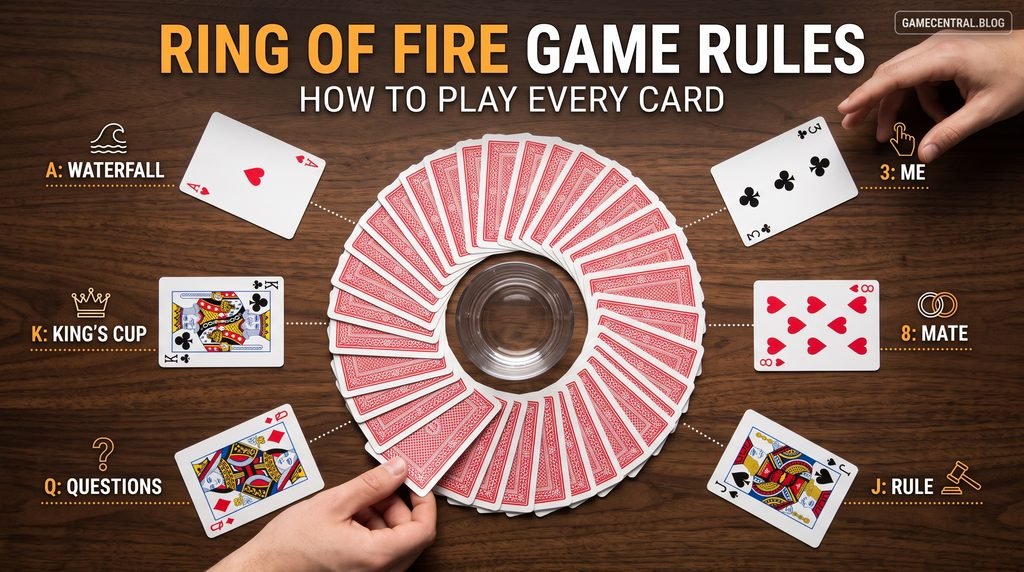
The Ring of Fire game rules explain how to play a popular group card game in which players draw cards from a circle and follow the action assigned to each card. Also known as Kings Cup or Circle of Death in some versions, Ring of Fire combines quick reactions, word games, social challenges, and special rules that can change throughout a round.
The game is easy to learn, making it a popular choice for parties, student gatherings, and game nights with friends. However, there is one important detail for beginners: Ring of Fire does not have a single universally accepted set of card meanings. Some groups use a King’s Cup for the four Kings, while others use different actions for Jacks, Fours, Fives, and other ranks. Antics+1
This guide explains a practical version you can agree on before playing, including the equipment, setup, all 13 card ranks, the King’s Cup, common variations, and a non alcoholic alternative. Once everyone understands the rules, the game can begin without constant interruptions to settle disagreements.
What Is the Ring of Fire Card Game?
Ring of Fire is a social card game in which each card rank represents an action, challenge, or temporary rule. Players take turns drawing cards from a face down circle arranged around a central cup. The person who draws a card announces its meaning, and the group follows the corresponding rule.
The traditional drinking game version involves beverages, but alcohol is not essential to the gameplay. Water, juice, soft drinks, or non drinking forfeits can be used instead.
The name Ring of Fire comes from the circular arrangement of the cards. In a common version, players must draw cards carefully to preserve the ring. Breaking the circle can trigger a penalty if the group has agreed to that rule.
Ring of Fire is sometimes called King’s Cup or Circle of Death. These names overlap, but the exact rules differ between groups, regions, and published rule sets. Some versions make the fourth King the finale, while others change what happens when particular cards appear. Drinking Game+1
What makes the game different?
Unlike a conventional card game, Ring of Fire does not focus on winning tricks, collecting sets, or reaching a particular score. Instead, the deck creates a sequence of short activities.
Players might have to:
- Name items belonging to a chosen category.
- Find words that rhyme with a starting word.
- React quickly to a hand signal.
- Follow a temporary rule invented by another player.
- Avoid answering questions from the Question Master.
These changing activities make the game accessible to beginners while allowing experienced groups to introduce their own variations.
What You Need to Play Ring of Fire
You do not need a special board, expensive equipment, or a dedicated card set. A standard deck and enough table space are usually sufficient.
| Equipment | Purpose |
|---|---|
| Standard 52 card deck | Provides the 13 card ranks used in the game |
| Central cup | Used for the King’s Cup version |
| Table or flat surface | Holds the circular arrangement of cards |
| Drinks or alternative forfeits | Optional elements of the chosen rules |
| Three or more players | A practical starting point for a group game |
A standard deck contains four suits, each with an Ace, numbered cards from Two through Ten, and three face cards: Jack, Queen, and King. That gives you 13 ranks, each with a corresponding action.
How many players can play? Three or more is a practical minimum, although four to eight players often make it easier to keep the conversation, challenges, and turns moving. Larger groups can play too, but you may need a larger table and clearer turn taking.
For the smoothest experience, choose one person to explain the rules before the first card is drawn. That person does not have to act as a permanent referee; the goal is simply to make sure everybody starts with the same expectations.
How to Set Up Ring of Fire
Setup takes only a few minutes. The most important part is arranging the cards and agreeing on which version of the rules the group will use.
Rage Cage Regeln: Anleitung, Aufbau und Tipps zum Trinkspiel | TRICHTR – Trichtr
Step 1: Place the central cup
Put an empty cup in the middle of the table if you are playing the King’s Cup version. For a non alcoholic game, fill it with water or another agreed upon drink, or replace it with a bowl containing written challenges.
ぶたのしっぽのやり方!子どもにわかりやすいルールや楽しいアレンジも | くふうロコ
Step 2: Arrange the deck in a ring
Shuffle a standard deck and place all 52 cards face down in a circle around the cup. In versions that use the broken ring penalty, make the cards touch or sit close together so the circle is continuous.
Félagsvist Kvennabands Vestur-Húnavatnssýslu | Húnaþing vestra
Step 3: Seat the players
Everyone sits around the table where they can reach the cards. Choose a starting player and agree whether turns move clockwise or counterclockwise.
Best 5 player card games
Step 4: Confirm the card meanings
Review the card reference below. In particular, decide whether a Four means Floor or a group based action, whether a Jack creates a rule or starts another activity, and how the fourth King ends the game.
Once the setup is complete, the first player draws a card without deliberately disturbing the remaining ring. They reveal it, perform the assigned action, and pass the turn to the next player.
Important: Breaking the ring is not automatically a penalty in every version. Agree on whether it triggers a forfeit before play begins. Drinking Game+1
Ring of Fire Card Meanings at a Glance
The following table uses a common UK style arrangement for the numbered cards, with a few clearly identified alternatives. It is a recommended house rule set, not a claim that every group plays identically.
| Card | Common action | What happens |
|---|---|---|
| Ace | Waterfall | Players follow a starting and stopping sequence |
| Two | You | Choose another player for the agreed penalty or challenge |
| Three | Me | The person who drew the card takes the penalty |
| Four | Floor | Everyone touches the floor; the last player loses |
| Five | Thumb Master | Players copy a thumb signal; the last to react loses |
| Six | Group action | Use an agreed group based action or substitute challenge |
| Seven | Heaven | Players raise a hand or point upward; the last loses |
| Eight | Mate | Choose a partner for the agreed duration |
| Nine | Rhyme | Players take turns saying rhyming words |
| Ten | Categories | Players name items in a chosen category |
| Jack | Rule Maker | Create a temporary rule |
| Queen | Question Master | Catch other players answering your questions |
| King | King’s Cup | Follow the group’s central cup rule |
Card assignments vary considerably. For example, some versions use Fours and Sixes for group based drinking actions, while others use different actions for those ranks. Some assign Never Have I Ever to a Jack or Ten. Dark Square Games+2
If your group already knows a different version, use it consistently rather than mixing several rule sets halfway through the game.
How to Play Ring of Fire Step by Step
Once the cards are arranged and the rules have been agreed upon, the game follows a straightforward sequence.
1. Draw one card. The starting player selects one face down card from the circle and turns it face up for everyone to see.
2. Identify the action. The player announces the card’s rank and the corresponding rule. If the group is new to the game, consult the reference table instead of relying on memory.
3. Complete the challenge. The player or group performs the action. For a category or rhyming challenge, continue around the circle until someone repeats an answer, gives an invalid answer, or cannot respond within the agreed time.
4. Apply any temporary rule. Some cards create powers that remain active after the turn. A Question Master, Thumb Master, or Rule Maker may keep that role until the next qualifying card is drawn, depending on the version being played.
5. Pass the turn. Play continues in the agreed direction. The next person draws a card and follows its rule.
6. Resolve the King’s Cup if applicable. In the classic version, each of the first three Kings adds a small amount of a chosen beverage to the central cup. The player who draws the fourth King triggers the finale, as explained below. Dark Square Games+1
What happens if a player cannot complete a challenge?
The group should agree on this before starting. A simple rule is that an incorrect answer, a repeated answer, or failure to respond within a short agreed period counts as losing the challenge.
The consequence can be a point, a harmless forfeit, a silly pose, or another activity chosen by the group. There is no need to impose excessive penalties.
For instance, if a player chooses the category “video game characters,” each person must name a distinct character. Repeating a name or taking too long ends the round. This approach works even if some players prefer not to drink.
Ring of Fire Game Rules Explained for Every Card
The individual card meanings are the heart of the game. The explanations below provide practical instructions for a consistent version, while noting where common alternatives exist.
Ace: Waterfall
Waterfall is a group activity in which players begin at the same time and follow a sequence for stopping. Traditionally, the person who draws the Ace starts, and the other players follow in order around the table.
In the classic drinking version, players stop one after another rather than everyone stopping simultaneously. Some groups reverse the order or use a different stopping rule, so clarify the sequence before play.
For a non drinking version, everyone can begin a repetitive action together, such as tapping the table, and stop in sequence when the player before them stops.
The key to making Waterfall work is to establish the order clearly. It should never be used to pressure someone into consuming more than they want.
Two Through Seven: Quick Actions and Group Challenges
Two — You: The player who draws the Two selects another player to complete a small challenge or take the agreed penalty. A harmless example is asking the chosen person to name three games in a particular genre.
Three — Me: The player who draws the Three completes the challenge themselves. It can be a simple forfeit, a short trivia question, or another action agreed upon before the game.
Four — Floor: Everyone tries to touch the floor when the card is revealed. The last person to do so loses the round. Some versions instead assign a group based action to the Four, so confirm the choice in advance.
Five — Thumb Master: The player who draws the Five becomes the Thumb Master. At an unexpected moment before the next qualifying Five, they place their thumb on the table or use another agreed signal. Everyone else must copy it. The last person to react loses the round.
Six — Group action: Six has several competing meanings across published and informal rule sets. Some groups use a category based or group based action, while others assign it to one half of the group. Choose a specific action before playing rather than assuming everyone knows the same convention.
Seven — Heaven: The player who draws the Seven initiates a signal, commonly pointing upward or raising a hand. Everyone copies it, and the last person to react loses the challenge. As with Thumb Master, decide whether the signal can be made at any point before the next Seven.
The Five and Seven are reaction based cards. Their success depends on players paying attention even when it is not their turn.
Eight Through Queen: Social Challenges and Special Powers
Eight — Mate: The player who draws the Eight chooses a partner. In a common version, the two players must complete certain challenges together or mirror each other’s penalties. Agree on whether this partnership lasts for the rest of the game or only for a single round.
Nine — Rhyme: The player who draws the Nine says a word. Going around the circle, each player must provide a different word that rhymes with it. The round ends when someone repeats a word, gives an invalid rhyme, or cannot think of an answer within the agreed time.
For example, a round beginning with light could include night, bright, and flight. The group should agree on whether near rhymes, proper nouns, and words from other languages are acceptable.
Ten — Categories: The player chooses a category, and everyone takes turns naming an item that fits. Possible categories include video game franchises, racing games, gaming consoles, animals, foods, or films.
For example, if the category is gaming consoles, players could name PlayStation, Xbox, Nintendo Switch, and other valid examples. Repeating an answer or naming something outside the category ends the round.
Jack — Rule Maker: In this version, the player invents a temporary rule everyone must follow. Examples include calling every player by a chosen nickname or using a particular hand to pick up cards. The rule remains active until the next Jack is drawn, unless the group agrees otherwise.
Avoid rules that could cause embarrassment, injury, or disruption. A good house rule makes the game more amusing without making it difficult to play.
Queen — Question Master: The player who draws the Queen becomes the Question Master. They can ask other players questions, and anyone who answers directly loses the challenge. A common version keeps the role active until another Queen appears.
For example, the Question Master might ask, What game did you last play? A player who responds normally falls into the trap. Asking a question in return may avoid the penalty, depending on the agreed rules.
These social cards reward attention and creativity. They also create opportunities for players to interact rather than simply draw cards and wait for their next turn.
King: The King’s Cup
The King is the defining card in the traditional King’s Cup version of Ring of Fire.
When one of the first three Kings appears, the player adds a small, predetermined amount of their chosen beverage to the central cup. When the fourth King is drawn, the player triggers the final round. In the traditional drinking version, this means consuming the contents of the cup, and the game usually ends there. Dark Square Games+1
However, this rule is not universal. Some groups choose a non alcoholic finale, divide the contents into separate servings, or replace the cup with a final challenge. A group should never require anyone to consume a mixture or quantity they do not want.
A practical alternative is to place four folded challenge slips in the center and reveal one whenever a King is drawn. The fourth King can trigger a final group challenge instead of a drinking penalty.
The most important distinction is that the King’s Cup rule concerns the King card, not every card drawn. Other card effects should be resolved according to the group’s agreed rules.
Popular Ring of Fire Rule Variations
One reason Ring of Fire remains easy to adapt is that groups can change the card meanings to suit their preferences. The downside is that players who learned different versions may disagree about the correct rules.
There is no need to argue over which version is the only authentic one. Choose a complete set of rules and stick with it for the game.
The classic King’s Cup version
This version uses a central cup, a circle of face down cards, and a special finale when the fourth King appears. The individual card meanings follow a familiar set of actions, including Waterfall, Rhyme, Categories, and Question Master.
It is a suitable choice for groups who want the traditional format and a clear ending.
The UK style Ring of Fire version
In many UK style versions, the card assignments include Waterfall for the Ace, You for the Two, Me for the Three, Thumb Master for the Five, Mate for the Eight, and King’s Cup for the King. The Four, Six, and Jack are among the ranks that frequently vary. Dark Square Games+1
If you choose this format, write the meanings down before the first turn. That prevents disagreements when a less familiar card appears.
The house rule version
A house rule game allows players to invent or modify selected actions. For example, you might replace a difficult word challenge with a gaming trivia question, or make the Jack introduce a temporary rule.
Keep changes limited. If every card has several possible meanings, players will spend more time negotiating rules than playing.
A useful compromise is to agree on a standard set for the numbered cards and allow just one or two optional variations. This maintains the game’s variety without creating confusion.
The non alcoholic party version
This version keeps the same card layout and challenges but replaces drinking penalties with points, silly tasks, trivia questions, or other harmless forfeits.
It works particularly well for mixed preference groups, designated drivers, and gatherings where not everyone wants alcohol. You can also use it as a general party game rather than a drinking game.
Practical Tips for a Smooth Game
The rules are simple, but a few small decisions can make a significant difference to the pace and enjoyment of the game.
Keep a visible card reference. Beginners should not have to memorize 13 different actions. A printed list or a phone note can help everyone check a rule quickly.
Settle variations before dealing. Decide what the Four, Six, Jack, and Eight mean in your version. These are especially useful ranks to clarify because their meanings differ between groups.
Keep word challenges moving. For Rhyme and Categories, agree on a reasonable response limit, such as five seconds. Allow enough time to think without letting a round stall indefinitely.
Make temporary rules memorable. If the Rule Maker introduces a rule, ask the group to repeat it once. That reduces accidental mistakes and arguments.
Use a clear turn direction. Clockwise play is common, but the group can choose either direction. Just make sure everyone knows who goes next.
Avoid overly complicated house rules. The best temporary rules are easy to remember and do not interfere with the basic game. A rule that requires everyone to perform several actions at once can slow down the round.
Respect individual boundaries. Players should be able to skip an action or choose a non drinking alternative without being pressured. A party game should remain voluntary and enjoyable.
Common Ring of Fire Mistakes to Avoid
New players often understand the basic idea quickly but miss details that can cause confusion later.
- Mixing different rule sets: One player may know the Four as Floor, while another expects a different group action. Choose one meaning before play.
- Changing rules mid round: A house rule should have a clear starting point and ending point. Otherwise, players will not know when it applies.
- Forgetting the Question Master: If the Queen’s effect lasts until the next Queen, the group must remember who currently holds the role.
- Repeating answers in word challenges: Categories and Rhyme work best when players agree that repeated answers count as failures.
- Breaking the ring unintentionally: If your version uses a broken ring penalty, draw carefully. Also decide what happens if cards shift or the circle was incomplete before the game started.
- Assuming every King has the same effect: The first three Kings and the fourth King often have different roles in the traditional King’s Cup version.
- Using penalties that go too far: Challenges should remain light hearted. Do not use rules that encourage dangerous behavior or force someone to drink.
A short rules briefing before the first draw usually solves most of these problems. If a dispute comes up, pause and agree on an interpretation before continuing.
Can You Play Ring of Fire Without Alcohol?
Yes. Ring of Fire works without alcohol because most of its core activities involve quick reactions, memory, wordplay, and social interaction rather than drinking itself.
A non alcoholic version can follow exactly the same setup and card order. Replace any drinking penalty with one of the following:
- Points: The player who loses a challenge receives a penalty point. The group can set a target score before starting.
- Trivia: The player answers a question about games, movies, music, or general knowledge.
- Quick challenges: Perform a harmless task, such as naming five animals or describing a favorite game in one sentence.
- Team activities: For the Eight, choose a partner who must answer a question with you or complete a shared challenge.
- Finale card: Replace the King’s Cup with a final group task or a mystery challenge.
You can also use water, soft drinks, or juice if players want to keep a beverage in the game. No one needs to consume an unpleasant mixture or complete a challenge that makes them uncomfortable.
If the group does choose to use alcohol, keep the rules voluntary, avoid rapid consumption challenges, provide non alcoholic alternatives, and never drive after drinking. The game’s success should depend on interaction and humor, not how much anyone consumes.
Frequently Asked Questions
What are the basic Ring of Fire game rules?
Players arrange a standard deck face down in a circle around a central cup, take turns drawing one card, and follow the action assigned to its rank. The game continues until the deck or the agreed finale ends the round.
How many players do you need for Ring of Fire?
Three or more players is a practical starting point. Four to eight players often provide a good balance between interaction and manageable turn taking, although larger groups can play with enough space.
How many cards do you need for Ring of Fire?
A standard 52 card deck is the usual choice. Jokers are generally left out unless the group deliberately assigns them special meanings.
What does each card mean in Ring of Fire?
A common version uses Ace for Waterfall, Two for You, Three for Me, Four for Floor, Five for Thumb Master, Seven for Heaven, Eight for Mate, Nine for Rhyme, Ten for Categories, Jack for Rule Maker, Queen for Question Master, and King for King’s Cup. Six and several other ranks vary by house rules, so confirm the complete list before playing.
What happens if you break the ring in Ring of Fire?
In versions with a broken ring rule, a player who creates a gap while drawing a card receives the agreed penalty. Some groups use a forfeit, while others ignore accidental gaps. Decide on this rule before the first turn.
Does Ring of Fire always end when someone draws the fourth King?
In the traditional King’s Cup version, the fourth King triggers the final cup action and usually ends the game. Other versions change the finale or allow the group to continue, so the ending depends on the rules selected.
Is Ring of Fire the same as King’s Cup?
They are closely related and often refer to the same card game. Ring of Fire emphasizes the circular arrangement of cards, while King’s Cup emphasizes the central cup. Their card meanings can differ between versions. Antics+1
Can you play Ring of Fire without drinking alcohol?
Yes. Use water or soft drinks, or replace penalties with points, trivia, and harmless challenges. The card drawing format and most social activities work just as well without alcohol.
Conclusion
The best way to learn the Ring of Fire game rules is to start with one consistent set of card meanings, arrange the deck in a circle, and explain the temporary rules before the first draw. Waterfall, Rhyme, Categories, and Question Master provide variety, while the King’s Cup can serve as the finale in the traditional version.
Remember that different groups use different card assignments. Decide on the variations, the broken ring penalty, and the ending before the game starts. That small amount of preparation prevents most disagreements and keeps the focus on the group activity.
Whether you choose the traditional format or a non alcoholic party version, Ring of Fire is most enjoyable when everyone understands the rules, participates voluntarily, and feels comfortable with the challenges.
LEAVE A PIXEL ZINE COMMENT