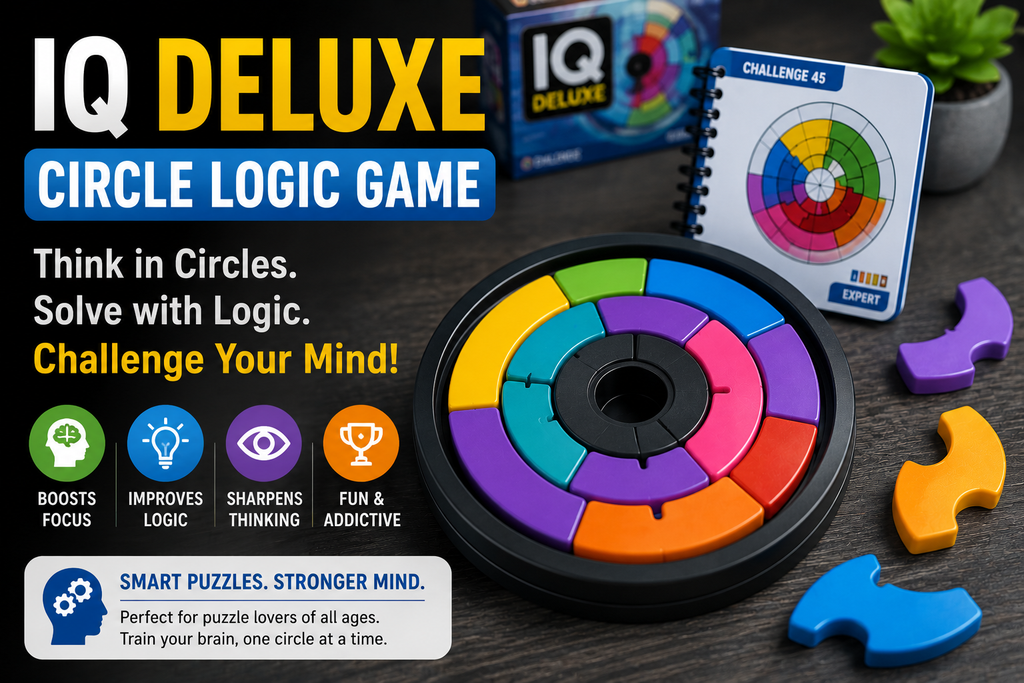
The IQ Deluxe circle logic game sits in an interesting space between traditional brain teasers and modern puzzle gaming. Its central challenge is simple to understand but can become surprisingly demanding: players must examine the available pieces, understand the rules of the puzzle layout, and determine how every element can fit into the required arrangement.
That combination of spatial reasoning, logic, planning, and trial-and-error is what gives circle-based IQ puzzles their appeal. The early challenges may appear straightforward, but more difficult setups can punish rushed decisions. A piece placed in a seemingly correct position can block the only solution later in the puzzle.
This article explains what the IQ Deluxe circle logic game is, how this style of puzzle works, what skills it tests, and how to approach difficult challenges more efficiently. It also looks at why these games appeal to players who enjoy brain-training titles, tabletop puzzles, mobile puzzle games, and traditional logic challenges.
What Is the IQ Deluxe Circle Logic Game?
The IQ Deluxe circle logic game is best understood as a spatial logic puzzle built around arranging puzzle pieces within a circular or otherwise restricted playing area.
The player’s goal is generally to place the available pieces according to the puzzle’s rules until the board is completed correctly. Unlike a standard jigsaw puzzle, success is not based on matching a picture. The challenge comes from understanding shape, orientation, available space, and placement order.
A typical puzzle presents the player with three important elements:
- A defined playing area or challenge layout
- A collection of pieces with different shapes or configurations
- A rule that determines which pieces can be moved, rotated, or positioned
The difficulty comes from the fact that the number of possible placements can grow quickly. Several moves may look reasonable at first, but only one arrangement may allow the entire puzzle to be completed.
That makes the game a logic challenge rather than a simple test of speed.
Why Circle-Based Logic Puzzles Can Be Difficult
Circular puzzle spaces create a different kind of spatial problem from square grids.
In a rectangular puzzle, players can often use corners and straight edges as obvious reference points. A circle removes some of those familiar visual anchors. Curved boundaries and changing angles make it more difficult to judge which pieces belong near the edge and which combinations will leave usable spaces behind.
The most challenging part is usually not placing the first few pieces. It is avoiding a placement that creates an awkward gap later.
The Problem of Unusable Spaces
One of the most common mistakes in logic puzzles is creating a space that no remaining piece can fill.
For example, a player may place a flexible-looking piece near the center because it fits perfectly. The move appears correct, but the placement may leave a narrow curved gap near the outer edge. If none of the remaining pieces can occupy that space, the puzzle is effectively lost.
This is why experienced puzzle players think beyond the current move.
Instead of asking only:
“Does this piece fit here?”
They also ask:
“What spaces will remain if I put it here?”
That small change in thinking can significantly improve puzzle-solving efficiency.
Rotation Is Not Always an Advantage
Players often assume that a piece with several possible rotations is easy to place. In reality, more orientations can create more possibilities to evaluate.
A piece may fit in four different positions, but three of those placements could lead to dead ends.
The key is not simply finding a legal move. The goal is finding a move that preserves enough useful space for everything that remains.
How to Play the IQ Deluxe Circle Logic Game More Effectively
A strong approach begins before placing pieces randomly.
Take a moment to examine the full challenge. Look at the available pieces, the occupied spaces if the puzzle starts with a setup, and the shape of the remaining board.
Then begin with the most constrained information.
Identify the Most Restricted Areas First
Small, narrow, curved, or unusually shaped spaces are often the hardest areas to fill.
If a particular section can only accept one or two pieces, it deserves attention early. Leaving it until the end increases the risk that the necessary piece will already have been used somewhere else.
This follows a useful logic-puzzle principle: solve the most constrained part before working on the flexible areas.
Large open spaces usually provide more options. Strange or limited spaces provide fewer.
Study the Pieces Before Committing
Do not immediately place the first piece that appears to fit.
Compare the remaining shapes. Some pieces may have unusual curves, long sections, or combinations that make them suitable for only a few locations. Others may fit almost anywhere.
Use the specialized pieces carefully.
A highly flexible piece can often be saved for later because it may help solve the remaining open space. A uniquely shaped piece may need to be placed earlier because it has fewer possible homes.
Think About the Final Piece
A useful mental exercise is to consider what might happen near the end of the puzzle.
If your current move leaves a tiny space that obviously requires a particular piece, you should check whether that piece will still be available. If you have already used it elsewhere, the current arrangement may be a dead end.
This does not mean you need to solve the entire puzzle mentally before making a move. It means thinking one or two steps ahead rather than treating every placement as an isolated decision.
A Step-by-Step Strategy for Difficult Challenges
When an IQ Deluxe circle logic game challenge becomes frustrating, a structured method is usually more productive than repeated random experimentation.
Step One: Read the Starting Layout Carefully
If the challenge includes preset pieces or occupied positions, study them before touching anything.
Preset information reduces the number of possible solutions. Look for areas where the starting arrangement creates an unusual gap or restricts the orientation of nearby pieces.
These areas often contain the puzzle’s most useful clues.
Step Two: Find Forced Placements
A forced placement occurs when a specific piece can realistically fit in only one location or orientation.
These are valuable because they reduce uncertainty.
Do not confuse a forced placement with a piece that merely looks correct. Check the available alternatives. If the piece genuinely has only one useful position, it is usually a strong candidate for early placement.
Step Three: Preserve Flexible Space
Try to avoid dividing the board into several small, irregular gaps.
Large connected areas are generally easier to work with because more pieces can potentially fit into them. Fragmented spaces create restrictions and can quickly make a puzzle impossible.
Before placing a piece, look at the shape of the empty area that will remain.
Step Four: Use Elimination Instead of Endless Guessing
If a placement repeatedly leads to an impossible final arrangement, treat that as information.
Remove the piece and try a different orientation.
Effective puzzle solving is often a process of controlled elimination:
- Make a reasonable placement.
- Check how the remaining pieces interact with the remaining space.
- Identify contradictions or impossible gaps.
- Undo the move.
- Test the next logical alternative.
This is far more useful than randomly moving pieces without tracking what has already failed.
Step Five: Reassess the Entire Board When Stuck
A common mistake is assuming that the last piece placed must be the problem.
Sometimes the real mistake happened much earlier.
If several attempts fail, clear the recent sequence and reconsider the board from a wider perspective. Look again at the pieces you treated as flexible and the spaces you ignored at the beginning.
The solution may require changing an assumption rather than forcing a difficult piece into place.
What Skills Does This Type of Logic Game Test?
The IQ Deluxe circle logic game is not based on one skill alone. Its challenge comes from combining several forms of reasoning.
Spatial Reasoning
Players need to visualize how shapes occupy space and how rotation changes their possible positions.
This is especially important in circular layouts because the boundaries may make a piece appear compatible from one angle but incompatible after surrounding pieces are considered.
Pattern Recognition
Repeated play can help players recognize familiar situations.
For example, experienced puzzle solvers may quickly notice that a certain gap requires a particular shape or that two remaining pieces must work together in a specific area.
Pattern recognition does not replace logic, but it can reduce the time needed to identify promising moves.
Planning and Decision-Making
The best move is not always the most obvious one.
Players must weigh immediate progress against future flexibility. This is similar to many strategy and puzzle video games, where using a resource too early can make a later challenge harder.
The difference is that a physical or compact logic puzzle often presents this decision in a concentrated form: every placement changes the available state of the board.
Error Recognition
Good puzzle players also learn to recognize when an approach is failing.
Continuing to force a piece into an impossible arrangement wastes time. Being willing to reset part of the puzzle and test another path is an important problem-solving skill.
Why This Puzzle Style Appeals to Video Game Players
Although an IQ Deluxe circle logic game may not look like a traditional video game, the thought process behind it has a great deal in common with digital puzzle design.
Players who enjoy Tetris-style spatial decisions, block-placement games, escape-room puzzles, Sudoku, match-based strategy games, and environmental puzzle solving may recognize familiar skills.
The main difference is the pace.
Many video games reward fast reactions. Logic puzzles usually reward deliberate analysis. There is often no need to react within a few seconds, which allows the player to focus entirely on evaluating possibilities.
That slower pace can make this type of game appealing as a break from competitive multiplayer titles or action-heavy games.
It also makes the puzzle format accessible. Players do not need to learn complex controls, memorize character abilities, or understand a large game world. The rules are usually visible through the board itself.
The depth comes from the puzzle design.
Common Mistakes That Make the Puzzle Harder
Many difficult puzzle sessions become harder because of the approach rather than the challenge itself.
Filling the Largest Empty Area First
A large space may feel like the obvious place to start, but it often provides too many options.
By using pieces there immediately, you may accidentally consume shapes needed for more restrictive sections.
Look for the hardest spaces first.
Assuming the First Good Fit Is Correct
A piece can fit physically and still be strategically wrong.
Always consider the resulting gaps before committing to a placement.
Ignoring Piece Orientation
Players sometimes repeatedly test a piece in one general position without considering every meaningful rotation.
When stuck, deliberately check the available orientations rather than relying on visual intuition.
A different rotation may reveal a placement that was not obvious from the original angle.
Continuing After the Puzzle Has Reached a Dead End
If the remaining space clearly cannot match the remaining pieces, stop.
Trying to force a solution from an impossible state usually creates frustration. Undo the last uncertain move and test an alternative.
Recognizing a dead end quickly is part of becoming better at logic games.
How to Improve at Circle Logic Puzzles Over Time
Improvement usually comes from developing better habits rather than memorizing individual solutions.
Start Slowly on New Puzzle Types
When learning a new puzzle system, speed should not be the priority.
Spend time understanding how the pieces interact. Notice which shapes are flexible, which areas are restrictive, and how rotations affect placement.
Once those relationships become familiar, solving speed can improve naturally.
Review Failed Attempts
A failed arrangement can still teach you something.
Ask what caused the problem:
- Did you create an unusable gap?
- Did you use a specialized piece too early?
- Did you overlook a rotation?
- Did you assume a placement was forced when it was not?
Identifying the cause helps prevent repeating the same mistake.
Increase Difficulty Gradually
Moving immediately to the hardest available challenge can lead to unproductive trial-and-error.
Progressing through easier and medium-level puzzles helps establish an understanding of the game’s spatial rules. More difficult puzzles can then be approached with a larger mental library of patterns.
The goal is not to memorize every arrangement. It is to become better at recognizing the kinds of situations that lead to successful placements.
Is There Always Only One Solution?
The answer depends on the specific puzzle and its rules.
Many logic challenges are designed around a single intended arrangement, while others may allow multiple valid solutions. A puzzle’s instructions or official solution material is the best source for determining whether a particular challenge has one solution or several.
For players solving independently, the more useful question is often simpler: does the current arrangement satisfy every rule and complete the board correctly?
If the puzzle accepts any complete legal arrangement, finding one valid solution is enough. If it is designed around a specific challenge setup, the intended solution may be unique.
When Should You Use Hints or Solutions?
Hints are useful when you have reached a genuine reasoning barrier rather than simply encountering the first difficult moment.
A good approach is to seek the smallest hint possible.
For example, learning which general area to focus on is often more satisfying than seeing the entire completed board. A partial clue preserves the challenge while helping you escape an unproductive loop.
Full solutions are more useful after you have made several serious attempts and want to understand the reasoning behind the correct arrangement.
If possible, study why the solution works rather than immediately moving to the next challenge. That analysis can improve your performance on future puzzles.
How Does the IQ Deluxe Circle Logic Game Compare With Other Puzzle Games?
This type of game shares characteristics with several puzzle genres, but its focus is distinct.
Tetris-inspired games emphasize spatial placement, but usually add time pressure and continuously changing conditions.
Sudoku focuses more heavily on numerical deduction and rule elimination.
Jigsaw puzzles depend on shape matching and visual recognition, often with an image providing additional clues.
Escape-room games combine object interaction, observation, codes, and environmental reasoning.
The IQ Deluxe circle logic game places greater emphasis on the relationship between a limited set of shapes and a constrained board. The player is not simply finding what fits now. They are managing the consequences of every placement.
That makes it closer to a compact spatial strategy challenge.
Who Will Enjoy the IQ Deluxe Circle Logic Game?
This style of puzzle is particularly well suited to players who enjoy solving problems at their own pace.
It may appeal to:
- Fans of spatial and logic puzzles
- Players who enjoy thoughtful single-player challenges
- Families looking for a screen-free puzzle activity
- Video game players who enjoy titles based on planning and pattern recognition
- Puzzle enthusiasts interested in gradually increasing difficulty
- Anyone who prefers strategy and deduction over reaction speed
The appeal is broad because the basic interaction is easy to understand. The challenge comes from mastering the possibilities rather than learning complicated controls.
Frequently Asked Questions
What is the IQ Deluxe circle logic game?
The IQ Deluxe circle logic game is a spatial reasoning puzzle in which players arrange available pieces within a restricted, often circular, puzzle area according to the challenge rules. Success depends on understanding shape, orientation, available space, and the order in which pieces are placed.
How do you solve a difficult circle logic puzzle?
Start by identifying the most restricted spaces and any placements that appear forced. Avoid creating small, irregular gaps, and think about how each move affects the pieces you still need to place. If an arrangement reaches an impossible state, undo the uncertain move and test another option.
Does rotating the pieces matter?
Yes. Rotation can completely change where a piece fits. When you are stuck, systematically check the available orientations instead of repeatedly testing the same general placement.
Are circle logic games good for beginners?
They can be, particularly when the game offers challenges that increase gradually in difficulty. Beginners can focus first on understanding how pieces interact and then develop stronger planning and pattern-recognition skills as the puzzles become more complex.
What is the best strategy for avoiding dead ends?
Do not evaluate a move only by whether the current piece fits. Examine the empty spaces that will remain afterward. Preserving large, flexible areas and solving highly restricted spaces early can reduce the risk of leaving gaps that no remaining piece can fill.
Is trial and error necessary?
Some experimentation is normal, especially on difficult puzzles. The most effective approach is controlled trial and error: test a logical possibility, observe why it succeeds or fails, and use that information to narrow the remaining options.
Final Thoughts
The IQ Deluxe circle logic game works because it turns a simple idea into a deeper problem-solving challenge. The pieces may be limited, and the board may look straightforward, but every placement affects the possibilities that remain.
The strongest approach is to focus on restricted spaces, identify useful or forced placements, preserve flexibility, and treat failed attempts as information instead of wasted effort. As the challenges become harder, success depends less on randomly trying pieces and more on understanding the relationship between the shapes and the space they occupy.
For puzzle fans, that balance is the real attraction. The challenge is accessible at first glance, yet difficult enough to reward patience, spatial reasoning, and careful planning
LEAVE A PIXEL ZINE COMMENT