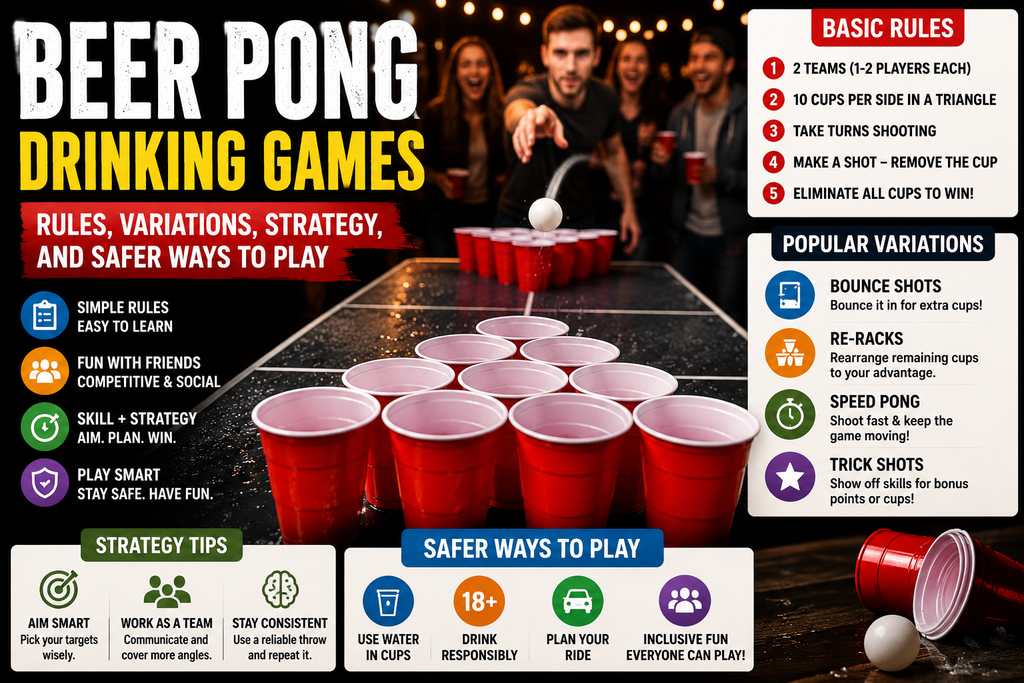
What Are Beer Pong Drinking Games?
Beer pong is a cup throwing party game in which players or teams attempt to throw or bounce ping pong balls into cups arranged on the opposite side of a table. In the traditional drinking game version, making a shot means the opposing team removes a cup, with the contents consumed according to the rules the group has agreed upon.
The central mechanic is simple, which explains why the game has remained popular for decades. Players do not need complicated equipment, extensive preparation, or prior gaming experience. The game combines accuracy, turn taking, team coordination, and a small amount of tactical decision making.
Despite its name, beer pong does not require beer, and it does not need to involve alcohol at all. Many groups now use water filled cups for gameplay and treat drinking as optional, separate from the cups used as targets. That approach is also more practical from a hygiene perspective, since balls can collect dust or come into contact with surfaces before landing in a cup.
The basic formula remains the same: arrange the cups, establish the rules, take turns shooting, and try to eliminate the opposing team’s cups before they eliminate yours.
How Does a Standard Beer Pong Game Work?
A standard game is usually played by two teams of one or two players, although larger groups can rotate players between rounds.
The most recognizable setup places ten cups in a triangle on each side of a table. Players stand behind their side and take turns throwing ping pong balls toward the opposing cups.
Basic Beer Pong Setup
A typical game requires:
- A long, stable table
- Plastic cups
- Ping pong balls
- Water for rinsing balls
- A non alcoholic or alcoholic beverage, depending on the group
- A clear agreement about house rules
The ten cup triangle is common, but it is not the only format. Smaller games may use six cups, and larger party versions may use more.
The most important part of setup is consistency. Both teams should begin under the same conditions, with cups arranged in the same way and the same shooting distance.
Standard Gameplay
Teams alternate turns, generally taking one or two shots depending on the number of players and the rules being used.
When a ball lands successfully in a cup, that cup is removed from play. The game continues until one side has no remaining cups.
That sounds straightforward, but beer pong is known for house rules. One group may allow bounce shots to count as two cups, while another may treat them exactly like regular shots or disallow them entirely. Some groups permit cup rearrangement at certain points, while others require the cups to remain where they are.
This is why experienced players usually settle the rules before the first throw.
Why House Rules Matter in Beer Pong
Beer pong has no single universal ruleset followed by every player. The broad concept is consistent, but details often vary from one party, college community, or region to another.
Arguments usually arise when a rule is introduced after the game has already started.
A smooth game begins with a short agreement covering the most important points:
- How many cups will each team start with?
- How many shots does each team receive per turn?
- Are bounce shots allowed?
- What happens if a ball knocks over a cup?
- When can teams request a rerack?
- Are trick shots permitted?
- Does the final cup have special rules?
- Is there a redemption round after the last cup is made?
A quick discussion can prevent far more confusion than a lengthy rulebook.
Bounce Shots
In some versions, a player may bounce the ball off the table before it enters a cup. Traditional house rules often reward this with the removal of more than one cup.
The balancing factor is that a bounce shot can usually be blocked or swatted away by the defending team after it hits the table.
Other groups avoid bounce shots completely because they introduce additional arguments about timing, interference, and how many cups should be removed.
The best rule is simply to decide before play begins.
Re Racking the Cups
As cups disappear, the remaining cups can become scattered. Re racking allows players to request that the remaining cups be rearranged into a tighter formation.
Common shapes include a triangle diamond line or other compact arrangement.
Some groups limit each team to a specific number of re racks per game. Others automatically rearrange the cups whenever a certain number remain.
Reracking changes the difficulty of the game, so both teams should have equal opportunities.
Redemption Rules
Some beer pong games include a redemption or rebuttal rule. After one team clears the final cup, the losing team receives an opportunity to continue shooting.
If the trailing team successfully makes every remaining redemption shot according to the agreed rules, the game may continue.
This can create dramatic finishes, but it can also significantly extend a game. Groups running a tournament may prefer to skip redemption rounds to keep matches moving.
Popular Beer Pong Variations
The standard ten cup game is only one version. Variations can make the format faster, more competitive, or better suited to larger groups.
Six Cup Beer Pong
Six cup beer pong is one of the easiest ways to speed up the game.
Each side starts with six cups instead of ten, usually arranged in a triangle. The core rules remain the same, but fewer targets mean shorter matches.
This format works particularly well when:
- A large group is waiting for a turn
- The table space is limited
- Players want several short rounds
- A tournament has many teams
The smaller setup also makes it easier to reset the table between games.
Speed Pong
Speed pong increases the pace by reducing the waiting time between shots.
Instead of a deliberate turn structure players may shoot as quickly as they can after retrieving the ball. Depending on the rules, both teams may even be throwing at the same time.
This version creates more chaos and requires more attention which is part of its appeal. It is best suited to groups that understand the standard game already.
Because fast moving games can become physically hectic, the playing area should remain clear and players should avoid crowding around the table.
Island or Solo Cup Rules
Some groups introduce an island rule when a single cup becomes separated from the rest of the formation.
Players may call the isolated cup before throwing. If they successfully make it, the shot can receive a bonus according to the house rules.
This adds a small strategic layer. The player must decide whether to target the easier cluster of cups or attempt the more difficult isolated target.
It also creates an opportunity for dramatic shots without changing the entire structure of the game.
Trick Shot Beer Pong
Trick shot variations focus less on traditional competition and more on creativity.
Players might attempt:
- Behind the back throws
- Bank shots
- Off the wall shots
- One handed throws
- No look attempts
The group can assign points based on difficulty rather than simply removing cups.
This format is often better as a casual party challenge because it gives less experienced players a chance to participate without competing directly against someone with a highly practiced throw.
Tournament Beer Pong
A tournament structure turns a casual activity into a more organized competition.
Teams can be placed into:
- Single elimination brackets
- Double elimination brackets
- Round robin groups
- League style formats
For larger events, standardized rules become more important. Every table should use the same cup count, shooting distance, rerack rules, and match format.
A tournament also benefits from shorter games. Six cup matches can keep the schedule moving better than long ten cup games with multiple redemption opportunities.
Beer Pong Strategy: How to Play More Consistently
Beer pong involves more than luck, although no strategy can guarantee a successful shot.
The strongest players usually develop consistency through repetition. The objective is to reproduce the same throwing motion rather than attempting a completely different technique every turn.
Focus on a Repeatable Throw
A consistent throwing routine can help with accuracy.
Choose a comfortable stance, hold the ball the same way, and use a similar release point. Some players prefer an arc, while others use a flatter throw.
There is no universally perfect technique because table size, distance, and individual coordination can vary.
The goal is repeatability.
Changing your stance, grip, and throwing speed after every missed shot usually makes it harder to identify what is working.
Choose Targets Strategically
A player does not always need to aim at the closest or largest looking cup.
Target selection can matter, particularly when the cups are spread apart.
Consider:
- Which cup is easiest to see clearly?
- Is one cup isolated from the main formation?
- Would removing a particular cup create a more difficult layout for the other team?
- Is the team using a rule that rewards called shots?
In casual games, strategy should not become so serious that it removes the social element. The most enjoyable games balance competition with a relaxed atmosphere.
Communicate With Your Teammate
In doubles play, teammates can benefit from a simple plan.
One player may prefer a specific target while the other concentrates on a different section of the formation. If both players repeatedly aim at the same cup, they may waste opportunities.
Communication does not need to be complicated. A quick agreement before the turn can be enough.
Safer Ways to Play Beer Pong
The competitive game itself does not require alcohol. This distinction is useful because beer pong can be adapted for different ages, environments, and social settings.
A safer setup is to fill the target cups with water and keep any beverages in separate personal containers. This means the ping pong balls are not repeatedly landing in drinks that people are expected to consume.
Non alcoholic versions can use:
- Water
- Juice
- Soda
- Sports drinks
- Mocktails
- Points instead of drinks
The game mechanics remain almost identical.
Use Water in the Playing Cups
Using water in the target cups is one of the simplest changes a group can make.
The cups still function as targets, but the game is separated from consumption. If adults choose to drink alcohol, they can do so independently and at their own pace rather than tying consumption directly to every successful shot.
This also makes cleanup easier and allows the same format to work at mixed age gatherings.
Avoid Turning Competition Into Pressure
Drinking games can become less enjoyable when players feel pressured to consume alcohol or continue playing after they no longer want to participate.
A better party environment allows people to opt out, switch to a non alcoholic drink, or simply play for points.
The competition should be optional and enjoyable, not a reason to pressure someone into drinking.
Keep the Game Area Practical
Beer pong tables can become slippery when drinks spill. Keep towels or paper towels nearby and remove obstacles from the playing area.
If the event involves alcohol, planning transportation before the gathering is also more sensible than making decisions after drinking.
Small choices like these do not make the game less fun. They simply reduce avoidable problems.
Beer Pong for Parties, Game Nights and Adult Groups
Beer pong works best when the format matches the group.
A small gathering might prefer traditional doubles. A large party may benefit from six cup games and a rotating queue. A competitive group might create a tournament bracket.
The key is to avoid making newcomers wait too long.
One useful format is to create a winner stays on table with short matches. Another option is to run two smaller tables at the same time.
For mixed groups, a non alcoholic scoring system can make participation more inclusive. Players can still compete, celebrate difficult shots, and keep track of wins without connecting the result of every shot to a drink.
How to Make Beer Pong More Fun Without Complicating It
The best modifications usually add variety without requiring players to memorize an entirely new rulebook.
Simple ideas include:
- Assigning a point value to difficult cups
- Introducing one optional trick shot per game
- Playing best of three short matches
- Creating team names
- Running a small tournament bracket
- Allowing one strategic rerack
- Using themed cup arrangements
- Keeping a leaderboard across multiple rounds
The goal should be to create memorable moments, not to make the rules so complicated that players need a referee.
A good party game is easy to explain, quick to restart, and flexible enough to include people with different skill levels.
Frequently Asked Questions
What is the basic objective of beer pong?
The objective is to throw ping pong balls into the opposing team’s cups and remove all of their cups before they remove yours. The exact rules can vary depending on the group’s house rules.
How many cups are used in beer pong?
The most common setup uses ten cups per side arranged in a triangle. Six cup games are also popular when groups want shorter matches.
Can you play beer pong without alcohol?
Yes. Beer pong can be played entirely without alcohol by filling the target cups with water and using points, penalties, or another scoring system. The throwing and competitive elements remain the same.
Are bounce shots allowed in beer pong?
Bounce shot rules vary. Some groups allow them and award bonus cup removals, while others treat them as regular shots or do not allow them. Agree on the rule before the game starts.
What is a re rack in beer pong?
A rerack is the rearrangement of the remaining cups into a more compact formation. Groups may limit the number of reracks each team can request.
What is the best way to improve at beer pong?
The most practical approach is to develop a consistent stance and throwing motion, practice from the same distance, and focus on repeatability rather than constantly changing technique. Team communication and smart target selection can also help during doubles games.
Final Thoughts
The enduring appeal of beer pong drinking games comes from their simplicity. The basic idea takes only minutes to explain, but the combination of accuracy, competition, teamwork, and unpredictable shots gives each round its own personality.
There is also plenty of room to adapt the format. Traditional ten cup games suit relaxed groups, while six cup matches can keep a busy party moving. Tournament formats add structure, and trick shot variations create a more casual challenge.
The most practical approach is to agree on the rules before the first throw and choose a version that fits the group. Using water in the playing cups and treating alcohol, if present among legal age adults, as separate from gameplay can also preserve the competitive experience while making the game more flexible and hygienic.
At its core, beer pong is a target game. The cups, scoring, variations, and party atmosphere can all change, but the reason people keep playing is simple: a well aimed shot is satisfying, a close match creates tension, and even a casual table can produce moments that the group remembers long after the final cup is removed.
LEAVE A PIXEL ZINE COMMENT