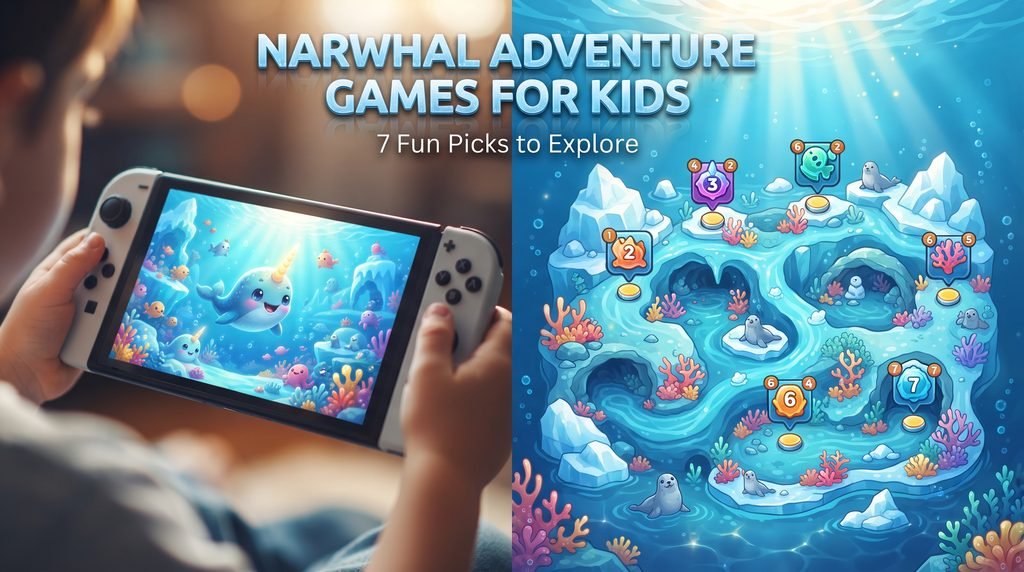
Narwhals make surprisingly good gaming characters. Their unusual appearance, Arctic habitat, and underwater lifestyle give developers plenty of room to build games around exploration, movement, puzzles, animals, and imaginative play. But there is an important distinction for anyone searching for Narwhal Adventure Games for Kids: the phrase does not point to one universally recognized game with that exact title.
Instead, narwhal themed gaming experiences appear across several formats. Some are simple mobile adventures, some are educational games, and others are cooperative tabletop experiences designed for family play. There are also animal learning games where a narwhal is one of the central creatures rather than the entire premise.
That variety can actually be useful. A preschooler who enjoys colorful animal activities needs something very different from an elementary school child who wants strategy or an older child who enjoys casual arcade gameplay.
This guide looks at the most relevant options, what children actually do while playing them, what skills they encourage, and which type of player each experience suits.
What Are Narwhal Adventure Games for Kids?
Narwhal Adventure Games for Kids is best understood as a category rather than a single established franchise. These games use narwhals, Arctic wildlife, ocean exploration, or underwater movement as major parts of the experience.
The gameplay can vary considerably.
A digital game might ask children to guide a narwhal through the air, collect objects, avoid obstacles, or explore an underwater environment. An educational title may use a narwhal to teach animal facts, logic, vocabulary, or environmental concepts. A tabletop game can turn narwhal movement into a cooperative challenge involving planning and decision making.
That means parents should look beyond the animal featured on the cover.
A good choice depends on several factors:
- The child’s age
- Reading ability
- Preferred platform
- Attention span
- Interest in learning games
- Whether they prefer solo or multiplayer play
- How complicated the rules are
- Whether screen-free play is preferred
The strongest narwhal themed experiences are those where the animal theme supports the gameplay instead of simply being decoration.
Best Narwhal Adventure Games for Kids
There is no single universal ranking because these experiences serve different audiences. Instead, the following games are useful examples of the different ways developers and game makers have used narwhals in children’s entertainment.
Sky Whale
Sky Whale is one of the clearest examples of a digital game built around controlling a narwhal. The core idea is simple: keep the narwhal moving through the environment while collecting objects and using clouds and other objects to extend the run.
The game’s simple control concept makes it easier for younger players to understand. Rather than requiring a complicated control scheme, the player focuses on timing, movement, collecting items, and trying to travel farther.
The game’s official App Store listing describes it as a casual game with a 4+ age rating, while its gameplay revolves around bouncing through the sky, collecting donuts, using objects to increase distance, and unlocking additional items.
That makes it quite different from a traditional story driven adventure.
There is no need for children to learn a large inventory system, complex character build, or detailed combat mechanics. The attraction is the immediate feedback of movement and collection.
For parents, that simplicity is useful for short play sessions. A child can understand the basic objective quickly rather than spending the first several sessions learning complicated rules.
What children can learn from the gameplay
Although Sky Whale is primarily entertainment rather than a formal educational game, games built around movement and collection can still encourage basic skills such as:
- Timing
- Hand eye coordination
- Attention
- Reaction
- Short term planning
- Understanding cause and effect
The game should therefore be viewed as a casual arcade experience rather than a substitute for an educational curriculum.
LeapFrog’s Animals, Animals, Animals
For families looking for something more educational, LeapFrog’s Animals, Animals, Animals game pack takes a different approach.
The game pack is designed for children ages 4–8 and works with the RockIt Twist system. It includes activities involving animals and their habitats, along with logic based mazes, animal quizzes, and animal name challenges.
The narwhal connection comes through a virtual RockIt Pet named Coral. Children can hatch, nurture, and grow Coral while also playing activities such as an ocean cleaning game.
This is particularly interesting because the narwhal is integrated into a broader animal learning experience.
Instead of asking a child to spend an entire session doing one repetitive narwhal activity, the game introduces several types of play. A child might learn about animal habitats, solve a maze, answer an animal question, and then interact with the virtual narwhal.
That variety can help when a child loses interest quickly in one type of activity.
The educational focus also makes this option different from arcade style narwhal games. LeapFrog identifies animal knowledge, life science, logic skills, and visual puzzles among the areas addressed by the game pack.
Narwhal Waterfall
Narwhal Waterfall takes the concept in a completely different direction because it is a cooperative tabletop game.
The game involves moving narwhals across a changing river while trying to keep them from tumbling down the waterfall. The official product information describes it as a cooperative experience in which players work together rather than competing directly against one another.
That distinction matters.
Competitive games teach children how to win and lose against other players. Cooperative games introduce another skill: working toward a shared objective.
Narwhal Waterfall uses a moving game board, swimming cards, special action cards, a die, and narwhal pieces. The changing board gives the game a physical element that digital narwhal games cannot reproduce.
For a family game night, this can be particularly appealing because adults can help younger children understand the rules without simply taking control of the game.
The main skills emphasized by the game include:
- Cooperation
- Shared decision making
- Simple strategy
- Communication
- Planning
The result is less like a conventional video game and more like a family strategy adventure with a narwhal theme.
Arctic Riders
Arctic Riders is another tabletop game, but its focus is mathematics and decision making.
The official game is designed for ages 7 and up and supports 2–4 players. Players solve addition and subtraction problems and place treats on a board in an attempt to feed moving narwhals.
The interesting part is that mathematics is connected directly to the board game objective.
Instead of completing an arithmetic worksheet and then returning to a game, the child uses the answer to determine where a token should be placed. The narwhals then move along the board, creating opportunities to score.
This adds a layer of planning.
A child needs to think about the answer to the equation, where the token should go, where the narwhal may move, and how another player’s actions can affect the result.
SimplyFun identifies addition, subtraction, solving equations, and decision making as core learning areas.
That makes Arctic Riders a useful example of how an animal themed game can combine entertainment with a specific educational purpose without turning the entire experience into a traditional lesson.
How to Choose the Right Narwhal Game for a Child
The biggest mistake parents can make is choosing a game based only on its theme.
A narwhal on the box does not automatically mean the gameplay will be appropriate for every child.
Start with age and complexity.
A preschool child may benefit from simple matching, movement, sounds, or animal identification activities. An elementary school child may be ready for rules, strategic decisions, arithmetic challenges, or cooperative objectives.
Then consider how the child likes to play.
Some children want immediate action. Others enjoy puzzles. Some prefer playing alongside a parent or sibling, while others are perfectly happy with short solo sessions.
A useful way to narrow the options is to ask four questions:
Does the child want action?
Look toward simple digital or arcade style gameplay.
Does the child enjoy animals and learning?
An animal focused educational game may provide more variety.
Does the family want something away from screens?
A tabletop narwhal game can turn the theme into a shared activity.
Does the child enjoy numbers and puzzles?
A game such as Arctic Riders connects narwhals with mathematical problem solving.
The right choice is the one that matches the child’s existing interests while offering a manageable level of challenge.
Digital vs. Tabletop Narwhal Games
The difference between digital and physical narwhal games is more important than it may initially appear.
Digital games generally provide faster feedback. A child presses a button or taps the screen and immediately sees the character move, collect something, or encounter an obstacle.
This can make digital games easy to start but also encourages shorter attention cycles.
Tabletop games work differently. Players need to understand the rules, manipulate physical pieces, wait for turns, and communicate with other players.
That slower pace can be an advantage for family play.
Digital games
Digital narwhal experiences tend to work well when children enjoy:
- Short sessions
- Fast feedback
- Character movement
- Collection mechanics
- Simple controls
- Solo play
They are also convenient because a parent does not have to set up a board or organize several players.
Tabletop games
Physical games are more suitable when the goal is:
- Family interaction
- Cooperative play
- Turn taking
- Face to face communication
- Hands on activities
- Shared problem solving
Neither format is automatically better. They simply provide different types of play.
What Makes a Good Ocean Adventure Game for Kids?
A strong children’s adventure game does not need complicated mechanics.
In fact, unnecessary complexity can make a game less enjoyable for younger players.
The most useful design elements are often simple ones.
Clear objectives
Children should quickly understand what they are trying to do.
Collect the objects, help the narwhals cross the river, or solve the equation and place your treat is easier to understand than a system involving several overlapping objectives.
Manageable difficulty
A good children’s game should provide enough challenge to create a reason to continue without making every attempt feel like failure.
Difficulty can come from timing, puzzles, changing board conditions, or strategic choices.
Meaningful feedback
Children benefit when their actions produce an obvious result.
A correct answer should feel different from an incorrect one. A successful movement should be visually clear. A cooperative decision should have a visible effect on the game.
Appropriate pacing
Not every child wants a 60 minute session.
Games with short rounds or clearly defined turns can be easier for families to fit into everyday routines.
A theme that supports play
The narwhal should ideally have a reason to exist in the game.
An Arctic journey, underwater environment, animal learning system, or ocean cleaning activity gives the theme more purpose than simply putting a narwhal image on a generic game.
Practical Tips for Parents and Young Players
Parents can make narwhal themed games more useful by treating them as opportunities for conversation rather than simply handing over a device or board.
For digital games, ask children what they are trying to accomplish. This encourages them to explain their strategy rather than playing entirely on instinct.
For educational games, avoid immediately giving the answer. Instead, ask questions that help the child work through the problem.
For cooperative games, encourage children to explain why they want to make a particular move.
For example:
Where do you think the narwhal will move next?
Why did you choose that space?
What happens if we wait one turn?
These questions turn ordinary gameplay into a simple exercise in prediction and reasoning.
Parents can also connect the fictional game world to real world science. Narwhals are Arctic marine mammals, so a game can become the starting point for learning about sea ice, Arctic habitats, marine food chains, and animal adaptations.
That works particularly well when a child is already fascinated by the character.
Are Narwhal Games Educational?
Some are, while others are primarily entertainment.
This distinction is important.
Sky Whale, for example, is fundamentally a casual arcade style game. Its mechanics focus on movement, collection, and distance rather than formal academic instruction.
LeapFrog’s Animals, Animals, Animals has a much clearer educational structure, with animal habitats, quizzes, puzzles, and other learning activities.
Arctic Riders directly incorporates addition and subtraction into its gameplay, while Narwhal Waterfall emphasizes cooperative decision making.
So the answer depends on the game.
A narwhal themed game can support learning through:
- Problem solving
- Mathematics
- Logic
- Decision making
- Animal knowledge
- Communication
- Cooperation
- Observation
But parents should not assume that every game with an educational looking theme has the same learning value.
Look at what the child actually does during a typical session.
That is a much better indicator than the animal or artwork used in the game’s marketing.
A Simple Narwhal Game Guide by Player Type
| Player Type | What to Look For | Relevant Example |
|---|---|---|
| Young animal fan | Animal discovery and simple activities | LeapFrog’s Animals, Animals, Animals |
| Casual digital player | Simple movement and collection | Sky Whale |
| Family game night player | Cooperative objectives | Narwhal Waterfall |
| Math focused child | Numbers and strategic decisions | Arctic Riders |
| Screen free family | Physical pieces and shared play | Narwhal Waterfall / Arctic Riders |
| Child interested in ocean life | Marine and Arctic themes | Animal focused games |
The table is not a quality ranking. It simply shows how different narwhal themed experiences fit different play styles.
Common Mistakes When Choosing Kids’ Narwhal Games
One common mistake is searching only by the animal name.
A parent might search for narwhal game and assume the results will all be similar. They are not.
Another mistake is ignoring the platform.
A tabletop game and a mobile game can share the same animal theme while offering completely different experiences.
Age recommendations also matter. A game designed around arithmetic may be frustrating for a child who has not developed the required skills, while a very simple preschool game may feel boring to an older elementary school player.
Parents should also check whether the game requires additional hardware.
LeapFrog’s animal game pack, for example, is designed for the RockIt Twist system rather than being a standalone conventional mobile game.
Finally, consider the length of a typical session. A child who enjoys five minute activities may not enjoy a long strategic game, even if the theme looks perfect.
Conclusion
Narwhal themed games occupy an interesting corner of children’s gaming because the animal naturally fits several styles of play. It can be the main character in a simple arcade game, a virtual pet in an educational system, a piece in a cooperative board game, or part of a mathematics focused experience.
For families searching for Narwhal Adventure Games for Kids, the most important step is therefore not finding a single best title. It is identifying the type of experience the child actually wants.
Young children who enjoy animal learning may respond well to an educational game such as LeapFrog’s animal pack. Children looking for simple digital action can explore the arcade style approach of Sky Whale. Families wanting screen free cooperation have options such as Narwhal Waterfall, while older elementary school children who enjoy mathematics can find a more structured challenge in Arctic Riders.
The narwhal theme is only the starting point. The gameplay, age range, platform, difficulty, and learning objectives ultimately determine whether a particular game is a good match.
For parents and young gamers, that is the useful way to approach this category: choose the adventure mechanics first, then let the narwhal lead the way.
FAQ
What are Narwhal Adventure Games for Kids?
They are games or game like experiences centered on narwhals, Arctic wildlife, ocean exploration, or underwater adventures. The category includes digital, educational, cooperative, and tabletop games rather than one universally recognized title.
Is Sky Whale suitable for young children?
The current App Store listing gives Sky Whale an age rating of 4+, and its gameplay focuses on controlling a narwhal, collecting objects, and maintaining movement. Parents should still consider the child’s individual maturity and preferred play style.
Are there educational narwhal games for kids?
Yes. LeapFrog’s Animals, Animals, Animals pack includes animal and habitat activities, quizzes, mazes, and a virtual narwhal named Coral.
Is Narwhal Waterfall a video game?
No. Narwhal Waterfall is a cooperative tabletop game in which players work together to move narwhals safely across a changing river.
What narwhal game teaches math?
Arctic Riders incorporates addition and subtraction into its gameplay. Players solve equations, place treats on the board, and plan around the movement of narwhal pieces. It is designed for ages 7 and up.
Are narwhal games good for family game night?
They can be, particularly cooperative and tabletop titles. Games such as Narwhal Waterfall are specifically designed around players working toward a shared objective.
What age group is best for narwhal games?
There is no single age range. Some experiences target preschool and early elementary children, while others are designed for children aged 7 and up. Parents should check the individual game’s age recommendation and complexity.
Are all narwhal games educational?
No. Some are primarily casual entertainment. Others explicitly incorporate animal knowledge, mathematics, logic, or cooperative decision making. The actual gameplay should be evaluated rather than assuming educational value from the narwhal theme alone.
LEAVE A PIXEL ZINE COMMENT