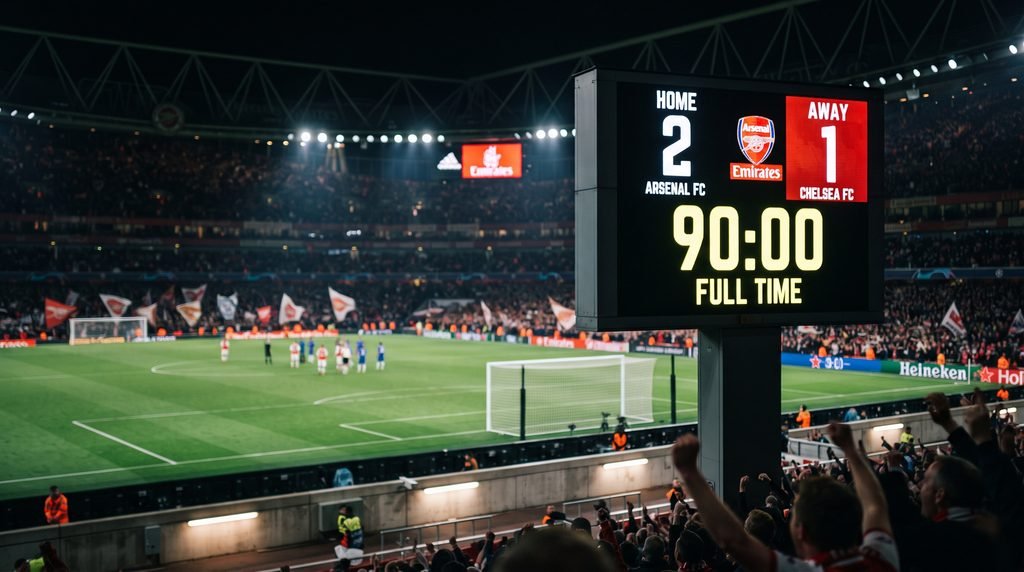
If you’re wondering how long is a soccer game, the standard answer is 90 minutes of playing time. A regulation soccer match consists of two 45 minute halves, separated by a halftime interval that can last up to 15 minutes. However, watching a complete match usually takes longer than 90 minutes because referees add time for stoppages during each half.
That distinction matters if you’re trying to plan your evening around a match. A typical soccer game is not simply 90 minutes from kickoff to the final whistle. Halftime, stoppage time, substitutions, injuries, video reviews, goal celebrations, and other interruptions can push the total viewing time beyond two hours.
Some matches can take considerably longer. Knockout competitions may use extra time when a winner is required, followed by a penalty shootout if the score remains level. Under the current Laws of the Game, extra time consists of two periods of up to 15 minutes each.
Here’s how soccer match timing actually works.
How Long Is a Soccer Game?
A standard soccer match lasts 90 minutes of regulation playing time.
The game is divided into:
- First half: 45 minutes
- Halftime: Up to 15 minutes
- Second half: 45 minutes
- Stoppage time: Added to the end of each half
The International Football Association Board (IFAB), which maintains the Laws of the Game, specifies two equal 45 minute periods for a standard match. The halftime interval cannot exceed 15 minutes.
So, if you’re asking strictly about the amount of scheduled playing time, the answer is 90 minutes.
But if you’re asking how long a soccer match takes in real life, the answer is usually longer.
A useful way to think about it is:
90 minutes of regulation play + halftime + stoppage time = the normal match experience.
The exact total varies from game to game because the referee determines how much time is added for interruptions.
How the 90 Minutes Are Divided
First Half, Halftime, and Second Half
The first half begins at kickoff and lasts 45 minutes of playing time. Once that period ends, the referee signals halftime.
Players then receive a halftime interval that cannot exceed 15 minutes under the Laws of the Game.
After halftime, the teams switch ends and play another 45 minute period.
Importantly, the clock does not normally stop every time the ball goes out of play. Soccer uses a continuous running clock. Instead, the referee keeps track of significant lost time and adds an allowance at the end of the half.
For example, if a match has several substitutions, an injury, a lengthy VAR review, and extended goal celebrations, the second half might continue beyond the 45 minute mark.
This is why you’ll often see a fourth official display something such as +4, +6, or +8 near the end of a half.
That number represents the minimum additional time the referee has indicated will be played.
Why Soccer Games Last Longer Than 90 Minutes
The 90 minute figure refers to the two regulation periods, not necessarily the time between kickoff and the final whistle.
Several events can cause time to be added.
According to IFAB’s current Law 7, referees allow for time lost through incidents including substitutions, injuries, wasting time, disciplinary situations, permitted medical stoppages, VAR checks and reviews, goal celebrations, and other significant delays to restarts.
This means a match with relatively few interruptions might have only a small amount of additional time, while a heavily interrupted game can receive a much larger allowance.
The important point is that stoppage time is not a separate third period. It is an extension of the relevant half.
If the first half has three minutes of added time, the first period effectively ends after 45 minutes plus those three minutes. The same principle applies to the second half.
The amount is also not necessarily an exact countdown from the moment it is announced. IFAB states that the displayed allowance is a minimum and can be increased by the referee if further time is lost during the additional period.
That explains one of the most common questions from new soccer viewers: Why didn’t the referee blow the whistle exactly when the clock reached 90?
Because 90 minutes is the regulation playing period, not necessarily the end of the match.
What Is Stoppage Time in Soccer?
Stoppage time, also called added time or additional time, is the time the referee adds to compensate for significant interruptions during a half.
Suppose a player receives medical treatment for several minutes. The game cannot simply lose those minutes while the scheduled clock continues toward the end of the half.
Instead, the referee calculates the appropriate allowance and adds it after the 45th or 90th minute.
Stoppage time can result from:
- Player injuries and medical treatment
- Substitutions
- VAR checks and reviews
- Goal celebrations
- Delays caused by disciplinary incidents
- Time wasting
- Certain drinks or cooling breaks permitted by competition rules
- Delays restarting play
- Other significant interruptions
IFAB specifically lists goal celebrations as a source of lost playing time, meaning celebrations can contribute to the additional time shown at the end of a period.
This is particularly noticeable in modern matches where lengthy VAR checks, multiple substitutions, injuries, and prolonged celebrations can create substantial delays.
Does Stoppage Time Have a Fixed Length?
No.
There is no universal rule saying every soccer game must have exactly five, six, or seven minutes of added time.
The referee determines the allowance based on time lost during the half. Competition rules and match circumstances can also influence the overall timing.
For that reason, two matches can both have 45 minute halves but finish with very different amounts of additional time.
How Long Is a Soccer Game With Extra Time?
A regular league match can finish after regulation time plus stoppage time, with a draw remaining a valid result.
Some knockout competitions, however, require one team to advance. When competition rules require a winner and the match is level after regulation, extra time may be used.
Under IFAB’s Laws of the Game, extra time consists of two equal periods of up to 15 minutes each.
That means extra time can add up to 30 additional minutes of playing time.
So a match that reaches extra time can involve:
- 90 minutes of regulation
- Stoppage time
- A break before extra time, according to competition procedures
- Up to 30 minutes of extra time
- Additional time during the extra time periods
If the score is still level after extra time and the competition requires a winner, the match can proceed to a penalty shootout.
Extra Time and Penalty Shootouts
A penalty shootout is not another timed period of soccer.
Instead, players take kicks from the penalty mark to determine the winner according to the competition’s procedures.
This means a knockout match that reaches penalties can take significantly longer than an ordinary 90 minute match, even though the shootout itself isn’t measured as another 30 minute period.
For viewers, this is one reason a match that appears to be heading toward a straightforward two hour viewing window can suddenly extend much further.
Does Every Soccer Match Last the Same Amount of Time?
No.
The standard senior match structure is two 45 minute halves, but the total duration can vary.
A normal league match may end after the second half and its added time. A knockout match may require extra time. If it is still tied afterward and competition rules demand a winner, penalties can follow.
There are also different forms of soccer in youth, veterans, disability, and grassroots football. IFAB allows competition organizers and national associations to modify certain aspects of the game for these categories, including the duration of the halves.
That means you should not assume that every soccer match at every level uses precisely the same format.
For professional men’s and women’s matches played under the standard Laws, however, the familiar 45 minute halves are the basic reference point.
How Long Should You Set Aside to Watch a Soccer Game?
If you’re planning to watch a normal professional soccer match, don’t schedule your time around exactly 90 minutes.
A better approach is to allow roughly two hours for the complete broadcast experience, depending on the competition and broadcaster.
A simple planning example might look like this:
| Match Stage | Approximate Scheduled Time |
|---|---|
| First half | 45 minutes |
| Halftime | Up to 15 minutes |
| Second half | 45 minutes |
| Added time | Varies |
| Regulation match experience | Usually more than 105 minutes |
| Extra time, if required | Up to 30 minutes |
| Penalty shootout, if required | Additional time |
The table illustrates why the answer to “how long is a soccer game?” depends on what you mean.
If you mean official regulation playing time, it is 90 minutes.
If you mean from kickoff until the final whistle, it is longer.
If you mean a knockout match that goes all the way through extra time and penalties, it can be considerably longer.
For a casual viewer, budgeting around two hours for a standard match is sensible. For a major knockout game, especially one where a winner must be determined, it’s safer to leave additional time available.
Soccer Match Length Compared With Other Formats
The 90 minute structure applies to traditional full length soccer, but other versions of the sport use different formats.
Youth competitions can use shorter halves depending on age and competition rules. Small sided games are also designed around shorter playing periods and smaller teams.
Futsal is another example. It has its own rules and timing system and should not be treated as simply indoor 90 minute soccer.
This distinction is useful because someone searching for how long is a soccer game may have encountered different answers online. Those answers can all be correct if they are referring to different formats.
The safest baseline is:
Standard full length soccer: two 45 minute halves.
After that, competition rules and match circumstances determine what happens.
Why Soccer Uses a Running Clock
One of soccer’s defining timing features is its continuous clock.
Unlike sports where the clock may stop frequently after an incomplete play, soccer generally allows the match clock to continue while the ball is out of play. The referee then compensates for significant lost time with additional time.
This creates a rhythm that is different from sports such as American football or basketball.
For viewers, it also means the number shown on a stadium or broadcast clock does not always tell you exactly how much real world time remains.
When the clock reaches 90:00, the game may still have several minutes to play.
The same concept applies at halftime. The end of the 45 minute period does not necessarily occur precisely when the broadcast reaches the 45 minute mark because added time may be played.
What Can Make a Soccer Game Longer?
Several factors can influence the final whistle.
Injuries
A serious injury can require medical attention, player assessment, and removal from the field. That lost time can contribute to the additional time at the end of the half.
Substitutions
Substitutions require players to leave and enter the field, which takes time. IFAB includes substitutions among the situations for which allowance can be made.
VAR Reviews
Video assistant referee checks can interrupt play and contribute to additional time. The current Laws explicitly identify delays relating to VAR checks and reviews as a source of lost time.
Goal Celebrations
A goal does not automatically mean the clock stops and the lost minutes disappear. Lengthy celebrations can contribute to the referee’s calculation of additional time.
Time Wasting
Players or teams may deliberately or unintentionally delay restarts. The referee can account for significant lost time when determining the allowance.
Weather and Medical Breaks
Competition rules can permit drinks or cooling breaks in certain conditions. IFAB also recognizes permitted medical stoppages among the reasons time can be added.
These factors explain why one match might have a relatively short period of added time while another extends noticeably beyond the 90 minute mark.
Practical Tips for Watching a Full Match
If you’re new to soccer, match timing becomes easier to follow once you know what the numbers mean.
First, remember that 45 does not necessarily mean the half is ending immediately. The referee can add time.
Second, treat 90 minutes as regulation playing time, not the guaranteed moment of the final whistle.
Third, pay attention to the fourth official’s board near the end of each half. It shows the minimum additional time signaled by the referee.
Fourth, if you’re watching a knockout match, check the competition format before assuming a draw will end the game. Some competitions allow a match to finish level, while others require extra time and potentially penalties.
Finally, if you’re planning around a match, allow more time than the headline “90 minutes” suggests.
Final Answer: How Long Is a Soccer Game?
So, how long is a soccer game?
A standard full length soccer match has 90 minutes of regulation playing time, split into two 45 minute halves. There can be a halftime interval of up to 15 minutes, and the referee adds time at the end of each half to compensate for significant stoppages.
That means a normal match takes longer than 90 minutes from kickoff to the final whistle.
If a knockout competition requires a winner and the teams are level after regulation, extra time can add up to another 30 minutes. If the score is still tied, a penalty shootout may determine the winner.
For most viewers, the easiest rule to remember is 90 minutes of soccer, roughly two hours to watch a standard match, and potentially much longer when extra time and penalties are involved.
The exact length depends on what happens on the field, which competition you’re watching, and whether the match needs a winner.
That simple distinction—90 minutes of regulation versus the total time spent watching—is the key to understanding soccer match duration.
FAQ
How long is a soccer game in total?
A standard soccer game has 90 minutes of regulation playing time, divided into two 45 minute halves. Halftime can last up to 15 minutes, and additional time is added for significant stoppages.
How long is a soccer game including halftime?
A regulation match includes 90 minutes of playing time plus a halftime interval of up to 15 minutes and stoppage time. In practical terms, viewers should generally allow around two hours.
Why does soccer go past 90 minutes?
The referee adds time for significant interruptions such as injuries, substitutions, VAR checks, goal celebrations, and other delays.
How long is extra time in soccer?
Extra time consists of two periods of up to 15 minutes each, allowing for up to 30 additional minutes of playing time.
Can a soccer game end in a draw?
Yes. A draw is a valid result in competitions where the rules do not require a winner. If a competition requires one team to advance, its rules may use extra time and penalties to determine the winner.
How long does a soccer penalty shootout take?
A penalty shootout does not have a fixed duration like a 45 minute half. It continues according to the competition’s penalty procedures until a winner is determined.
Is every soccer game 90 minutes?
No. Standard full length soccer uses two 45 minute halves, but youth, grassroots, and other formats can use modified match durations under applicable competition rules.
How much time should I set aside to watch a soccer game?
For a normal match, allowing around two hours is a practical estimate. Knockout matches that can go to extra time and penalties may require substantially more time.
LEAVE A PIXEL ZINE COMMENT