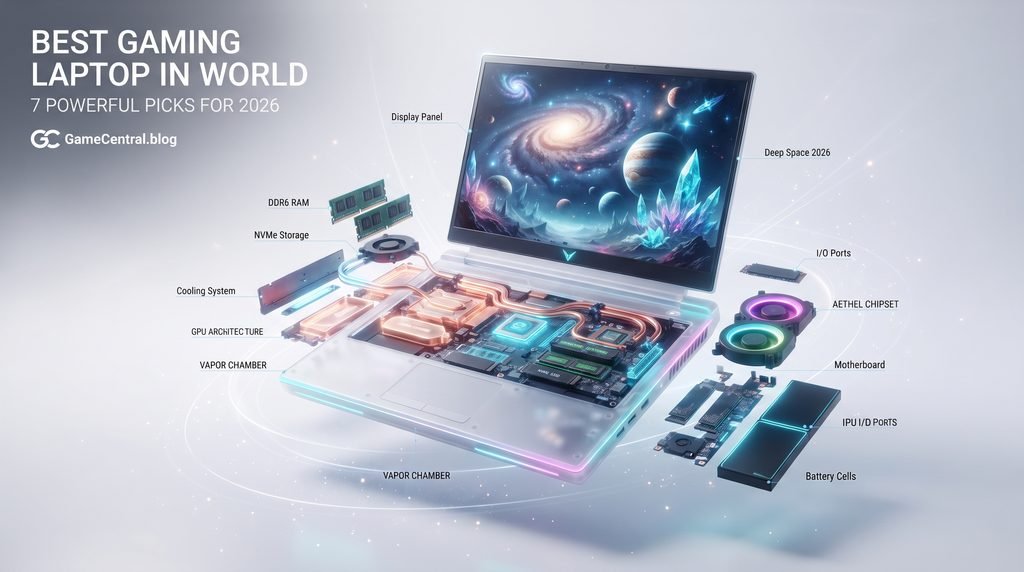
Finding the best gaming laptop in world is less straightforward than choosing the laptop with the biggest specification sheet. At the top end of the market, several machines now combine NVIDIA RTX 5090 graphics, high end Intel processors, large high refresh displays, advanced cooling, fast storage, and premium chassis designs.
The Razer Blade 18 (2026) currently has the strongest claim to the overall crown. Tom’s Hardware ranks it as its best gaming laptop, pairing an Intel Core Ultra 9 290HX Plus processor with an RTX 5090 Laptop GPU and a dual mode 18 inch display capable of 4K at 240Hz or 1080p at 440Hz.
That does not make every competing machine inferior. ASUS has an exceptionally impressive 18 inch display, MSI pushes enormous CPU GPU power in the Titan 18 HX AI, and Alienware’s Area 51 is designed as a serious desktop replacement.
So the right question is not simply which laptop has the most powerful components. It is which machine makes the best overall use of them.
What Makes the Best Gaming Laptop in the World?
A genuinely high end gaming laptop has to solve several problems simultaneously.
Raw GPU performance is obviously important. Modern AAA games can place enormous demands on graphics hardware, particularly at 4K with ray tracing enabled. But the GPU is only one part of the equation.
The display determines how much of that performance you can actually see. Cooling determines whether the processor and graphics card can sustain high power levels. Memory affects demanding games and multitasking. Storage affects loading and large game libraries. The keyboard, trackpad, speakers and chassis determine how pleasant the machine is to use outside gaming.
There is also a fundamental compromise with gaming laptops: portability.
A powerful 18 inch machine can deliver performance approaching a desktop, but it is not realistically designed to replace an ultraportable laptop. The larger chassis exists because powerful mobile components require substantial cooling and power delivery.
That is why the best gaming laptop in world should be judged as a complete system rather than a collection of numbers.
Razer Blade 18 (2026): Best Overall Flagship
The Razer Blade 18 (2026) is the strongest overall recommendation for buyers who want an uncompromising flagship without making the machine purely about maximum physical size or specification numbers.
Tom’s Hardware currently places it at the top of its gaming laptop rankings. Its configuration can include Intel’s Core Ultra 9 290HX Plus and NVIDIA’s RTX 5090 Laptop GPU, while the 18 inch screen supports two operating modes: 3840 × 2400 at 240Hz or 1920 × 1200 at 440Hz.
That dual mode display is one of the laptop’s most interesting features.
A high resolution mode makes sense for visually demanding single player games, creative work and general desktop use. Switching to the lower resolution, high refresh mode makes considerably more sense for competitive games where extremely high frame rates matter more than pixel density.
Razer also uses an advanced vapor chamber cooling system and a multi fan design intended to sustain demanding workloads. The company lists Thunderbolt 5, WiFi 7, 2.5Gb Ethernet and a 5MP camera among the machine’s connectivity features.
Why the Blade 18 stands out
The Blade 18 is not simply a specification monster.
Its biggest advantage is balance.
Tom’s Hardware praised its performance and dual mode display while noting that the machine is expensive and that the storage configuration could be faster for the price.
That matters because the best gaming laptop should not be judged solely by benchmark performance.
If you want one machine capable of handling demanding games, high refresh competitive gaming, creative workloads and everyday desktop use, the Blade 18 makes a compelling case.
Best for: Enthusiasts who want an elite all round gaming laptop.
Main strengths: Performance, display versatility, premium construction, connectivity.
Main weakness: Extremely expensive, large and heavy compared with mainstream laptops.
ASUS ROG Strix SCAR 18: Best Display Focused Choice
The ASUS ROG Strix SCAR 18 (2026) is one of the most serious alternatives to the Blade 18.
ASUS offers configurations with the RTX 5090 Laptop GPU, 24GB of GDDR7 memory and up to 175W GPU power. The flagship configuration also uses an 18 inch 4K 240Hz Mini LED display.
That combination is difficult to ignore.
For players who prioritize image quality, the SCAR 18 is particularly attractive because the display combines high resolution, high refresh rate and Mini LED technology.
ASUS has also advertised up to 320W of sustained maximum total system power for the 2026 model, emphasizing the machine’s desktop replacement ambitions.
There is a catch.
Tom’s Hardware’s testing found the SCAR 18 extremely powerful but ultimately placed it behind the Razer Blade 18 in its elite comparison. The review also criticized areas such as its SSD configuration and memory arrangement.
That does not make it a bad laptop. Quite the opposite.
It means ASUS has created a machine that may be more attractive to a buyer who values the display and gaming focused design than someone who simply wants the best overall package.
Best for: Gamers who place display quality and high refresh 4K gaming near the top of their priorities.
Main strengths: 4K 240Hz Mini LED display, RTX 5090 option, high system power.
Main weakness: Expensive and physically large, with some configuration compromises.
MSI Titan 18 HX AI: Best for Maximum Hardware Power
If your definition of the best gaming laptop starts with maximum hardware, the MSI Titan 18 HX AI deserves serious attention.
MSI offers the Titan 18 HX AI with up to an RTX 5090 Laptop GPU with 24GB of GDDR7 memory. The company lists up to 175W of graphics power and up to 270W of combined CPU GPU power through its OverBoost Ultra system.
The machine can also be configured with Intel’s Core Ultra 9 285HX.
Its display options are equally aggressive. MSI lists an 18 inch UHD+ Mini LED configuration with a 3840 × 2400 resolution and 120Hz refresh rate, alongside other display choices depending on configuration.
The Titan also includes a mechanical per key RGB keyboard, multiple M.2 storage slots, Thunderbolt 5, HDMI 2.1, 2.5Gb Ethernet and a 99.9Wh battery.
This is clearly not designed around minimalism.
It is designed around giving the buyer as much performance and expansion potential as possible.
That makes it an excellent desktop replacement, particularly for someone who wants to use the laptop for gaming, video production, 3D work or other demanding workloads.
The downside is predictable: size, weight and cost.
The Titan 18 HX AI weighs about 3.6kg in one listed RTX 5090 configuration before accounting for its large power adapter.
Best for: Buyers who prioritize maximum hardware power and expansion.
Main strengths: RTX 5090, high power limits, Mini LED option, extensive connectivity and storage expansion.
Main weakness: Heavy and expensive.
Alienware 18 Area 51: Best Desktop Replacement
The Alienware 18 Area 51 takes a different approach.
Rather than trying to make an 18 inch gaming laptop feel small, Alienware embraces the desktop replacement category.
PC Gamer currently describes it as one of the strongest 18 inch gaming laptops available and specifically highlights its combination of performance, chassis design and gaming focused hardware.
RTINGS similarly describes the machine as an excellent gaming laptop while emphasizing that its size and weight make it better suited to a desk than frequent travel.
That is an important distinction.
If your gaming laptop will spend most of its life sitting on a desk, portability becomes less important. In that situation, a large chassis can actually be an advantage because there is more room for cooling and powerful components.
The Area 51 is therefore an attractive option for players who want something closer to a portable desktop than a traditional notebook.
Best for: Desktop replacement buyers.
Main strengths: Strong performance, distinctive premium chassis and effective cooling.
Main weakness: Large and inconvenient for frequent travel.
Lenovo Legion Pro 7i: Best Performance Without Going Extreme
Not everyone needs an 18 inch flagship.
The Lenovo Legion Pro 7i is worth considering for gamers who want high end performance in a somewhat more conventional gaming laptop format.
It sits below the enormous desktop replacement machines in terms of physical scale while still targeting enthusiasts who care about GPU performance, display quality and sustained gaming workloads.
This category is arguably more practical for many buyers.
A laptop does not automatically become better because it gets larger. If you frequently move between home, university, work or gaming events, a massive 18 inch machine can become inconvenient.
That makes the Legion Pro 7i particularly interesting for users who want high performance without committing entirely to the desktop replacement concept.
PC Gamer currently places the Legion Pro 7i Gen 10 among its high performance recommendations.
Best for: Gamers wanting flagship level performance in a more practical format.
Main strengths: Strong performance to size balance.
Main weakness: The largest 18 inch machines can deliver more absolute hardware power.
Razer Blade 16: Best Premium Balance
The Razer Blade 16 is another important option because not every buyer needs an 18 inch machine.
Current 2026 recommendations are split depending on how reviewers define “best.” PC Gamer currently lists the Razer Blade 16 as its overall gaming laptop recommendation, while Tom’s Hardware favors the newer Blade 18 for its flagship category.
That difference illustrates why there is no universally correct answer.
The Blade 16 is easier to justify for someone who values a more manageable form factor. You sacrifice some of the physical cooling and screen real estate of an 18 inch desktop replacement, but the result is more practical for everyday use.
For someone who carries their laptop regularly, that trade off may be more important than squeezing out the final percentage of gaming performance.
Best for: Buyers who want premium design and high performance without going to an 18 inch chassis.
Main strengths: More practical size and premium design.
Main weakness: Less desktop like than the largest flagship systems.
How These Gaming Laptops Compare
| Laptop | Best For | Standout Feature | Main Trade Off |
|---|---|---|---|
| Razer Blade 18 (2026) | Best overall | Dual mode 4K/440Hz display | Very expensive |
| ASUS ROG Strix SCAR 18 | Display quality | 4K 240Hz Mini LED | Large chassis |
| MSI Titan 18 HX AI | Maximum hardware | High CPU GPU power | Heavy |
| Alienware 18 Area 51 | Desktop replacement | Large high performance design | Poor portability |
| Lenovo Legion Pro 7i | High end balance | Strong performance in a more practical format | Less extreme than 18 inch flagships |
| Razer Blade 16 | Premium portability | Compact flagship approach | Lower ceiling than 18 inch systems |
The table highlights an important point: the best gaming laptop in world depends on what “best” means to you.
If it means the strongest complete package, the Blade 18 has the clearest argument.
If it means the most impressive display, ASUS becomes extremely compelling.
If it means maximum hardware power and expansion, MSI’s Titan is difficult to ignore.
If it means a desktop replacement with a premium identity, Alienware deserves consideration.
What Specifications Actually Matter for Gaming?
A common mistake when shopping for a gaming laptop is to compare only processor names and GPU model numbers.
The implementation matters.
GPU power matters most
The RTX 5090 Laptop GPU can appear in multiple machines, but the surrounding cooling and power delivery design can influence sustained performance.
That is why two laptops with the same GPU can behave differently.
A laptop with a strong cooling system and generous power limits can maintain demanding workloads more effectively than a thinner machine that has to restrict power.
This is also why the MSI Titan and ASUS SCAR place so much emphasis on total system power.
Display quality can change the experience
A powerful GPU deserves a suitable display.
For cinematic games, 4K resolution can produce an exceptionally sharp image. For competitive games, high refresh rates are often more valuable.
The Razer Blade 18’s dual mode panel is particularly interesting because it addresses both priorities. Its 4K 240Hz mode favors image quality while the 1920 × 1200 440Hz mode targets extremely high frame rate gaming.
Cooling and power limits matter
Gaming laptops are compact computers containing hardware that generates substantial heat.
That makes cooling a major component of performance.
Large 18 inch machines have a natural advantage because manufacturers have more physical room for heat pipes, vapor chambers, fans and ventilation.
The trade off is weight.
This is one reason an 18 inch laptop should be thought of as a portable desktop rather than an everyday ultraportable.
Which Gaming Laptop Should You Buy?
Choose the Razer Blade 18 (2026) if you want the strongest overall combination of performance, display versatility, build quality and premium features. Tom’s Hardware currently ranks it as its best gaming laptop, which supports that overall recommendation.
Choose the ASUS ROG Strix SCAR 18 if your priority is an outstanding 4K Mini LED display and high end gaming performance. Its 2026 configuration can combine an RTX 5090 with a 4K 240Hz Mini LED panel.
Choose the MSI Titan 18 HX AI if you want maximum hardware power, extensive connectivity and expansion potential. Its RTX 5090 configuration can reach 270W of combined CPU GPU power.
Choose the Alienware 18 Area 51 if your laptop will primarily remain on a desk and you want a serious desktop-replacement machine.
Choose the Lenovo Legion Pro 7i if you want high end gaming performance without moving all the way into the enormous 18-inch category.
Choose the Razer Blade 16 if premium design and a more manageable form factor matter more than having the absolute largest screen and cooling system.
Common Mistakes When Buying a Flagship Gaming Laptop
The first mistake is assuming the most expensive laptop is automatically the best.
It isn’t.
A machine can have an enormous specification sheet while making compromises in storage, memory configuration, portability or display characteristics.
The second mistake is ignoring the screen.
Buying an RTX 5090 laptop with a display that does not suit your games defeats part of the purpose of the hardware. A competitive player and a single player RPG enthusiast may want very different panels.
The third mistake is underestimating size.
An 18 inch gaming laptop is dramatically less convenient to carry than a 14 , 15 or 16 inch machine. If you commute every day, that difference matters.
The fourth mistake is ignoring power requirements.
These machines can consume substantial power under heavy gaming workloads. A flagship gaming laptop is not going to behave like a thin office notebook when running a demanding AAA title.
Finally, do not buy specifications you will never use.
If you primarily play esports titles at 1080p or 1440p, spending several thousand dollars on a giant 4K RTX 5090 desktop replacement may make little practical sense.
Final Verdict
The Razer Blade 18 (2026) is the strongest answer to the question of the best gaming laptop in world right now, particularly if “best” means the best overall flagship rather than the laptop with the most extreme specification sheet. Its RTX 5090 option, Core Ultra 9 290HX Plus processor, premium construction and unusual 4K 240Hz/1080p 440Hz dual-mode display give it a particularly strong combination of gaming and general purpose capability.
But the alternatives are genuinely competitive.
The ASUS ROG Strix SCAR 18 is a better fit for display focused buyers. MSI’s Titan 18 HX AI is the choice for maximum hardware and expansion. Alienware’s 18 Area 51 makes sense as a dedicated desktop replacement, while the Legion Pro 7i and Razer Blade 16 are more practical for buyers who do not want an enormous 18 inch machine.
The smartest purchase is therefore not necessarily the laptop with the biggest specification sheet. It is the machine whose performance, display, size and features match how you actually play.
FAQ
What is the best gaming laptop in world in 2026?
The Razer Blade 18 (2026) is one of the strongest overall choices. Tom’s Hardware currently ranks it as its best gaming laptop, with an RTX 5090 option and a dual mode 18 inch display.
Is the Razer Blade 18 better than the ASUS ROG Strix SCAR 18?
For overall balance, the Blade 18 has the stronger case. The ASUS SCAR 18 is particularly compelling if display quality is your priority because its 2026 flagship configuration offers a 4K 240Hz Mini LED panel.
Which is the most powerful gaming laptop?
The MSI Titan 18 HX AI is among the most aggressively configured gaming laptops, with an RTX 5090 option and up to 270W combined CPU GPU power according to MSI.
Is an RTX 5090 laptop worth buying?
It can be worthwhile for enthusiasts who want maximum mobile GPU performance, particularly for demanding 4K gaming and other GPU intensive workloads. For less demanding games, a cheaper RTX configuration may offer better value.
Is an 18 inch gaming laptop too large?
For frequent travel, probably. For desk based gaming, an 18 inch chassis can make sense because its larger physical design allows manufacturers to accommodate stronger cooling and high power hardware.
What is the best gaming laptop for 4K gaming?
The Razer Blade 18 and ASUS ROG Strix SCAR 18 are particularly strong choices. The Blade 18 supports 3840 × 2400 at up to 240Hz, while the SCAR 18 offers a 4K 240Hz Mini LED configuration.
Should I buy a gaming laptop or desktop?
Choose a laptop if you need mobility or limited space gaming. Choose a desktop if maximum performance, upgradeability and long term value matter more than portability.
How much RAM should a high end gaming laptop have?
For a premium gaming machine, 32GB is a sensible baseline for demanding modern gaming and multitasking. Higher capacities can be useful for content creation, development and other memory heavy workloads, but gamers do not necessarily need extreme RAM configurations.
LEAVE A PIXEL ZINE COMMENT