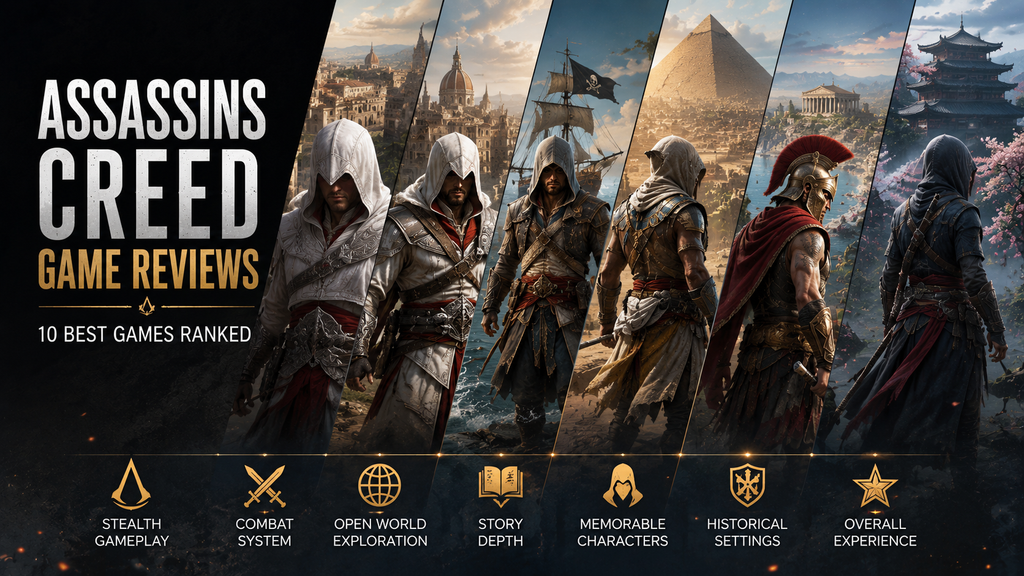
The Assassins Creed series has changed dramatically since its 2007 debut. The early games emphasized stealth, parkour, social blending, and carefully planned assassinations, while later entries expanded into huge open world RPGs with skill trees, loot, dialogue choices, naval exploration, and hundreds of side activities.
That makes choosing the right game surprisingly difficult. Someone looking for a focused stealth adventure may have very different priorities from a player who wants a 100 hour historical RPG.
These Assassins Creed game reviews focus on what actually makes each entry worth playing today. The ranking considers story, world design, combat, stealth, mission structure, exploration, replayability, and how well each game represents its particular era of the franchise.
The list is editorial rather than a simple aggregation of review scores. The goal is to answer the more useful question: which Assassins Creed games are genuinely worth your time?
How We Ranked the Assassins Creed Games
There is no single formula that determines the best Assassins Creed game.
A game can have an enormous map and still feel repetitive. Another can have a shorter campaign but deliver much better stealth missions. Some games excel because of their characters, while others are remembered primarily for their settings.
For this ranking, the most important factors are:
Stealth and assassination design: Can you actually feel like an assassin rather than simply another action hero?
World quality: Does the historical setting encourage exploration, or is the map mostly a collection of activities?
Combat: Is fighting satisfying without completely replacing stealth?
Story and characters: Does the narrative give the historical setting and protagonist enough weight?
Mission design: Are objectives varied and interesting, or do they rely too heavily on repetitive activities?
Replay value: Does the game remain enjoyable after completing the main story?
Modern appeal: Does the game still make sense for someone discovering the franchise today?
Ubisoft describes Assassins Creed as a series combining open world action adventure with stealth and RPG elements across different historical periods. That evolution is important because comparing a focused 2009 stealth game directly with a massive RPG from 2018 can be misleading.
Assassins Creed Game Reviews: 10 Best Games Ranked
Assassins Creed II
Best for: Classic Assassins Creed fans, story focused players, and newcomers who want the traditional formula.
Assassins Creed II remains the easiest recommendation for understanding why the franchise became so influential.
Ezio Auditores journey through Renaissance Italy gives the game a strong narrative backbone, while Florence, Venice, and the surrounding regions provide a memorable playground for climbing, exploration, assassination missions, and rooftop traversal.
The biggest improvement over the original game was variety. The first Assassins Creed had an impressive foundation but could become repetitive. Its sequel expanded mission types, progression, exploration, and character development considerably. GameSpots contemporary review specifically praised the sequel for addressing many of the original games weaknesses while retaining its movement and atmosphere.
The combat is much less sophisticated than that of later entries, but that is not necessarily a disadvantage. The relatively simple systems keep attention on movement, stealth, and assassination.
The main drawback today is age. Some mission structures and combat mechanics feel dated, and modern open world players may find the world less mechanically dense than newer games.
Verdict: Still one of the strongest starting points for anyone wanting classic Assassins Creed.
Assassins Creed Brotherhood
Best for: Players who want the strongest combination of Ezios story, open world freedom, and assassin mechanics.
Brotherhood takes the foundation established by Assassins Creed II and makes the protagonist feel more powerful within the Assassin Brotherhood itself.
Rome is the centerpiece. Instead of moving through several major cities, the game concentrates much of its experience around one large historical environment. This creates a stronger relationship between the player and the city.
The Brotherhood recruitment system is particularly important. Instead of simply eliminating targets yourself, you can recruit and train assassins who can be called upon during missions.
That mechanic adds a strategic layer to the traditional stealth formula. You can still perform an assassination personally, but the game increasingly allows you to think like the leader of an organization.
The story also benefits from the continued development of Ezio and the franchises larger conflict.
Its age is again noticeable in combat and movement, but the focused structure means it remains highly playable.
Verdict: A superb classic entry and arguably the best expression of the traditional Ezio era formula.
Assassins Creed IV: Black Flag
Best for: Players who value exploration, naval gameplay, adventure, and memorable characters.
Black Flag is one of the franchises most interesting experiments because its strongest feature is not necessarily traditional assassination gameplay.
It is the pirate adventure.
Edward Kenways journey across the Caribbean combines sailing, naval combat, island exploration, treasure hunting, underwater exploration, hunting, and conventional Assassins Creed missions. Ubisofts current franchise page still describes the game around Edwards pirate career, ship customization, treasure hunting, underwater locations, and the Caribbean setting.
That combination gives Black Flag an unusually strong sense of freedom. You can spend an evening following the main story or simply sail toward another island because something on the horizon caught your attention.
Edward is also an interesting protagonist because he does not begin as a committed Assassin. His relationship with the Assassin Templar conflict develops gradually.
The weakness is consistency. Some traditional Assassins Creed missions are considerably less enjoyable than the open world sailing and exploration. The games land based stealth mechanics also do not always match the freedom provided by the naval systems.
Even so, Black Flag remains one of the easiest entries to recommend to someone who wants a historical open world adventure.
Verdict: The best Assassins Creed game for players who want adventure and exploration alongside assassination.
Assassins Creed Odyssey
Best for: Players who want the biggest RPG experience in the series.
Odyssey pushes Assassins Creed firmly into action RPG territory.
Set during the Peloponnesian War in Ancient Greece, the game gives players the choice of Alexios or Kassandra and builds a huge world around exploration, combat, quests, gear, abilities, dialogue choices, and naval travel.
Its greatest strength is scale. There is a tremendous amount to see, and the Greek setting provides mountains, islands, cities, coastlines, ruins, and historical locations that encourage wandering.
GameSpots review praised the games detailed setting, ambitious narrative, and protagonists while also pointing out that the very large campaign can become tiring.
That criticism explains why Odyssey will not appeal to everyone.
If you want a tightly constructed stealth game, the size and RPG mechanics can feel excessive. Enemies are tied to character progression, equipment has statistics, and combat can become a much larger part of the experience than stealth.
But if you approach it as an open world historical RPG, it becomes much easier to appreciate.
Verdict: One of the best choices for players who want exploration, RPG systems, and a massive historical world.
Assassins Creed Origins
Best for: Players who want the bridge between classic Assassins Creed and the modern RPG formula.
Origins is arguably the most important transition point in the series.
Set in Ancient Egypt, it introduced a substantially redesigned combat system and expanded RPG mechanics while telling the origin story of the Assassin Brotherhood. Ubisoft highlights its large Egyptian setting, weapon variety, quests, and the formation of the Brotherhood.
Bayek is one of the games biggest strengths. His personal motivation gives the main story emotional weight, while his role as a Medjay makes him feel connected to the communities around him.
Egypt itself is arguably even more important.
Deserts, settlements, temples, tombs, cities, and waterways create a world that rewards exploration. GameSpots review praised the games depiction of Egypt while criticizing the way level requirements and loot mechanics could interfere with the fantasy of being a highly skilled assassin.
That tension remains the defining issue with Origins. It successfully expands the franchise, but sometimes the RPG systems work against the stealth fantasy.
Verdict: A great starting point for players who want RPG mechanics without going quite as far as Odyssey or Valhalla.
Assassins Creed Shadows
Best for: Players who want a modern Assassins Creed experience built around contrasting stealth and combat styles.
Shadows brings the series to late Sengoku period Japan and centers its gameplay around two protagonists: Naoe and Yasuke.
Naoe represents the stealth focused side of the game. She can use darkness, noise, tools, parkour, and environmental opportunities to infiltrate locations. Yasuke approaches encounters more directly with a combat oriented style and a different arsenal. Ubisoft describes the two as complementary protagonists with separate progression, skills, stats, and gear.
This contrast is one of the most interesting aspects of the game.
It allows players to approach missions differently rather than simply changing weapons. Naoe is naturally suited to infiltration, while Yasuke can handle confrontations that favor direct combat.
The changing seasons and reactive environments also give the world a stronger visual identity.
The main weakness is pacing. GameSpots review praised Naoe as a valuable addition to the franchise but criticized parts of the story, particularly its weaker middle section.
Still, Shadows is an important entry for anyone interested in the current direction of the series.
Verdict: One of the better modern choices for players who want both stealth and heavier action.
Assassins Creed Unity
Best for: Stealth enthusiasts, parkour fans, and players who value dense city design.
Unity had a difficult launch reputation, but its underlying design deserves a second look.
Paris is one of the most detailed urban environments in the franchise, and the games parkour system remains one of its defining strengths. Buildings, crowds, interiors, vertical routes, and narrow streets create opportunities for approaching missions from multiple directions.
The assassination missions are also more structured than in several later RPG entries.
Ubisoft has since added a 60 FPS update for Unity on modern consoles, including PlayStation 5 and Xbox Series X|S, giving the game a smoother presentation today.
Its cooperative missions are another distinctive feature. Players can work together on specific activities rather than simply sharing the entire campaign.
The downside is that some systems remain rough around the edges, and its story does not have the same impact as the best Ezio era narratives. Contemporary reviews also recognized both its ambitious changes and its problems.
Verdict: Worth revisiting if parkour, dense cities, and stealth matter more to you than RPG progression.
Assassins Creed Mirage
Best for: Players who miss the older stealth focused formula.
Mirage was deliberately designed as a return toward the foundations of Assassins Creed.
Basim operates in ninth century Baghdad, and the game places greater emphasis on stealth, investigation, social infiltration, parkour, and assassination contracts rather than enormous RPG systems.
Ubisoft describes Basim as a street thief who joins the Assassin organization while seeking answers about his visions and identity. The game is available on modern PlayStation and Xbox platforms as well as PC and compatible iOS devices.
The result is more compact than Odyssey or Valhalla, which is both its advantage and limitation.
There is less content to distract you, but also less of the huge scale exploration that some players expect from modern Assassins Creed.
GameSpots review praised the return of social stealth and detective work while arguing that the supporting cast prevented the game from reaching the heights of the strongest classic entries.
The game has also received later improvements, including the Valley of Memory update, which added a new region and story content alongside gameplay enhancements such as mission replay and smoother parkour.
Verdict: Probably the best modern choice if your priority is classic Assassins Creed stealth.
Assassins Creed Syndicate
Best for: Players who want a stylish Victorian setting and fast traversal.
Syndicate takes the series to Victorian London and introduces two playable siblings, Jacob and Evie Frye.
The setting gives the game a different personality from most other entries. Industrial London provides factories, train routes, crowded streets, criminal organizations, and a more modern urban environment.
The rope launcher dramatically changes traversal. Instead of relying entirely on traditional climbing, you can quickly move between buildings and cross gaps.
The dual protagonist structure is also useful because Jacob and Evie have different personalities and gameplay strengths.
GameSpots contemporary review highlighted the games mixture of street level activities, stealth, rope launcher traversal, and its two character structure.
Its main weakness is that some open world activities become repetitive, while the combat can feel overly dependent on repeated encounters.
Verdict: An underrated option for players who want fast traversal, a distinctive city, and a lighter tone.
Assassins Creed Revelations
Best for: Long time fans who want story closure for the original saga.
Revelations does not have the same reputation as Assassins Creed II or Black Flag, but it plays an important role in the franchises history.
It brings Ezio and Altaïr together through the broader Assassins Creed narrative while setting much of the story in Constantinople.
Its strongest quality is narrative continuity. It feels like a farewell to an era rather than simply another sequel.
The gameplay also experiments with elements such as the hookblade and expanded traversal options, although some systems feel less essential than the central story.
For a new player, it is not the ideal first Assassins Creed game. Its emotional impact depends heavily on familiarity with earlier entries.
Verdict: A worthwhile story focused entry, particularly after playing Assassins Creed, Assassins Creed II, and Brotherhood.
Which Assassins Creed Game Is Best for You?
There is no universal winner because the series now contains several different types of games.
| If you want… | Best choice |
|---|---|
| Classic Assassins Creed | Assassins Creed II |
| Best Ezio era experience | Brotherhood |
| Pirates and exploration | Black Flag |
| Huge RPG gameplay | Odyssey |
| Ancient history and balanced RPG systems | Origins |
| Modern stealth and combat | Shadows |
| Parkour and urban stealth | Unity |
| Classic style modern Assassin gameplay | Mirage |
| Victorian London | Syndicate |
| Ezio and Altaïrs story | Revelations |
For someone completely new to the franchise, Assassins Creed II remains a strong historical starting point, while Origins is a better choice if modern graphics and RPG mechanics are priorities.
If you mainly want stealth, Mirage is the more direct recommendation.
If you want the largest RPG experience, Odyssey is the obvious choice.
Classic Assassins Creed vs Modern RPG Entries
The biggest question surrounding Assassins Creed is not which individual game is best. It is which version of Assassins Creed you actually prefer.
Classic entries emphasize movement, stealth, social blending, investigations, and carefully structured assassinations.
Modern entries emphasize exploration, combat, progression, equipment, abilities, and large scale open worlds.
Neither approach is automatically better.
The classic games make you think more about how to reach and eliminate a target. Modern games give you more freedom to build a character and approach combat according to your preferred playstyle.
Origins sits somewhere between those two philosophies. It retains the recognizable Assassins Creed identity while introducing the RPG framework that later became much more prominent.
Odyssey and Valhalla go much further toward RPG territory. Ubisofts official description of Valhalla, for example, emphasizes exploration, raids, alliances, combat choices, settlement development, and RPG mechanics.
Mirage subsequently moved back toward stealth and social infiltration.
Shadows attempts another hybrid by making stealth and direct combat feel substantially different through its two protagonists.
That evolution is why older fans can disagree so strongly about the series. They may effectively be looking for different genres under the same franchise name.
What to Know About Black Flag Resynced in 2026
There is an important current development for anyone reading Assassins Creed reviews in 2026: Assassins Creed Black Flag Resynced is now available.
It is not simply a visual remaster. Ubisoft presents it as an enhanced remake of the pirate adventure, while GameSpots review notes that it changes combat, stealth, parkour, story structure, and other parts of the original.
The remake launched on July 9, 2026, for PC, PS5, and Xbox Series X|S.
This creates an unusual situation for fans.
The original Black Flag remains an excellent game in its own right, while Resynced attempts to modernize its mechanics. GameSpots review praised the continued strength of the Caribbean world and Edwards story but argued that some of the remakes changes introduce new problems.
The current remake also sits inside the franchises modern narrative framework rather than simply reproducing the original games structure. That makes it interesting for returning players but potentially confusing for someone expecting a straightforward graphical remake.
For a first time player, Resynced is worth considering if you want a modernized version of the pirate adventure. For someone who already loves the 2013 original, the choice is more complicated.
Final Verdict
The best Assassins Creed game depends heavily on what you expect from the series.
Assassins Creed II remains the safest recommendation for classic storytelling and the traditional formula. Brotherhood is arguably the strongest continuation of that design. Black Flag stands apart as an exceptional pirate adventure, while Odyssey offers the largest RPG experience.
Origins is the best bridge between the old and new formulas. Mirage is the strongest modern choice for players who want stealth to matter again. Unity deserves attention from parkour fans, and Shadows represents the franchises current attempt to combine stealth and action through contrasting protagonists.
The most useful lesson from these Assassins Creed game reviews is that the franchise has never remained one fixed type of game. Its identity has shifted from focused stealth adventures to enormous historical RPGs and, more recently, toward a mixture of both approaches.
That variety is also why there is still an Assassins Creed game worth playing for almost every type of historical action-adventure fan.
FAQ
What is the best Assassins Creed game overall?
For a traditional Assassins Creed experience, Assassins Creed II is one of the strongest choices. Players who prefer large RPG systems may prefer Odyssey, while stealth focused players may favor Mirage.
Which Assassins Creed game should a beginner play first?
Assassins Creed II is a strong introduction to the classic formula. If you prefer modern visuals and RPG mechanics, Origins is a better starting point.
Is Assassins Creed Mirage worth playing?
Yes, especially if you prefer stealth, parkour, investigation, and smaller scale missions over the huge RPG structure of Odyssey or Valhalla. Ubisoft has also added later gameplay and content updates.
Is Assassins Creed Odyssey better than Origins?
It depends on your preferences. Odyssey offers greater RPG depth, more choices, and a larger world. Origins has a more focused protagonist and a setting that many players find easier to explore without the same scale of RPG complexity.
Is Assassins Creed Shadows worth playing?
It is a strong option for players interested in modern Assassins Creed. Its two protagonists provide distinct stealth and combat approaches, although the storys pacing has been criticized in parts of the campaign.
Is the original Black Flag still worth playing?
Yes. The original remains highly regarded for its Caribbean world, naval gameplay, exploration, and Edward Kenways story. The 2026 Black Flag Resynced remake offers a modern alternative with substantial gameplay and story changes.
Which Assassins Creed game has the best stealth?
There is no objective winner, but Mirage, Unity, Brotherhood, and Assassins Creed II are particularly strong choices if stealth and assassination design are your main priorities.
Which Assassins Creed game is best for RPG fans?
Assassins Creed Odyssey is probably the strongest choice for players who specifically want extensive RPG mechanics, exploration, equipment, abilities, and a large open world.
LEAVE A PIXEL ZINE COMMENT