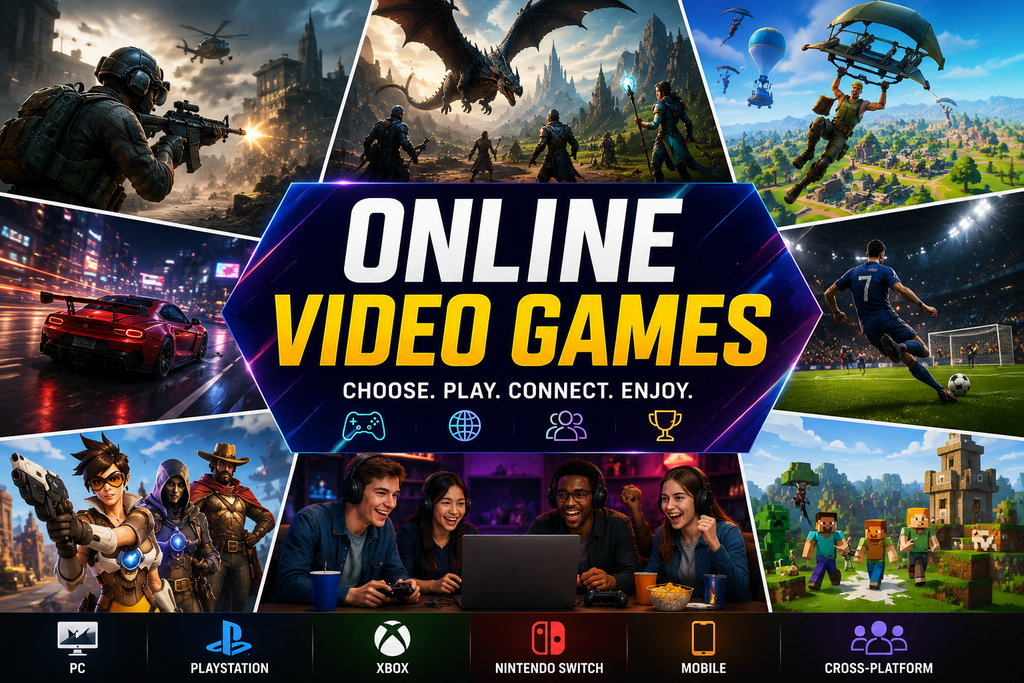
Online video games have become a broad category rather than a single type of gaming experience. A player can spend a few minutes in a competitive match, cooperate with friends through a long campaign, build a shared virtual world, race against opponents, or participate in a persistent game that receives new content over time.
That variety is useful, but it can also make choosing the right game difficult. A competitive shooter may suit someone who enjoys quick decisions and mechanical improvement, while another player may prefer a relaxed co op adventure with friends. Platform, connection quality, progression, monetization, matchmaking, and community behavior can all affect whether a game remains enjoyable after the first few sessions.
This guide explains what makes Online Video Games different from one another, how the major genres work, what to consider before choosing a game, and how to get more from multiplayer gaming without turning every session into a grind.
What Are Online Video Games?
Online video games are games that use an internet connection to provide multiplayer interaction or connected gameplay features. That can mean competing against other players, cooperating with friends, joining a persistent virtual world, accessing cloud based game services, or participating in community created experiences.
The term covers a wide range of formats, including:
- Competitive shooters
- Battle royale games
- Multiplayer RPGs
- MOBAs
- Racing games
- Sports games
- Survival games
- Sandbox games
- Co-op adventures
- Fighting games
- Strategy games
- Social and user generated platforms
The important distinction is that online gaming is defined by connectivity, not by one particular genre.
A game can be highly competitive, completely cooperative, or somewhere between the two. Some games are designed around short matches, while others encourage players to return for months or years through progression systems, seasonal content, expansions, or community events.
For players, this means there is no universal best online game. The better question is: which online game fits the way you want to play?
The Main Types of Online Video Games
Different multiplayer formats appeal to different kinds of players. Understanding those differences makes it easier to narrow down your choices.
Competitive Shooters
Competitive shooters emphasize precision, positioning, reaction time, communication, and tactical decision making.
Games in this category can range from traditional round based tactical shooters to faster arena style experiences. Some focus heavily on team objectives, while others emphasize individual performance.
The appeal comes from measurable improvement. Players can practice aiming, movement, map awareness, positioning, and communication and gradually become more effective.
The drawback is the learning curve. Established competitive games can have highly experienced communities, making the early matches difficult for newcomers.
If you enjoy pressure, short decision windows, and the satisfaction of improving mechanical skills, competitive shooters can be a strong choice.
Battle Royale Games
Battle royale games put survival at the center of the experience. Players typically begin with limited equipment, gather resources or weapons, and compete while the playable area becomes progressively smaller.
This structure creates a different type of tension from traditional team deathmatch.
Winning does not always require the highest number of eliminations. Positioning, timing, resource management, awareness, and knowing when to avoid a fight can be equally important.
Battle royale games are particularly appealing to players who enjoy unpredictable matches. No two games need to develop in exactly the same way because player decisions influence how each match unfolds.
Multiplayer RPGs
Online RPGs combine multiplayer interaction with character progression.
Depending on the game, players may develop characters, collect equipment, complete quests, explore large environments, join groups, or participate in cooperative and competitive activities.
Progression is often a major part of the appeal. Instead of simply improving your personal skills, your character can also become stronger or more specialized through equipment, abilities, levels, or other systems.
The downside is the time commitment. Some online RPGs are designed for players who enjoy returning regularly and learning complicated systems. If you only have short gaming sessions, a progression heavy game may feel more demanding than rewarding.
MOBAs and Strategy Games
Multiplayer online battle arena games are built around team strategy, character abilities, objectives, and resource management.
They can be difficult for beginners because understanding your own role is only part of the challenge. You also need to understand what opponents can do, when objectives become important, how team compositions interact, and how to manage the game’s economy or progression systems.
Strategy focused online games generally reward knowledge and decision making. Players who enjoy analyzing systems may find them more rewarding than games that rely primarily on reflexes.
Racing and Sports Games
Online racing and sports games provide a more accessible competitive format for many players.
A racing game may focus on braking, cornering, vehicle control, track knowledge, and race strategy. Sports games can involve positioning, timing, team management, tactics, and understanding the strengths of different players or teams.
These genres also work well for shorter sessions. A player does not necessarily need to dedicate an entire evening to enjoy a few races or matches.
Co-op and Survival Games
Co-op games are ideal when the goal is to play with people rather than constantly compete against them.
Players might explore a world, solve puzzles, defeat enemies, construct bases, gather resources, or complete missions together. Survival games can add crafting, resource management, exploration, and environmental threats to the formula.
Good cooperative design gives each player something useful to contribute. That could involve combat, healing, construction, exploration, resource gathering, or simply making important decisions together.
For groups of friends, this can create a more relaxed alternative to ranked multiplayer.
How to Choose the Right Online Game
The best choice depends on your priorities. Before installing or buying a game, consider how you actually want your gaming sessions to feel.
Think About Your Preferred Pace
Some games demand constant attention. Others allow players to explore, experiment, or take their time.
If you enjoy quick matches, look for games built around short rounds or compact sessions. If you prefer long term progression, an RPG, survival game, or persistent online world may be a better match.
Your available time matters too. A game can be excellent but still unsuitable if its core loop conflicts with your schedule.
Consider Your Skill Level
Competitive games can be rewarding, but they often have steeper learning curves.
A new player should not assume that losing means the game is bad. Multiplayer games require learning maps, mechanics, controls, terminology, strategies, and common player behavior.
Look for games that provide tutorials, practice modes, casual matchmaking, or other ways to learn before entering serious competition.
Players who already have experience in a genre can usually handle a more demanding learning curve.
Check the Platform
Before choosing an online game, check which platforms it supports.
PC players may have access to extensive graphics settings and a broad hardware ecosystem. Console players benefit from standardized hardware and a more controlled environment.
Cross platform play can be especially important for groups of friends.
If one person uses PC, another uses PlayStation, and another uses Xbox, a game with cross play can make the difference between everyone playing together and needing separate games.
Do not assume that every multiplayer title supports every platform combination. Cross play and cross progression are separate features and should be checked individually.
Look at Connection Requirements
Online games depend on network quality, but the importance of connection stability varies by genre.
A small amount of latency may be tolerable in a slower cooperative game. Competitive shooters, fighting games, and other precision based titles can be much more sensitive to delays.
Players should pay attention to:
- Latency or ping
- Packet loss
- Connection stability
- Server region
- WiFi reliability
- Background downloads
- Network congestion
A faster internet package does not automatically solve every multiplayer problem. Stability and latency are often more relevant than raw download speed.
Why Matchmaking Matters
Matchmaking has a major influence on the quality of an online game.
A good matchmaking system attempts to create appropriate matches while balancing factors such as skill, region, party size, and game mode.
For beginners, fair matchmaking can make learning significantly less frustrating. For experienced players, ranked matchmaking provides a structured environment where improvement can be measured.
However, matchmaking cannot guarantee perfectly balanced games. Player behavior, connection quality, party differences, and the size of the available player pool can all influence the result.
If a game has both casual and ranked modes, newcomers should generally spend time learning the mechanics before treating ranked performance as the main goal.
Free to Play vs Paid Online Games
The cost structure of an online game deserves attention before you commit time to it.
Free to play games remove the initial purchase barrier and can make it easier for friends to join the same experience. Many use optional purchases such as cosmetic items, seasonal passes, character customization, expansions, or other digital content.
Paid games take a different approach. Some rely on an upfront purchase, while others also offer expansions or optional purchases after launch.
The price alone does not tell you whether an online game is worth playing.
A better set of questions is:
- Is the core gameplay enjoyable without spending extra money?
- Are purchases cosmetic or gameplay related?
- How much content is included initially?
- Does the game receive substantial updates?
- Are important features locked behind additional purchases?
- Does the progression system respect your available time?
Monetization becomes a problem when it interferes with the game’s basic experience. Players should understand the business model before investing heavily in a long term online game.
Why Community Quality Matters
An online game is not just its mechanics. It is also the people you encounter.
A strong community can make a game more enjoyable by providing guides, strategies, tournaments, creative content, helpful discussions, and opportunities to meet other players.
A hostile community can have the opposite effect.
Competitive games are particularly vulnerable to toxic behavior because winning and losing are highly visible. Players should be prepared to mute disruptive teammates or opponents instead of allowing arguments to dominate the session.
Good communication is also a gameplay skill.
In team based games, concise information is often more useful than constant talking. Calling out an enemy position, warning teammates about an incoming attack, or coordinating an objective can have real strategic value.
How to Improve at Online Video Games
Improving at multiplayer games is easier when you identify specific problems instead of simply playing more matches.
A player who repeatedly loses does not necessarily need better reflexes. The real issue might be positioning, resource management, map awareness, decision making, or poor communication.
Focus on One Skill at a Time
Choose one area to improve.
For a shooter, you might work on crosshair placement. For a racing game, focus on braking points. For a strategy game, study resource management or objective timing.
Trying to improve everything simultaneously makes it difficult to understand what is actually working.
Review Your Mistakes
After a difficult match, think about what caused the problem.
Ask yourself:
- Did I take unnecessary fights?
- Did I understand the objective?
- Did I use my abilities at the right time?
- Was my positioning safe?
- Did I react too slowly?
- Did I make the same mistake repeatedly?
This approach turns losses into useful information.
Recording gameplay can also help because mistakes that seem obvious afterward are often difficult to notice during a stressful match.
Learn From Better Players
Watching skilled players can teach you how experienced players approach positioning, movement, resource management, and decision making.
The key is to analyze their choices rather than simply copy their actions.
A professional player’s strategy may depend on their team’s coordination, skill level, equipment, or game mode. Understanding why they made a decision is more useful than copying it without context.
Common Mistakes Players Make
Many online gaming frustrations come from choosing a game for the wrong reasons.
One common mistake is selecting a title purely because it is popular. A game with millions of players can still be a poor fit for someone who dislikes competitive pressure.
Another mistake is ignoring the time commitment. Some games are easy to start but increasingly demand regular participation.
Players can also underestimate the importance of platform compatibility. Before inviting friends into a new game, confirm that everyone can access the same multiplayer features.
Ignoring connection problems is another issue. If every online game feels delayed, the problem may be the network rather than the individual title.
Finally, avoid treating every loss as evidence that matchmaking is broken or that opponents are unfair. Some matches genuinely have poor balance, but consistent losses often indicate an opportunity to improve.
Online Gaming Safety
Online multiplayer requires basic digital awareness.
Players should avoid sharing personal information with strangers and should never provide passwords, authentication codes, financial information, or account recovery details through game chat.
Be cautious with external links promising free currency, rare items, giveaways, or account rewards. Scammers frequently use desirable digital items to encourage players to visit suspicious websites.
Account security is equally important. Use strong, unique passwords and enable available two factor authentication.
Parents should also review privacy and communication settings when children play online. Modern gaming platforms generally provide tools for managing communication, purchases, and other account features.
Good online behavior matters too. Blocking or muting abusive users is usually more productive than continuing an argument.
What Makes an Online Game Worth Playing?
Popularity is only one measure.
A worthwhile online game should provide a gameplay loop that remains enjoyable after the novelty wears off. That might come from competitive improvement, character progression, cooperative teamwork, exploration, customization, or simply the satisfaction of completing matches with friends.
A strong online game also needs a reason for players to return.
That reason does not always have to be endless content. A well designed competitive game can remain interesting because players continually improve. A co-op game can remain enjoyable because playing with friends creates different situations. A sandbox game can remain engaging because players create their own goals.
The important factor is whether the game’s systems support the experience you want.
How Online Gaming Is Changing
Online gaming continues to expand beyond traditional multiplayer matches.
Cross platform ecosystems are increasingly important because gaming groups are distributed across different devices. Cloud-based gaming services are also providing additional ways to access games, although the quality of cloud gaming remains strongly dependent on network conditions and service availability.
User generated content is another major part of the landscape. Some platforms allow players to create maps, modes, experiences, or entire games, turning the audience into part of the development ecosystem.
Live service games have also changed expectations around updates. Instead of releasing a game and moving immediately to another project, developers can continue supporting a title through new content, balance adjustments, events, seasonal systems, and expansions.
That model has advantages and drawbacks.
Frequent updates can keep a community active, but they can also create pressure for players who feel they need to keep up with every new event. The healthiest approach is to treat ongoing content as an option rather than an obligation.
Choosing Online Games for Friends
Playing with friends can change what makes a game enjoyable.
A game that feels average alone can become entertaining when everyone communicates and works toward a shared goal. Co-op survival games, party games, racing titles, sports games, and social sandbox experiences can all work well for groups.
Before choosing a game for your group, consider everyone’s:
- Platform
- Skill level
- Available time
- Preferred genre
- Communication preferences
- Tolerance for competition
The best group game is usually one that gives everyone something meaningful to do.
If one player is highly competitive while the others simply want to relax, a heavily ranked game may create unnecessary frustration. A flexible co-op or casual multiplayer game may be a better compromise.
FAQ
What are Online Video Games?
Online Video Games are games that use an internet connection for multiplayer interaction or connected features. They include shooters, RPGs, racing games, sports games, strategy games, survival titles, sandbox experiences, and co-op adventures.
What type of online game is best for beginners?
Co-op and casual multiplayer games are often good starting points because they allow players to learn mechanics without the same pressure found in highly competitive ranked environments. Games with tutorials and practice modes are particularly useful.
Can PC and console players play together?
Yes, some games support cross platform multiplayer between PC and consoles. However, cross play availability varies by game and platform, so players should check the specific title before purchasing it.
Are free to play online games worth playing?
They can be. Free to play games can provide substantial gameplay without an upfront purchase, but players should understand the game’s monetization system and determine whether optional purchases affect their enjoyment.
What internet connection is best for online gaming?
A stable, low latency connection is generally more useful for online gaming than simply having very high download speeds. Competitive games are particularly sensitive to latency, packet loss, and connection instability.
How can I get better at online multiplayer games?
Focus on one skill at a time, study recurring mistakes, learn the game’s mechanics, watch skilled players, and review your own gameplay when possible. Consistent practice is more useful when you know exactly what you are trying to improve.
Conclusion
The best Online Video Games are not necessarily the most popular or technically impressive titles. The right choice depends on the type of experience you want.
Competitive players may prefer shooters, battle royale games, MOBAs, fighting games, or racing titles. Players who want cooperation can look toward co-op adventures, survival games, and shared world experiences. Those interested in long term progression may prefer online RPGs or games with deeper progression systems.
Before committing to a game, consider its platform support, cross play options, connection requirements, matchmaking, monetization, community, and time commitment. These factors can have as much influence on your enjoyment as graphics or marketing.
Most importantly, choose games that fit your actual gaming habits. Online gaming works best when the mechanics, community, and pace complement the way you want to spend your time.
LEAVE A PIXEL ZINE COMMENT