Online gaming news is no longer limited to release dates and trailer announcements. A single week can bring a major game reveal, a balance patch that changes a competitive meta, a studio acquisition, a console update, an esports result, and a surprise launch that players can download immediately.
The problem is not finding information. The problem is deciding what deserves your attention.
A modern gaming news feed moves quickly, especially around major events. Official announcements from PlayStation, Xbox, Nintendo, publishers, and developers often appear alongside leaks, social-media speculation, recycled rumours, exaggerated headlines, and content designed primarily to generate clicks.
For players, the useful question is therefore not simply, “What is the latest gaming news?Online gaming news newsroom featuring game updates, new releases, esports coverage, and platform announcements It is:
What happened, is it confirmed, and how does it actually affect the games I play?
This guide explains how to approach online gaming news more intelligently, which types of stories matter most, how to separate official information from speculation, and how to keep up with the gaming industry without spending every day scrolling through headlines.
What Online Gaming News Means for Players Today
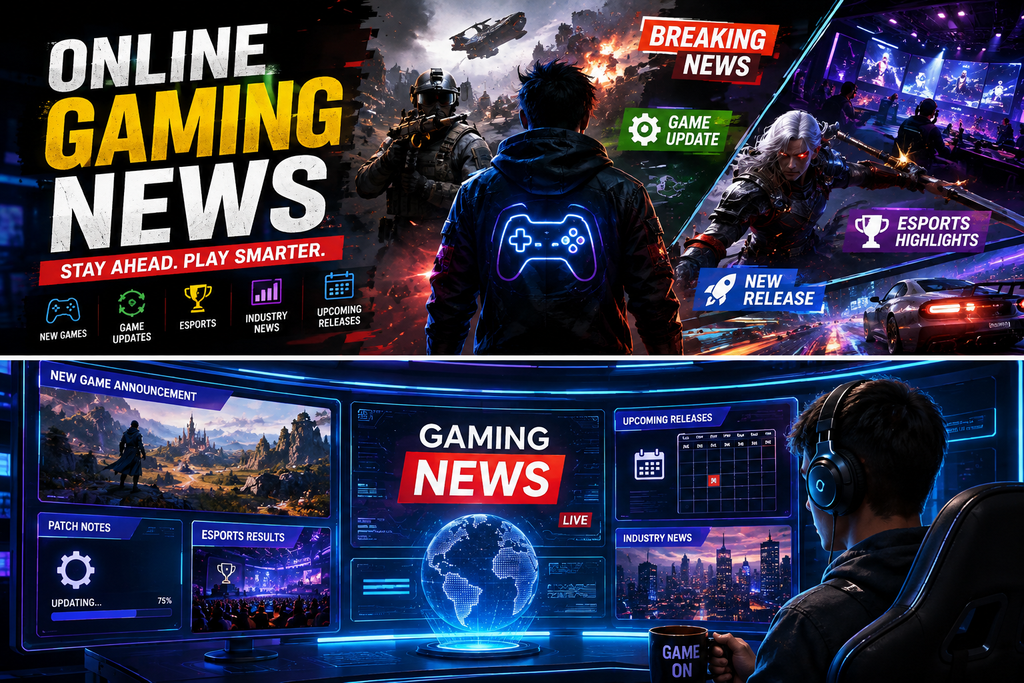
The phrase online gaming news covers a broad range of information. Depending on the player, the most important news may be completely different.
A competitive multiplayer player may care most about:
- Weapon balancing
- Character changes
- Ranked-mode updates
- New maps
- Server problems
- Tournament results
An RPG fan may instead be watching for:
- Release dates
- Expansion announcements
- New gameplay footage
- Story trailers
- Platform availability
- Developer interviews
Meanwhile, PC players may be more interested in:
- System requirements
- Performance updates
- Driver support
- Modding news
- Steam launches
- Cross-platform features
This is why a useful gaming news site should not treat every announcement as equally important.
A new cosmetic collaboration may matter to one community and be irrelevant to another. A small patch note might look unimportant in a general headline but completely change the competitive balance of a multiplayer game.
Good gaming journalism provides context.
Instead of merely saying that an update has arrived, it should explain:
- What changed
- Which players are affected
- Whether the change is confirmed by the developer
- How the update may influence gameplay
- What players should do next
- What remains unknown
That distinction becomes increasingly important as games receive years of updates after launch.
The Biggest Types of Online Gaming News Worth Following
Not every headline deserves the same amount of attention. The most useful stories usually fall into a few major categories.
New Games and Release Announcements
Release announcements are still among the biggest drivers of gaming interest, but gamers should look beyond a cinematic trailer.
When a publisher announces a game, useful information includes:
- Confirmed release date or release window
- Platforms
- Developer and publisher
- Game genre
- Single-player, multiplayer, or co-op support
- Business model, if confirmed
- Actual gameplay information
- Early access plans
- Pre-order information, where relevant
The difference between a game being announced, dated, and released is significant.
A game can be revealed years before launch. A trailer may confirm that development is underway without providing a release window. Similarly, a store listing or retailer page should not automatically be treated as confirmation unless the publisher or platform holder supports that information.
Official events remain major sources for these announcements. PlayStation’s June 2026 State of Play, for example, featured more than an hour of announcements and updates, including new looks and release information for multiple upcoming games.
The useful takeaway for players is not simply that a showcase happened. It is which announcements changed the release calendar or provided meaningful new information.
Updates, Patches, and Expansions
For games already in players’ libraries, patches can be more important than new announcements.
A major update may:
- Change weapon effectiveness
- Adjust character abilities
- Fix progression problems
- Introduce a new map
- Add missions or events
- Improve performance
- Change matchmaking
- Modify an in-game economy
- Add accessibility features
For a competitive game, a small numerical adjustment can have a much larger impact than a flashy new trailer.
Imagine a weapon that dominates long-range encounters receiving reduced damage or increased recoil. That one adjustment may force players to reconsider loadouts, alter tournament strategies, and change which characters or abilities work best together.
This is why patch coverage should go beyond copying patch notes.
Players benefit from analysis that answers: What does this mean in an actual match?
The same principle applies to expansions and DLC. The important information is not only that new content exists, but how it connects to the existing game. Does it continue the story? Raise the level cap? Add a new progression system? Introduce a new multiplayer mode?
Those details determine whether an update is relevant to existing players.
Platform and Hardware News
Gaming is increasingly shaped by decisions made outside individual games.
Platform news can include:
- Console system updates
- Subscription changes
- Cloud gaming developments
- New hardware
- Store policies
- Backward compatibility
- Cross-platform support
- PC releases of previously platform-specific games
Recent official announcements illustrate how major showcases continue to serve as central sources of platform information. Xbox’s 2026 showcase recap included first-party and partner announcements, gameplay reveals, release information, and new projects across its ecosystem.
Nintendo’s June 2026 Direct similarly covered games and updates for Nintendo Switch and Nintendo Switch 2, demonstrating how a single presentation can affect players’ expectations for an entire platform.
For players, platform news matters because it can affect where they can play, what hardware they need, and whether a game will support their preferred ecosystem.
Esports and Live-Service Developments
Esports news moves at a different pace from traditional release news.
Important stories may include:
- Tournament results
- Roster changes
- Rule changes
- League announcements
- Qualification formats
- Game balance updates before major events
- Prize pool information
- Competitive mode changes
Live-service games create another constant stream of news through seasons, limited-time events, battle passes, collaborations, patches, and new content.
Not every seasonal update needs a long article. The strongest coverage identifies what has changed and whether players need to know about it.
A new cosmetic item and a major redesign of progression are not equivalent stories.
How to Tell Confirmed Gaming News From Rumours
One of the most important skills for following online gaming news is understanding the difference between information categories.
A useful system is to separate stories into four groups.
Officially Confirmed Information
This includes information published or directly stated by:
- Developers
- Publishers
- Platform holders
- Official game websites
- Verified company announcements
- Official patch notes
A confirmed release date from a developer is stronger evidence than an anonymous social-media post.
However, even confirmed plans can change. Games are delayed, features are altered, and release schedules move. Confirmation means the information is official at the time of publication, not that future changes are impossible.
Reports From Reputable Sources
Sometimes reliable publications report information before a company makes a public announcement.
These stories should still be presented carefully.
A report is not the same thing as an official confirmation. The source, evidence, and language matter.
The correct approach is:
“According to a report…”
not:
“The game is definitely coming…”
unless the company has confirmed it.
Rumours and Leaks
Leaks can occasionally prove accurate, but accuracy cannot be assumed simply because a leaker was correct in the past.
A responsible article should explain:
- What is being claimed
- Where the claim originated
- Whether evidence was provided
- Whether the developer has responded
- What parts remain unverified
A convincing screenshot is not automatically authentic. A familiar insider name is not a guarantee. A rumour repeated by twenty websites is still one rumour if all twenty are referencing the same original claim.
Editorial Analysis and Prediction
Analysis can be valuable, but it must not be disguised as reporting.
For example:
- Confirmed: A developer announces a new expansion.
- Analysis: The expansion may address problems players have criticized.
- Speculation: The expansion could introduce a particular feature.
Those are three different levels of certainty.
Readers deserve to know which one they are reading.
Why Patch Notes Can Matter More Than Trailers
Trailers generate attention because they are easy to share and visually impressive. But for someone actively playing a game every week, patch notes often have a more immediate effect.
Consider three players:
- One plays a competitive shooter.
- One is progressing through an online RPG.
- One plays a live-service strategy game.
A trailer for a game launching next year may be interesting to all three.
But a patch released today could change all three of their current experiences.
A strong patch analysis should identify the practical consequences of an update.
For competitive games, that might include:
- Which strategies became weaker
- Which weapons or characters became more viable
- Whether mobility or defensive play changed
- Whether the ranked environment may shift
For RPGs, the focus may be:
- Progression adjustments
- Quest fixes
- Build changes
- New endgame activities
- Difficulty balancing
For technical updates, players need to know:
- Whether performance improved
- Which platforms are affected
- Whether a bug was fixed
- Whether a workaround is still necessary
Patch notes tell players what the developer changed. Analysis helps explain what those changes may mean after the next login.
The Platforms and Events Driving Major Gaming Announcements
Gaming announcements are increasingly concentrated around major showcases, but no single event controls the entire industry.
Important sources include official presentations from major platform holders, publisher events, developer broadcasts, and industry conventions.
PlayStation uses formats such as State of Play to reveal games, trailers, gameplay, and release information.
Xbox uses its showcase and Xbox Wire to communicate major announcements and games coming to its ecosystem.
Nintendo Direct presentations regularly combine new game announcements with updates on existing titles and hardware ecosystems.
Industry events also create concentrated periods of major news. Gamescom 2026, for example, runs from August 26 to August 30 and features a large number of games and announcements across publishers and platforms.
These events are useful for discovering games, but gamers should avoid assuming that every trailer represents the same stage of development.
A cinematic teaser, gameplay demonstration, playable demo, beta announcement, and confirmed launch date provide very different levels of information.
The more specific the announcement, the easier it is for players to make decisions.
How to Follow Online Gaming News Without Information Overload
Trying to follow every gaming story is unnecessary.
A better approach is to build a personal news system around the games and platforms you actually care about.
Start With Your Active Games
If you currently play three games regularly, follow their official:
- Websites
- Social channels
- Community updates
- Patch notes
- Developer blogs
These are often the fastest sources for information that directly affects your gameplay.
Follow Major Platform Announcements
Even if you primarily play on PC, major announcements from PlayStation, Xbox, and Nintendo can affect the wider release schedule.
The same applies in reverse. A major Steam launch or PC release may later influence the console market.
Use News Sites for Context, Not Just Headlines
Official sources provide primary information.
Gaming publications can provide:
- Analysis
- Interviews
- Hands-on impressions
- Technical testing
- Context
- Comparison
The strongest reading habit combines both.
Read the official announcement to establish what is confirmed. Then use reliable analysis to understand why it matters.
Avoid Chasing Every Rumour
Rumours can be entertaining, but they should not become the foundation of your gaming expectations.
A practical rule is simple:
Do not make buying decisions, pre-order decisions, or major assumptions based solely on unconfirmed leaks.
Wait for official information when possible.
This approach also prevents disappointment caused by treating fan speculation as a promised feature.
What Makes a Gaming News Story Actually Important?
The number of social-media posts about a story does not necessarily determine its importance.
A useful gaming news story usually answers at least one of these questions:
Does this change what I can play?
A new release date or platform announcement may answer yes.
Does this change how I play?
A major patch may answer yes.
Does this affect my purchases?
Subscription changes, pricing, editions, or hardware news may matter.
Does this change the future of a game or franchise?
Studio decisions, development changes, expansions, and major announcements may have long-term consequences.
Does this affect the competitive scene?
Tournament rules, balance changes, and roster developments may matter to esports fans.
If a story does none of these things, it may still be interesting, but it probably does not need to dominate a player’s attention.
This is where editorial judgment matters.
Gaming news is not simply about publishing the most stories. It is about helping readers understand which stories deserve their time.
Why GameCentral.blog Can Add Value Beyond Headlines
A gaming-focused publication can provide more value than a constantly updating list of announcements.
For online gaming news, GameCentral.blog can focus on a combination of:
- Fast, clearly sourced news updates
- Patch and update analysis
- Release-date coverage
- Gameplay explainers
- Platform comparisons
- Guide content connected to major updates
- Follow-up articles when new information changes the original story
That final point is important.
Gaming news often develops over time.
A game may be announced first. Later, the developer reveals gameplay. Then a release date appears. After launch, patches address performance and gameplay concerns.
A useful publication connects those developments instead of treating every announcement as an isolated article.
For example, coverage of a multiplayer game could link together:
Announcement → Gameplay breakdown → Beta guide → Launch coverage → Beginner guide → Patch analysis
That structure helps readers move from discovering a game to actually understanding and playing it.
It also creates stronger topical relationships than publishing unrelated headlines simply because they are currently trending.
The Future of Online Gaming News Is Context
The volume of gaming information will continue to increase.
Games now receive long-term support. Major publishers communicate directly with players. Developers post updates through blogs, videos, community channels, and social platforms. Large events can generate dozens of announcements in a single day.
The challenge for readers will increasingly be filtering information.
The most valuable gaming coverage will not necessarily be the fastest to repeat a headline. It will be the coverage that clearly distinguishes between:
- Announcement and speculation
- Marketing and gameplay
- Patch notes and practical impact
- Rumours and evidence
- Short-term excitement and long-term importance
That is especially useful for players who do not have time to watch every showcase, read every update, or follow every industry account.
A good gaming news article saves readers time while preserving accuracy.
Conclusion
Online gaming news is most useful when it helps players understand what has actually changed and why it matters.
New game reveals, release dates, major events, platform announcements, esports developments, expansions, and patches all deserve coverage. But they do not deserve the same treatment.
The best way to follow gaming news is to start with official sources for confirmation, use reputable reporting for context, treat rumours with caution, and focus on developments that affect the games and platforms you care about.
For GameCentral.blog, the opportunity is not simply to publish more headlines. It is to explain the story behind the headline—what players should know now, what remains uncertain, and what the development could mean for the games they play next.
FAQ
What is online gaming news?
Online gaming news covers current developments across video games and gaming culture, including new game announcements, releases, patches, DLC, platform updates, esports, hardware, and industry news.
Where can I find reliable online gaming news?
Start with official developer, publisher, PlayStation, Xbox, Nintendo, Steam, and game websites for confirmed information. Reputable gaming publications can then provide reporting, analysis, interviews, and context.
How can I tell if gaming news is a rumour?
Check whether the information comes from an official source. If it originates from an anonymous claim, leak, or unverified social-media post, it should be treated as unconfirmed until independently verified or officially announced.
Are gaming leaks always fake?
No. Some leaks have later proven accurate, but that does not make every leak trustworthy. Unconfirmed information should never be presented as established fact.
Why are patch notes important?
Patch notes explain changes made to a game. Depending on the update, they can affect gameplay balance, performance, progression, multiplayer, bugs, weapons, characters, and other systems.
What are the biggest sources of gaming announcements?
Major announcements often come through official developer and publisher channels, PlayStation State of Play presentations, Xbox showcases, Nintendo Direct broadcasts, and industry events such as Gamescom.
Should I pre-order a game based on a trailer?
A trailer alone usually does not provide enough information for an informed purchase. Consider waiting for confirmed gameplay details, platform information, pricing, performance information, and reviews where appropriate.
How often should I check gaming news?
That depends on your interests. Following official updates for games you actively play and checking broader gaming news during major events is usually more useful than trying to follow every daily headline
LEAVE A PIXEL ZINE COMMENT