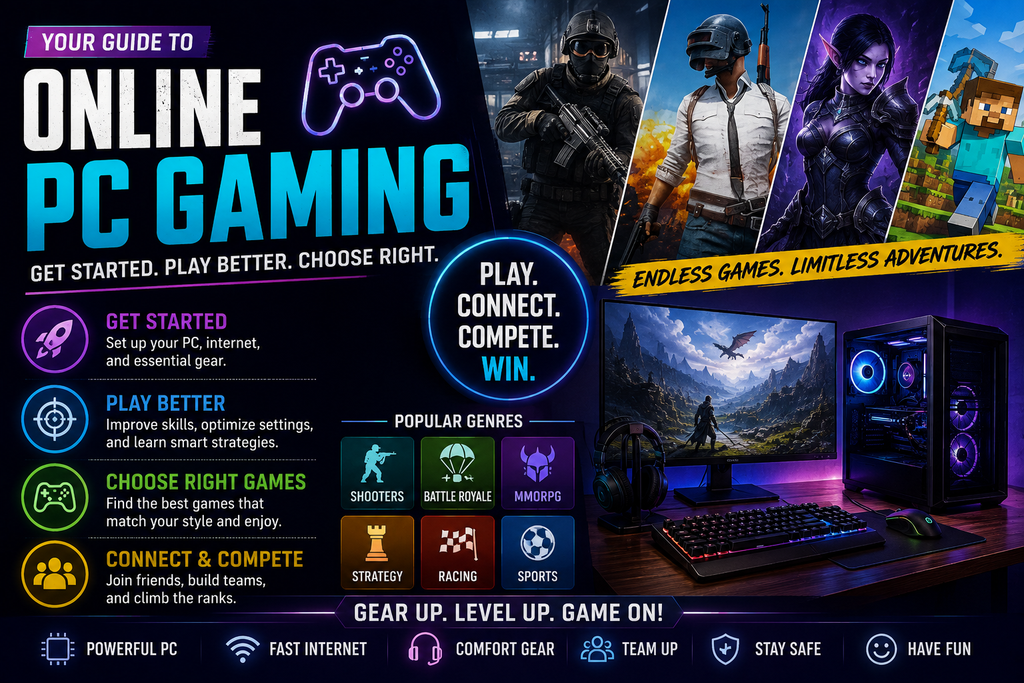
Online PC Gaming
The dominant search intent behind Online PC Gaming is Informational with a mixed practical intent. Most people searching this term want to understand what online PC gaming includes, how to get started, what equipment and software they need, which types of games are available, and how to improve their experience.
Some readers may also be comparing gaming platforms, looking for multiplayer games, or deciding whether their current PC and internet connection are good enough.
What Is Online PC Gaming?
Online PC Gaming refers to playing video games on a computer while connected to the internet. Depending on the game, that connection can allow players to compete against others, cooperate with friends, join persistent online worlds, download updates, use cloud services, or access social features.
The category is much broader than competitive multiplayer shooters. Online PC gaming includes:
- First person shooters
- Battle royale games
- MMORPGs
- MOBAs
- Racing games
- Sports games
- Strategy games
- Survival games
- Co op adventures
- Card and board games
- Social and party games
- Browser based games
- Cloud gaming services
A player can spend an evening coordinating with friends in a cooperative survival game, compete in ranked matches, or simply join a casual multiplayer lobby. The flexibility of the PC platform is one of its biggest strengths.
Why Online PC Gaming Remains So Popular
PC gaming offers a combination of flexibility, performance options, and game variety that is difficult to match on a single closed platform.
Unlike a dedicated console, a gaming PC can be upgraded over time. Players can change components, adjust graphics settings, use different input devices, and choose from multiple storefronts and services. This gives players more control over how they play.
Online PC Gaming also benefits from a huge range of communities. Large competitive games may have millions of active players, while smaller independent titles can build dedicated communities around specific genres or mechanics.
Another major advantage is the variety of ways people can play. A high end desktop can target demanding games at high settings, while a modest laptop may still handle esports titles, older games, indie releases, and browser games.
That flexibility means there is no single correct PC gaming setup.
What You Need to Start Online PC Gaming
Getting started does not always require an expensive gaming computer. The requirements depend heavily on the games you want to play.
A Suitable PC
Your computer is the foundation of the experience, but the right hardware depends on your preferred games.
Fast paced modern titles with detailed graphics usually place greater demands on the graphics card and processor. Competitive esports games are often designed to run across a wider range of systems, allowing players to prioritize high frame rates instead of maximum visual settings.
Before buying or downloading a game, check its official system requirements. Focus on both the minimum and recommended specifications. Minimum requirements generally indicate that the game can run, while recommended specifications provide a better idea of the intended experience.
Important components include:
- Processor (CPU): Handles game logic and general system tasks.
- Graphics card (GPU): Renders game visuals and is particularly important in graphically demanding titles.
- RAM: Helps the system manage the game and background applications.
- Storage: SSD storage can improve loading times compared with traditional hard drives.
- Display: Refresh rate and resolution can affect how the game looks and feels.
You do not need the most expensive hardware to enjoy Online PC Gaming. Matching your system to the games you actually play is usually a smarter approach.
A Reliable Internet Connection
Online games depend on more than download speed.
For many multiplayer games, latency, often called ping, is especially important. A stable connection with lower latency can provide a better experience than a faster connection that frequently drops or fluctuates.
Competitive games are particularly sensitive to connection quality. High latency can cause delayed actions, inconsistent movement, or synchronization problems.
A wired Ethernet connection can offer greater consistency than WiFi in some home setups. If WiFi is your only option, positioning the PC closer to the router and reducing network congestion may help.
A Gaming Account and Platform
PC players commonly use digital platforms to buy, download, update, and launch games. Some games are available through multiple stores, while others require a particular launcher or account.
It is worth understanding where your games are linked before making purchases. Managing several launchers is common in PC gaming, especially if you play games from different publishers.
Keep your accounts secure by using strong, unique passwords and enabling two factor authentication when available.
Choosing the Right Type of Online PC Game
One of the best parts of Online PC Gaming is the number of genres available. The challenge is not finding games; it is finding games that match your interests, available time, and preferred level of competition.
Competitive Multiplayer Games
Competitive games place players or teams against one another. These can include shooters, fighting games, sports titles, strategy games, and MOBAs.
They often reward mechanical skill, game knowledge, teamwork, communication, and consistent practice.
Before investing heavily in a competitive game, consider its learning curve. Some games are easy to understand but difficult to master. Others require new players to learn maps, characters, weapons, abilities, or detailed strategies before they feel comfortable.
Ranked competition can be rewarding, but casual modes are often a better starting point for beginners.
Cooperative and Social Games
Cooperative games focus on working with other players toward shared goals. You might complete missions, survive hostile environments, solve problems, or build something together.
These games can be more approachable for players who enjoy teamwork but do not want the pressure of ranked competition.
Communication matters, but the amount varies. Some coop games work perfectly with simple pings or text chat, while others benefit from voice communication and coordinated strategies.
MMORPGs and Persistent Online Worlds
Massively multiplayer online games create shared worlds where players can explore, complete quests, improve characters, trade, join groups, and participate in large scale activities.
These games often require more time than a quick multiplayer match. Progression systems, character builds, crafting, economies, and endgame activities can become major parts of the experience.
A good choice depends on how much time you want to commit. Some players enjoy long term progression, while others prefer games they can play in short sessions.
Strategy and Tactical Games
Strategy games test planning and decision making more than raw reaction speed.
Real time strategy games require players to make decisions quickly while managing resources and units. Turn based games allow more time for planning but can involve deep tactical systems.
These games are a strong choice for players who enjoy learning systems, predicting opponents, and improving through better decisions.
How to Find the Right Games for Your Playstyle
A game can be highly rated and still be a poor fit for you.
Instead of asking only, What is the most popular game? consider these questions:
- Do you prefer competition or cooperation?
- How much time can you spend in a typical session?
- Do you enjoy fast reflexes or slower strategic decisions?
- Do you prefer playing alone, with friends, or with strangers?
- Are you comfortable with a steep learning curve?
- Do you want regular progression or short, self contained matches?
For example, a player with only 30 minutes available may prefer a game with short matches. Someone who enjoys building a long term character may be more interested in an RPG or persistent online world.
Your preferred input method matters as well. Keyboard and mouse are common on PC, but many games also work well with controllers. Racing games, fighting games, and certain action titles may feel more comfortable with a gamepad, depending on personal preference.
Graphics Settings: Performance Matters More Than Maximum Settings
New PC gamers sometimes assume every graphics option should be pushed to its highest setting. That is not always the best choice.
The ideal settings depend on the game and your priorities.
In a visually driven single player experience, you may prefer higher image quality even if that reduces frame rate. In a competitive shooter, smoother performance and responsive controls may be more valuable.
Useful settings to understand include:
Resolution
Higher resolution can improve image detail but places greater demand on the GPU. If performance is poor, lowering resolution or using supported upscaling technologies may improve frame rates.
Frame Rate
Frame rate measures how many frames the system renders over time. Consistent performance can be as important as achieving a high peak number.
Competitive players often prioritize settings that help maintain smooth and stable performance.
Refresh Rate
A monitor’s refresh rate determines how frequently it can update the displayed image. A higher refresh rate display can make motion appear smoother when the PC can produce enough frames to take advantage of it.
You should balance the monitor with the performance of your system. Buying a very high refresh rate display does not automatically improve performance if your PC cannot consistently produce suitable frame rates.
The Importance of Mouse, Keyboard, and Other Equipment
Hardware matters, but comfort and reliability should come before unnecessary upgrades.
A good mouse should suit your hand size and grip style. Weight, shape, button placement, and sensor performance can all influence how comfortable it feels.
A mechanical keyboard may offer a different typing and gaming feel than a membrane keyboard, but switch preference is personal. There is no single keyboard that suits every player.
Headsets can be useful for communication and positional audio, especially in multiplayer games. However, microphone quality, comfort, and clear audio are generally more important than flashy features.
Avoid buying equipment solely because a professional player or reviewer uses it. Their hand size, posture, preferences, and game requirements may be very different from yours.
How to Improve Your Online PC Gaming Experience
Better performance is not only about buying stronger hardware. Small changes can improve comfort, consistency, and responsiveness.
Optimize Your Gaming Environment
Make sure your monitor is positioned comfortably and your desk has enough room for your mouse movement.
If you play games that require large mouse movements, a cramped mousepad can become a genuine limitation. Adjusting mouse sensitivity can also help you find a balance between speed and control.
Comfort matters during longer sessions. An uncomfortable posture can affect concentration and control.
Close Unnecessary Background Applications
Background programs can use system resources, storage bandwidth, or internet bandwidth.
You do not need to close every application, but reducing unnecessary activity can help on systems with limited resources. Browser tabs, downloads, recording software, and other demanding programs may affect performance in some situations.
Keep Important Software Updated
Graphics drivers and game updates can include performance improvements, bug fixes, and compatibility changes.
However, updating everything immediately is not always necessary. If your system is stable, check official release notes when possible and make informed decisions about major updates.
Learn the Game Instead of Blaming the Hardware
Improvement often comes from understanding the game.
In shooters, this might mean learning maps, positioning, recoil patterns, or timing. In strategy games, it may involve improving resource management and decision making. In team games, communication and understanding objectives can be more valuable than raw mechanical skill.
Hardware can support good performance, but it cannot replace game knowledge.
Common Mistakes New Online PC Gamers Make
A few mistakes appear repeatedly among players who are new to the platform.
The first is overspending on hardware before identifying what games they actually want to play. Build or buy around your needs rather than chasing the highest specifications available.
Another mistake is copying a professional player’s settings without understanding why they use them. Sensitivity, graphics settings, key bindings, and peripherals are personal choices.
New players also sometimes change their settings constantly. If you adjust sensitivity every day, it becomes difficult to build consistency. Give a sensible configuration enough time before deciding whether it works.
Finally, account security is easy to overlook. Online accounts can contain purchased games, cosmetics, saved progress, and personal information. Use strong passwords and security features provided by the platform.
Is Online PC Gaming Better Than Console Gaming?
Neither platform is automatically better for everyone.
PC gaming generally offers more hardware customization, graphics options, input flexibility, and access to a broad ecosystem of games and services. It can also provide access to genres and communities that are especially strong on PC.
Consoles offer simplicity. Hardware is standardized, setup is straightforward, and developers can optimize games for a fixed platform.
The better choice depends on what you value.
If you enjoy adjusting settings, upgrading hardware, using different peripherals, and accessing a wide variety of PC focused games, Online PC Gaming may be the better fit. If you prefer a simpler setup with fewer technical decisions, a console may be more suitable.
How Online PC Gaming Continues to Change
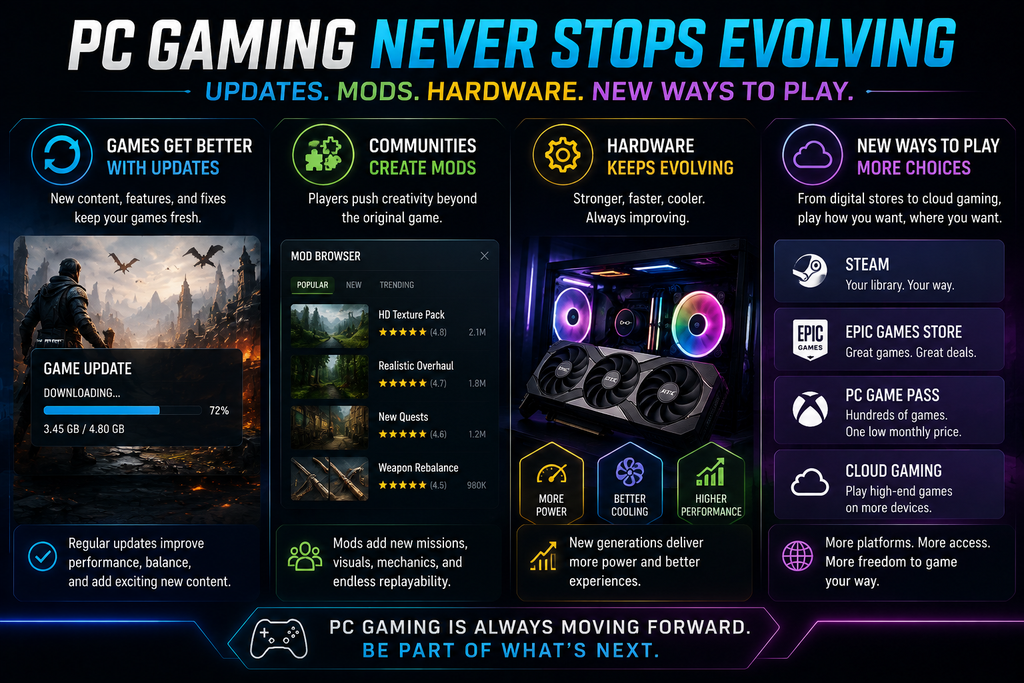
PC gaming is not static. Games receive updates, communities create mods, hardware evolves, and new distribution models continue to appear.
Cross platform multiplayer has also changed how many games connect players. In supported titles, PC players can compete or cooperate with people using other platforms.
Cloud technology is another area to watch, although the experience depends heavily on connection quality, available services, and regional infrastructure. For some players, streaming can provide access to games that their local hardware might not otherwise run comfortably.
The most important change, however, is that players now have more choices. A powerful desktop, a gaming laptop, an older PC running lightweight games, or a cloud based setup can all provide different paths into online gaming.
Practical Tips for a Better Online PC Gaming Setup
You do not need to upgrade everything at once. Start by identifying the weakest part of your current experience.
If games load slowly, storage may be the issue. If frame rates are low, graphics settings or hardware performance may deserve attention. If matches feel delayed, investigate your network connection.
A sensible improvement process looks like this:
- Check the official requirements for the games you play.
- Monitor performance during actual gameplay.
- Adjust graphics settings before assuming new hardware is necessary.
- Test your internet stability and latency.
- Improve ergonomics and desk space.
- Upgrade the component that creates the most meaningful limitation.
This approach is usually more effective than buying equipment based on trends or marketing.
Frequently Asked Questions About Online PC Gaming
What is Online PC Gaming?
Online PC Gaming is playing video games on a computer while connected to the internet. It can include competitive multiplayer, coop games, MMORPGs, social games, browser games, and other connected experiences.
Do I need an expensive PC for online gaming?
No. The required hardware depends on the games you want to play. Many esports, indie, strategy, and older games can run on modest systems, while newer graphically demanding games may require stronger components.
Is a wired connection better for online PC gaming?
A wired Ethernet connection can provide a more stable connection than WiFi in many setups. However, a strong and stable WiFi connection can still work well for online gaming.
What matters more: internet speed or ping?
Both matter, but ping and connection stability are particularly important in real time multiplayer games. Extremely high download speeds do not automatically guarantee low latency.
Can beginners enjoy competitive online games?
Yes. Most competitive games have casual modes, practice options, or beginner friendly communities. Starting outside ranked modes can give you time to learn the game’s mechanics without unnecessary pressure.
Should I use a gaming mouse?
A gaming mouse can provide useful features such as additional buttons, adjustable sensitivity, and sensors designed for precise tracking. The best choice depends on your hand size, grip style, preferred games, and comfort.
Final Thoughts
Online PC Gaming offers an enormous range of experiences, from quick competitive matches to long term cooperative adventures and persistent virtual worlds. The best way to get started is not to chase the most expensive PC or the most popular game. Start with the games and experiences that genuinely interest you.
Choose hardware based on your needs, prioritize a stable internet connection, adjust your settings for the type of games you play, and give yourself time to learn. A well balanced setup and a good understanding of your preferred playstyle can make Online PC Gaming far more enjoyable than simply buying the latest equipment.
The platform’s greatest advantage is choice. You can play competitively, socially, casually, or strategically, and you can shape your setup around the way you actually want to play.
LEAVE A PIXEL ZINE COMMENT