What Is an Online Multiplayer Social Deduction Game?
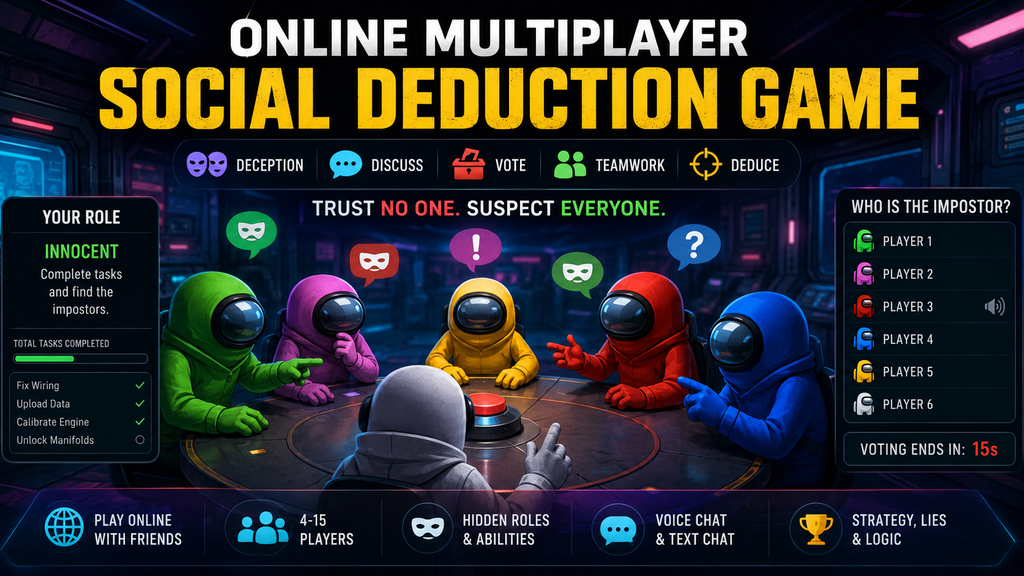
An online multiplayer social deduction game is a game in which players receive hidden identities, roles, teams, or objectives. The central challenge is figuring out who is telling the truth while protecting your own information.
A typical match may involve:
- Innocent players trying to identify traitors
- Hidden impostors attempting to deceive the group
- Discussions, accusations, and voting
- Special roles with unique abilities
- Incomplete information that forces players to make decisions
- Bluffing, teamwork, observation, and psychological strategy
The genre works particularly well online because the players themselves create much of the drama. The mechanics provide the structure, but conversations and decisions determine how each match develops.
A confident accusation can save a team. A bad vote can eliminate the most useful player. A perfectly timed lie can completely change the outcome.
That unpredictability is why the top 10 online multiplayer social deduction game category includes everything from lighthearted cartoon games to tense horror experiences.
Top 10 Online Multiplayer Social Deduction Game Choices
The games below are ranked according to accessibility, multiplayer experience, replayability, social deduction mechanics, and the type of group each game serves best.
1. Among Us
Among Us remains one of the easiest social deduction games to understand. Players work together as Crewmates while one or more hidden Impostors attempt to sabotage and eliminate them.
The basic structure is simple. Crewmates complete tasks and watch for suspicious behavior. Impostors create problems, fake tasks, and try to avoid detection. When something suspicious happens, the group can call a meeting and discuss who they believe is responsible.
Its greatest strength is accessibility. New players can understand the basic rules quickly, which makes it useful for mixed groups where not everyone plays games regularly.
The real strategy appears after players become comfortable with the rules. Movement patterns, task behavior, sabotage timing, alibis, and voting patterns all become important sources of information.
Best for: Casual groups, friends, beginners, and players who enjoy fast social interaction.
2. Goose Goose Duck
If you enjoy the basic structure of Among Us but want more role variety, Goose Goose Duck is one of the strongest alternatives.
Players are divided between Geese, Ducks, and other special roles. The expanded role system creates more unpredictable matches because players may have abilities and objectives that do not fit neatly into a simple good versus evil structure.
This means an accusation is often more complicated than it first appears. A player acting suspiciously may actually have a role that requires unusual behavior.
The game is also designed around social interaction and can become especially entertaining with voice communication. Recent 2026 roundups continue to identify it as one of the closest and most feature rich alternatives for players who enjoy the Among Us formula.
Best for: Players who want more roles, variety, and chaotic multiplayer sessions.
3. Town of Salem 2
Town of Salem 2 takes social deduction in a more strategic direction. Instead of physically moving through a map and observing other players, much of the game revolves around roles, information, deception, discussion, and deduction.
Players can receive dramatically different abilities and objectives. The official Steam listing describes the game as supporting 7 to 15 players and includes more than 50 unique roles, creating significantly more strategic complexity than a basic hidden traitor format.
This makes Town of Salem 2 particularly rewarding for players who enjoy studying claims and comparing information. A convincing story is not automatically proof. Players need to consider whether someone’s claimed role, actions, and available information logically fit together.
The learning curve is higher than Among Us, but the strategic depth is also much greater.
Best for: Strategy focused players and groups willing to learn a deeper role system.
4. Project Winter
Project Winter combines social deduction with survival gameplay. Players must cooperate to survive a dangerous environment, gather resources, and complete objectives.
The problem is that some players may secretly be working against the group.
This structure creates a different kind of tension. In many social deduction games, the most important information comes from meetings and discussions. In Project Winter, players also need to consider practical gameplay behavior.
Did someone genuinely get separated from the group? Did they intentionally lead another player into danger? Are they helping the team efficiently, or are they quietly slowing progress?
The survival element gives traitors more opportunities to manipulate situations instead of relying entirely on conversation.
Best for: Groups that want social deduction combined with active survival gameplay.
5. Deceit 2
Deceit 2 moves the genre toward horror and action. Players explore an unsettling environment while trying to determine who among them has a hidden agenda.
The atmosphere changes the social experience considerably. In a traditional discussion based game, players usually have time to analyze evidence. Horror mechanics can create pressure, confusion, and rapid decisions.
That makes communication particularly important. Players may hear conflicting information while trying to survive immediate threats.
Deceit 2 is a stronger choice for players who want their social deduction games to feel more intense and visually immersive rather than purely conversational.
Best for: Horror fans and groups looking for a more action oriented experience.
6. Unfortunate Spacemen
Unfortunate Spacemen blends first person action with hidden monster gameplay. Players work together in a science fiction environment while one or more participants can secretly become a threat.
The game creates an interesting balance between cooperation and suspicion. Players may need help surviving external dangers, but trusting the wrong person can create an entirely different problem.
Because gameplay happens in real time, observation matters. Players can notice movement, behavior, positioning, and sudden changes in a teammate’s actions.
This makes it a useful option for groups that want more direct gameplay than the meeting and voting structure found in many traditional social deduction games.
Best for: Players who enjoy shooters, science fiction, and real time deception.
7. Wolvesville
Wolvesville is based on the classic werewolf style formula. Players receive secret roles and must determine who is working against the village.
The format is familiar but highly effective. During the day, players discuss information and vote. During other phases, hidden roles take actions that can change the state of the game.
Games built around the werewolf format often place more emphasis on conversation than mechanical skill. Reading player behavior, identifying contradictions, and managing information become the central skills.
For mobile and cross platform social groups, this style can be easier to organize than a more demanding action game.
Best for: Players who enjoy classic werewolf and Mafia style deduction.
8. First Class Trouble
First Class Trouble places players in a stylish science fiction setting where cooperation is necessary, but hidden threats make every partnership questionable.
The game combines environmental objectives with social deduction. Players interact with the world while attempting to determine who is helping the mission and who is trying to sabotage it.
One of the appealing aspects of this format is that discussions are connected to actual events. Instead of arguing only from abstract claims, players can discuss who was present, who completed an objective, and who had the opportunity to interfere.
That creates a useful middle ground between pure conversation games and action heavy deception games.
Best for: Groups that want objectives, exploration, and social deduction together.
9. Mafia.gg
Browser based games can be particularly useful when a group does not want to download a large game or configure multiple platforms. Mafia style games remain effective because their core design requires relatively few mechanics.
Players receive hidden roles, discuss the situation, and attempt to identify opposing factions before their own team is eliminated.
The simplicity should not be confused with a lack of strategy. Mafia games often become extremely psychological. Players must decide how much information to reveal, when to challenge another player, and when staying quiet is actually safer.
A browser based option can be particularly convenient for online friend groups spread across different devices.
Best for: Players who want traditional social deduction without complex action mechanics.
10. Blood on the Clocktower Online
Blood on the Clocktower comes from the tabletop social deduction world, but online play has made it accessible to groups that cannot meet in person.
Its role design gives eliminated players continued involvement, helping address one of the traditional frustrations of social deduction games: being removed early and waiting for everyone else to finish.
The game also supports a much richer range of information than basic Mafia style systems. Players may receive clues that are accurate, misleading, incomplete, or influenced by other roles.
Because of that complexity, Blood on the Clocktower is best when the group is willing to learn its systems and ideally has someone comfortable facilitating the game.
Best for: Dedicated social deduction groups that want deep role interaction and long term replayability.
Which Game Is Best for Your Group?
There is no single winner for every type of player. The best choice depends heavily on what your group actually enjoys.
Best for beginners: Among Us
Among Us remains one of the easiest starting points because its core objective is immediately understandable. Players can begin enjoying the social aspect without memorizing dozens of roles.
Best for players who want more variety: Goose Goose Duck
The larger selection of roles and abilities can make repeated sessions feel less predictable. It is particularly suitable for groups that have already played a large amount of Among Us.
Best for deep strategy: Town of Salem 2
Players who enjoy analyzing information, constructing arguments, and learning complicated role interactions will usually find more strategic depth here. The game officially supports up to 15 players and offers a large role pool.
Best for action and tension: Deceit 2 or Unfortunate Spacemen
These games give players more to do physically during a match. Suspicion develops through gameplay as well as conversation.
Best for a dedicated friend group: Project Winter or Blood on the Clocktower
Both reward groups willing to invest more time in learning how the game works and developing stronger communication.
What Makes a Great Social Deduction Game?
The strongest games in the top 10 online multiplayer social deduction game category usually share several characteristics.
Clear hidden information
Players need enough information to form theories, but not enough to solve the match immediately. If the answer is always obvious, the deduction disappears. If players have no meaningful evidence, decisions become random.
Good social deduction design creates uncertainty without making players feel powerless.
Meaningful communication
Discussion should matter. A player who can communicate clearly, notice contradictions, or persuade others should have a genuine impact on the match.
Voice chat can make these games more entertaining, although it can also make experienced or highly confident players more influential. Groups may want to establish communication rules before playing competitive matches.
Multiple ways to play well
A good game should not reward only the loudest player. Observation, memory, mechanical skill, timing, teamwork, bluffing, and strategic silence can all be valuable.
Enough variety for repeat sessions
Hidden roles, randomized maps, different objectives, or changing player behavior help prevent matches from becoming predictable.
The players themselves are also a major source of replayability. A strategy that works perfectly against one group may fail completely against another.
How to Choose an Online Social Deduction Game
Before downloading a game, consider your group size and preferences.
Check how many people are playing
Some games work well with smaller groups, while others become significantly better with larger lobbies. Town of Salem 2, for example, is designed for matches involving 7 to 15 players.
A game that is excellent with 12 players may feel limited with only four friends.
Decide between voice chat and text
Voice communication creates faster, more emotional discussions. Text based games allow players more time to think and may work better for people who prefer a less intense social environment.
Neither option is automatically better. It depends on the group.
Consider the learning curve
If your group wants to start immediately, choose a game with simple objectives and clear roles.
If everyone enjoys learning complicated systems, deeper games such as Town of Salem 2 or Blood on the Clocktower can offer more long term strategic value.
Think about platform compatibility
For USA and global friend groups, platform access can determine whether a game is practical. A great game is not useful if half the group cannot easily join.
Check current platform availability, cross play support, regional access, and pricing before organizing a session, as these details can change over time.
Practical Tips for Playing Social Deduction Games Better
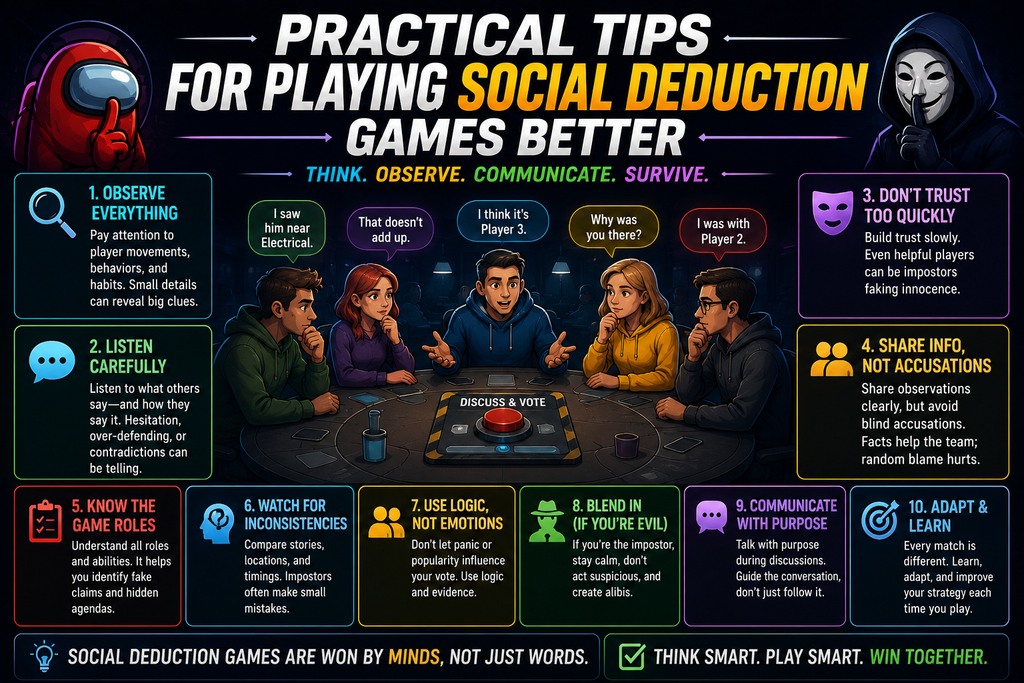
Being good at these games does not simply mean becoming a better liar.
Pay attention to patterns
One unusual action may mean nothing. Repeated contradictions are more useful.
Look for changes in behavior, inconsistent explanations, and situations where a player’s story does not match available information.
Do not accuse too quickly
A strong accusation should have a reason behind it. Throwing accusations at everyone can make it difficult for your team to identify genuinely useful information.
Explain what you observed and why it matters.
Separate confidence from evidence
A confident player is not necessarily correct. Social deduction games are specifically designed around persuasion and deception.
Ask what evidence supports the claim.
Remember that quiet players are not automatically suspicious
Some players are quiet because they are inexperienced, distracted, or simply prefer listening. Good deduction requires considering behavior within context rather than relying on one stereotype.
Learn the roles
In role heavy games, understanding what each role can and cannot do is often more valuable than simply trying to read personalities.
A convincing lie may fall apart when it contradicts the game’s mechanics.
Why Social Deduction Games Continue to Work So Well Online
The top 10 online multiplayer social deduction game genre has remained popular because the experience is fundamentally social.
A traditional competitive game asks whether you can aim faster, react better, or understand the map. Social deduction games ask different questions.
Can you recognize a contradiction?
Can you convince someone that your story is true?
Can you stay calm when the entire group suspects you?
Can you work with someone while wondering if they are secretly trying to eliminate you?
That combination makes every group feel different. The same game can produce a relaxed, funny session one night and an intense strategic battle the next.
The genre also works across cultures because the core concept is easy to understand: someone has hidden information, and the group must discover what it is.
FAQs
What is the best online multiplayer social deduction game?
For beginners and casual groups, Among Us is still one of the easiest recommendations. Goose Goose Duck is a strong alternative for players who want more roles, while Town of Salem 2 offers greater strategic depth. The best choice depends on your group size and preferred complexity.
What games are similar to Among Us?
Goose Goose Duck is one of the closest alternatives because it also uses hidden adversaries, objectives, meetings, and social discussion. Town of Salem 2, Project Winter, Deceit 2, and Unfortunate Spacemen approach social deduction through different mechanics. Recent 2026 comparisons also regularly place Goose Goose Duck, Town of Salem 2, and Project Winter among notable alternatives.
Are there free online social deduction games?
Yes. Availability and monetization can change, but freeto play options include games such as Goose Goose Duck and Town of Salem 2. Steam currently lists Town of Salem 2 as free to play.
Can you play social deduction games online with friends?
Yes. Most major games in this genre allow players to create or join online matches. Private lobbies, room codes, and external voice chat can make it easier to organize sessions with friends.
What is the best social deduction game for a large group?
For larger groups, Town of Salem 2 is a strong option because its official listing supports 7 to 15 players. Blood on the Clocktower can also work well for organized groups that enjoy deeper role based gameplay.
Conclusion
The best top 10 online multiplayer social deduction game choice depends less on which title has the biggest name and more on how your group likes to play.
Among Us remains an excellent entry point for quick and accessible sessions. Goose Goose Duck adds greater role variety, while Town of Salem 2 offers deeper strategic deduction. Project Winter brings survival into the equation, and games such as Deceit 2 and Unfortunate Spacemen show how effectively horror and action can support hidden-role gameplay.
If your group is new to the genre, start with a game that has simple rules and a short learning curve. Once everyone understands the basics of deception, information, and voting, moving toward more complex role systems can make game nights even more interesting.
The strongest social deduction games succeed because the players create the real story. Every accusation, alliance, mistake, and perfectly timed lie can turn an ordinary match into something your group talks about long after the game ends.
LEAVE A PIXEL ZINE COMMENT